Buying guide
Bed Frame Buying Guide (2027)
How to buy a bed frame in 2027: size and mattress fit, height and storage, slats and support, headboards, and assembly that stays quiet.
Size and mattress fit: measure twice
A Queen mattress is 60 by 80 inches and a King is 76 by 80, but the frame is always a few inches larger than the mattress on every side, and the headboard adds more. Measure the room before ordering, and leave at least two feet of clear floor on three sides for walking and making the bed. Check the frame's stated size against the mattress size, not against the room: a frame sold as Queen fits a Queen mattress, but the frame itself is wider than the mattress. In a small bedroom, a Full or a Twin leaves far more usable floor than a Queen, and the sleep difference is smaller than the room difference.
Height and under-bed storage
Height is the most consequential choice after size, because it decides both the sleeping height and the storage. A 12-inch frame suits a thick mattress and keeps the sleeping height normal, but it leaves almost nothing underneath. A 14-inch frame gives a foot of space for bins and shoes, which is enough for most bedrooms. An 18-inch frame swallows full storage bins but makes the bed high for shorter sleepers. Drawers change the maths: four under-bed drawers hold more usable storage than open space ever will, because everything stays organised. Add the mattress thickness to the frame height to get the real sleeping height, and sit on a bed of that height before buying if you can.
Slats and support: what holds the mattress up
A mattress sags where nothing holds it up, so slat spacing is the number to check. Closely spaced wood slats or a steel grid spread the load evenly and suit soft and thin mattresses. Widely spaced slats let a soft mattress dip between them and shorten its life. Solid wood frames and fixed steel platforms hold a mattress flattest, because nothing in them flexes. Foldable frames trade a little rigidity for the ability to fold flat, which is worth it for renters and movers but not for a main bedroom. A centre support leg matters on Queen and King frames: without one, the middle of the frame can bow under two sleepers.
Headboards: material decides the experience
A headboard is the part of the frame you touch every day, and the material decides how it feels. A slatted metal headboard looks sharp and costs little, but it flexes when leaned on and is not a reading backrest. A bamboo or wood headboard is firmer and warmer, and suits bedrooms that want the bed to look like furniture. An upholstered headboard is the only one that is genuinely comfortable to lean against, but it shows marks and needs the bolts re-tightened after the first weeks. A footboard finishes the silhouette but blocks sitting on the end of the bed. Buy the headboard by how you use the bed, not by how it photographs.
Assembly and keeping it quiet
A bed frame is only as good as its joints. Check the instructions before buying if you can: labelled parts and clear diagrams save an hour of frustration. Assemble the frame in the room where it will live, because a built frame rarely fits through a doorway. Tighten every bolt, then tighten them again after the first month, because frames settle and bolts loosen as the wood and metal bed in. Solid wood frames stay quietest, because nothing in them is metal on metal. Metal frames stay quiet too, once every bolt is tight, but they need a re-tighten after the first month. A frame that assembles in minutes is worth little if it squeaks by the second month.
Start with our top 3
The three highest-ranked products in our full bed frames ranking. Read the in-depth review where one exists, or jump to the product in the ranked list.
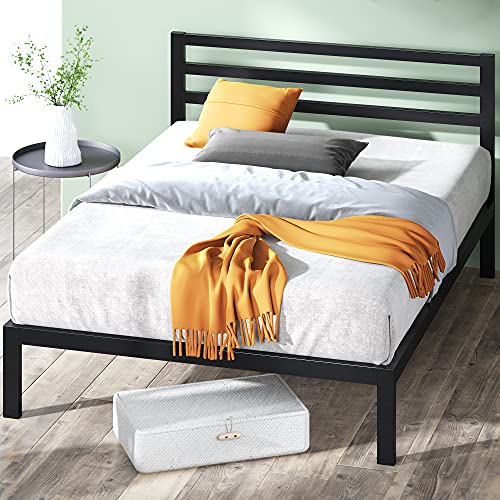
Zinus Mia Metal Platform Bed Frame with Headboard, Queen
The black metal frame with a slatted headboard that has become the default first bed frame: cheap, quiet and easy to build.
- Size: Queen
- Frame: Metal platform
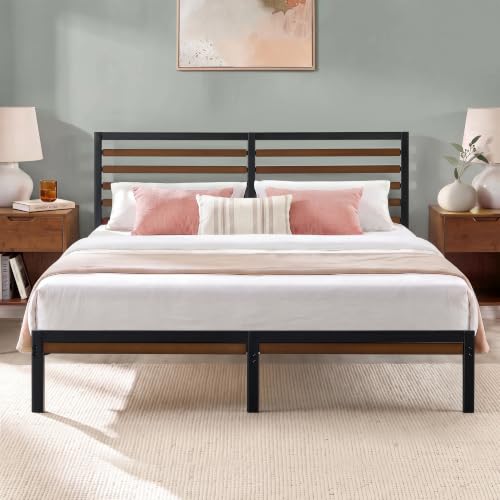
Zinus Kai Bamboo and Metal Platform Bed Frame, Queen
Bamboo slats across a steel frame: the warmest-looking metal bed frame in this guide, at a mid-tier price.
- Size: Queen
- Frame: Bamboo and steel
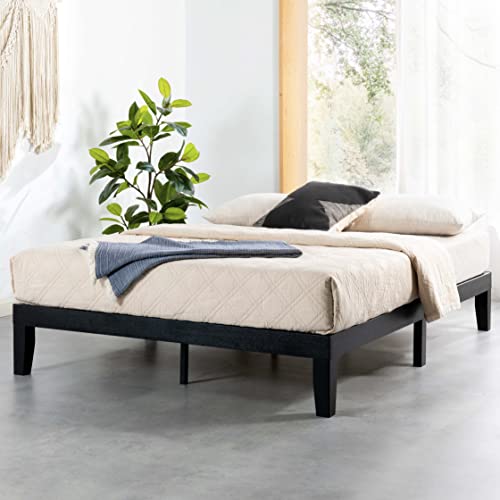
Mellow Naturalista Classic 12 Inch Solid Wood Platform Bed, Queen
Solid wood, twelve inches high, rated to 1,000 lb: the quietest low platform in this guide.
- Size: Queen
- Height: 12 in
Questions, answered
What is the best bed frame height?
Fourteen inches suits most bedrooms: it gives a foot of storage while keeping the sleeping height normal with a standard mattress. Twelve inches suits thick mattresses and low rooms. Eighteen inches suits small bedrooms that need the storage more than they need a low bed. Add the mattress thickness to the frame height to get the real sleeping height.
Do I need a headboard?
Not for sleep, but a headboard finishes the bed and protects the wall behind it. A slim slatted or flat headboard adds almost no depth to the room. Skip the headboard only if the bed sits against a wall that already anchors the room, or if the budget is tight and the mattress matters more.
How long should a bed frame last?
A solid wood frame can last decades, because there is almost nothing in it to wear out. A steel frame lasts years to decades, depending on the joints and the finish. A foldable frame lasts as long as its hinges and locks stay tight. The frame fails first at the joints, so a frame with solid bolts and a centre support leg outlasts a frame that relies on friction alone.
Can I use a platform bed frame with any mattress?
Almost any mattress works on a platform frame: foam, latex, hybrid and innerspring all sit well on slats or a steel grid. Very thin foam mattresses can dip between widely spaced slats, so a bunkie board under them closes the gaps. Check the slat spacing against the mattress maker's minimum, and never use a box spring on a platform frame unless the maker says so.
Every guide on Bed Frames15 pages
- Topic hubBed Frames
- Best ofThe Best Bed Frames (2027)
- A small bedroom punishes every wasted inch. A frame that is too tall dominates the room, a frame with no storage wastes the space underneath, and a frame that cannot be moved traps the room in one layout. This ranking weights footprint and storage above looks: foldable frames that go up and come down fast, low profiles that keep the room feeling open, and drawers that replace a dresser. King frames are excluded outright, because a King in a small bedroom leaves no room to walk around the bed, let alone make it.The Best Bed Frames for Small Bedrooms (2027)
- Storage is not one feature. Drawers hold folded clothes and bedding in organised compartments, tall open clearance holds bins and boxes of any shape, and a foldable frame gives clearance without drawers at a budget tier. This ranking weights usable, reachable storage above raw height: a drawer you can open every day beats a tall gap that fills with things you cannot reach. It also weights what the storage costs in assembly and in daily use, because a drawer that catches on a rug is storage you will stop using.The Best Bed Frames with Storage (2027)
- A main bedroom frame is furniture, not a platform. It is the largest object in the room, it is seen every day, and it has to look right for years. This ranking weights the finished look above price: a matching headboard and footboard, a wood or upholstered finish that suits the room, and a build that stays silent under two sleepers. Budget foldable frames are excluded from the top half, not because they are bad frames, but because a main bedroom deserves a frame that was designed to be looked at.The Best Bed Frames for Main Bedrooms (2027)
- ReviewMia Metal Platform Bed Frame with Headboard, Queen Review (2027)
- ReviewKai Bamboo and Metal Platform Bed Frame, Queen Review (2027)
- ReviewNaturalista Classic 12 Inch Solid Wood Platform Bed, Queen Review (2027)
- ReviewUpholstered Storage Bed Frame 4 Drawers, Queen Review (2027)
- ReviewFoldable Metal Platform Bed Frame 18 Inch, Queen Review (2027)
- ReviewSuzanne Bamboo and Metal Platform Bed Frame, Queen Review (2027)
- Head to headMia Metal Platform Bed Frame with Headboard vs Kai Bamboo and Metal Platform Bed Frame (2027)
- Head to headFoldable Metal Platform Bed Frame 14 Inch vs Foldable Metal Platform Bed Frame 18 Inch (2027)
- Fix itBed Frame Squeaking or Wobbling? Fixes (2027)