Head to head
DEWALT DCN680B vs Milwaukee 2746-20 (2027)
The two cordless brad flagships compared: DEWALT DCN680B against Milwaukee M18 FUEL 2746-20 on nose access, drive system, weight and platform, for 2027 buyers.
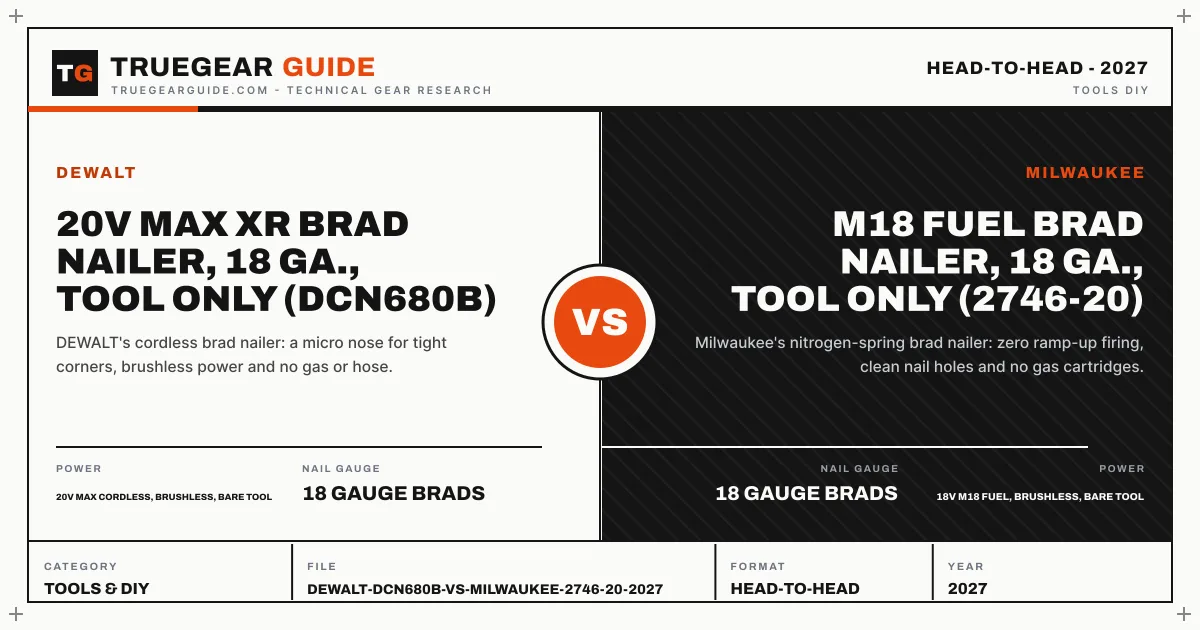

DEWALT 20V MAX XR Brad Nailer, 18 Ga., Tool Only (DCN680B)
DEWALT's cordless brad nailer: a micro nose for tight corners, brushless power and no gas or hose.
- Power: 20V MAX cordless, brushless, bare tool
- Nail gauge: 18 gauge brads

Milwaukee M18 FUEL Brad Nailer, 18 Ga., Tool Only (2746-20)
Milwaukee's nitrogen-spring brad nailer: zero ramp-up firing, clean nail holes and no gas cartridges.
- Power: 18V M18 FUEL, brushless, bare tool
- Nail gauge: 18 gauge brads
What owners report
Most praised
- Micro nose earns its keep in corners, where the tool places brads close to adjoining trim without marring the neighbour piece.
- Cordless setup means trim can be pinned in a finished room without dragging a hose across floors or furniture.
- Jam clearing without tools keeps a trim run going, and owners say the release is easy to find by feel.
Common complaints
- Depth consistency on the longest brads in hardwood trim takes practice, and shallow drives need a second pass.
- Bare-tool pricing frustrates buyers who expected a complete kit at the headline price.
- Nose visibility, though improved, still hides the exact brad point on very tight inside corners.
What owners report
Most praised
- Instant firing stands out on punch-out work, where the tool is picked up, fired once and set down again all day.
- Clean nail holes that match the brad head make filling and finishing faster on cabinets and furniture.
- No gas cartridge to buy or maintain removes a running cost and a maintenance chore owners disliked on older tools.
Common complaints
- Stopping with a few brads left in the magazine interrupts a run and forces an early reload.
- Weight with a battery fitted feels heavy for a brad nailer, especially on ceiling trim and overhead runs.
- Bump firing, when tried, jams more often than sequential firing, so most owners stick to single shots.
Our recommendation
This comparison is closer than the framing one, because both tools drive the same 18 gauge brads from 5/8 inch to 2-1/8 inches with tool-free depth control. Take the DEWALT if corner access decides your work, because its micro nose reaches tighter spots than the Milwaukee. Take the Milwaukee if clean holes and instant firing decide your work, because its nitrogen spring leaves the cleanest holes here and fires with no wait. If you own neither platform, the tiebreaker is again the catalog you will buy into, not the brad nailer alone.
Nose access against drive character
The DEWALT's micro nose is the placement advantage: it reaches into corners and close to adjoining trim, and it improves line of sight on the brad point. The Milwaukee's nitrogen spring is the drive advantage: it sinks brads to consistent depth with clean holes in hard and soft woods, with no gas cartridge to maintain. On open trim the two feel similar; in corners the DEWALT wins, and on fine cabinetry the Milwaukee wins.
Magazine and firing modes
Both tools offer sequential and contact firing, and both cover the same brad length range. The Milwaukee's 110-nail magazine is the stated capacity, while the DEWALT's magazine is not the headline figure in its spec sheet, which reflects different marketing emphasis rather than a large practical gap. The Milwaukee's magazine quirk, stopping with a few brads still loaded, is the one functional difference owners notice.
Weight and platform
Both tools are heavier than pneumatic brad nailers, and both draw the same overhead complaint, with the Milwaukee's stated 6.59 lb weight giving a concrete figure for comparison. The DEWALT's brushless motor and the Milwaukee's brushless plus nitrogen system both deliver long cordless runtime for brad work. Platform decides most purchases: 20V MAX against M18, with the rest of each brand's trim catalog behind the choice.
Choose DEWALT 20V MAX XR Brad Nailer, 18 Ga., Tool Only (DCN680B) if…
- You already own DEWALT 20V MAX batteries and tools
- Corner access and a micro nose matter most to your trim work
- Tool-free jam release is a daily need on your trim runs
- You prefer DEWALT's grip and control layout
Choose Milwaukee M18 FUEL Brad Nailer, 18 Ga., Tool Only (2746-20) if…
- You already own Milwaukee M18 batteries and tools
- Clean nail holes on cabinetry and furniture matter most to your work
- Instant firing with zero ramp-up time suits your punch-out rhythm
- You want no gas cartridge and no spool-up wait on any shot
Questions, answered
Which leaves a cleaner hole?
The Milwaukee, slightly, because its nitrogen spring is tuned to leave holes matching the brad head in hard and soft woods. The DEWALT is close, and on painted trim the difference vanishes under filler in most cases.
Which is better in tight corners?
The DEWALT, because its micro nose reaches into corners and close to adjoining trim where a blunter nose cannot sit squarely. If your trim work is mostly open runs, this advantage matters less.
Do these brad nailers take the same brads?
Yes, both drive 18 gauge brads from 5/8 inch to 2-1/8 inches, so brad stock is interchangeable between them. Each tool still needs its own brand's batteries and chargers.
Every guide on Nail Guns15 pages
- Topic hubNail Guns
- Best ofThe Best Nail Guns (2027)
- Framing is the one nail gun job where the wrong angle choice cannot be fixed later, because the magazine angle decides the nail stock. This ranking therefore sorts by angle and power source first: 30 degree cordless, 21 degree cordless and 21 degree pneumatic, with drive quality and weight deciding the order inside each group.The Best Framing Nail Guns (2027)
- Cordless nailers are battery decisions wearing a nailer's clothes, so this ranking weighs platform cost and kit completeness as heavily as drive quality. A bare tool on a platform you do not own is not a bargain at any price, while a complete kit that works out of the box earns its rank even with modest power.The Best Cordless Nail Guns (2027)
- Brad work inverts the usual power ranking. What matters here is a small hole, a nose that reaches into corners, depth control that never crushes delicate trim, and a tool light enough for a full day of pinning molding. Power beyond sinking a 2 inch brad cleanly is wasted, and weight beyond what the arm tolerates is a defect.The Best Brad Nailers (2027)
- ReviewDEWALT DCN692B Framing Nailer Review (2027)
- ReviewMilwaukee 2745-20 M18 FUEL Framing Nailer Review (2027)
- ReviewDEWALT DCN680B Brad Nailer Review (2027)
- ReviewMilwaukee 2746-20 M18 FUEL Brad Nailer Review (2027)
- ReviewMetabo HPT NR90AES1 Framing Nailer Review (2027)
- ReviewMakita XNB02Z Straight Finish Nailer Review (2027)
- Head to headDEWALT DCN692B vs Milwaukee 2745-20 (2027)
- Buying guideNail Guns Buying Guide (2027)
- Fix itNail Gun Not Sinking Nails? Fixes (2027)