Head to head
GCI Slim-Fold Cook Station vs Coleman Pack-Away Kitchen (2027)
Two camp kitchens compared: the one-piece GCI Slim-Fold Cook Station against the lighter Coleman Pack-Away Kitchen, on counter space, weight and setup for 2027 buyers.
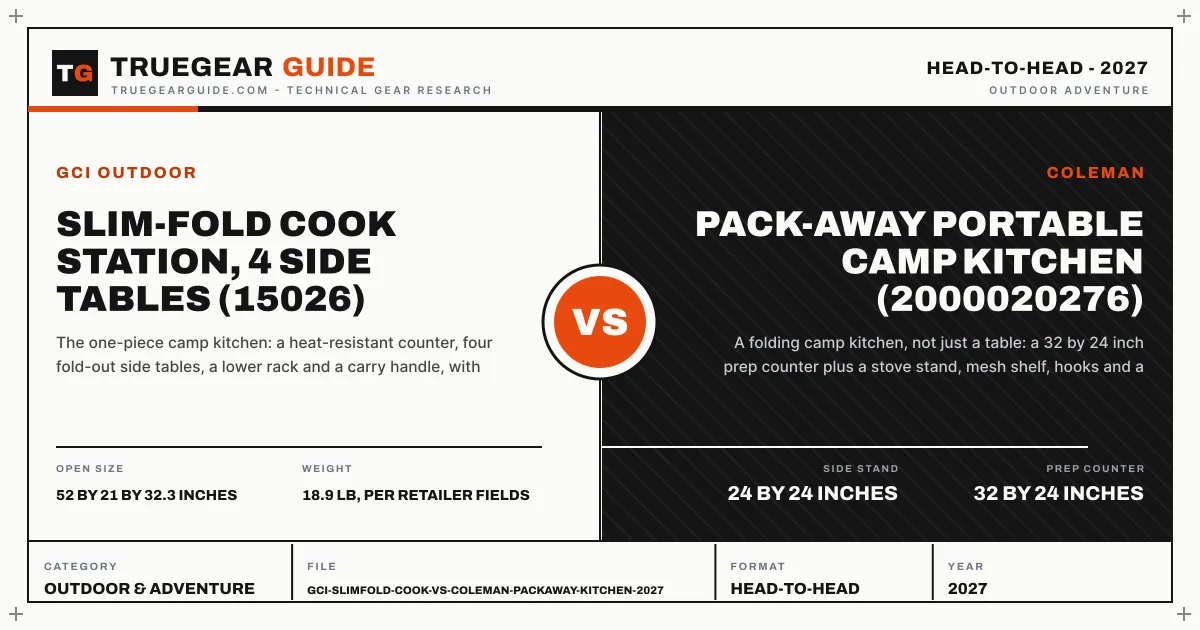

GCI Outdoor Slim-Fold Cook Station, 4 Side Tables (15026)
The one-piece camp kitchen: a heat-resistant counter, four fold-out side tables, a lower rack and a carry handle, with no loose frame to assemble.
- Open size: 52 by 21 by 32.3 inches
- Weight: 18.9 lb, per retailer fields

Coleman Pack-Away Portable Camp Kitchen (2000020276)
A folding camp kitchen, not just a table: a 32 by 24 inch prep counter plus a stove stand, mesh shelf, hooks and a lantern holder.
- Prep counter: 32 by 24 inches
- Side stand: 24 by 24 inches
What owners report
Most praised
- One-piece unfolding feels far less stressful at a rainy arrival than a multi-part kitchen frame.
- Side tables keep sauces, utensils and plates spread out instead of stacked on one small counter.
- Standing height makes long cooking sessions easier on the back than a low dining table.
Common complaints
- Carrying weight is felt on any walk longer than car park to pitch.
- Side tables flex if a heavy pot is parked on an outer corner instead of the centre.
- Folded length still needs planning in a packed car, since it will not tuck into a small gap.
What owners report
Most praised
- Separate stove stand ends the juggling act of cooking on the same surface where people eat.
- Mesh shelf keeps plates and dry goods off the ground and out of the dirt.
- Packed case shape stores neatly in a camper cupboard between trips.
Common complaints
- Setup feels fiddly until the frame, counter and shelf routine is learned.
- Counter surface needs care in wet weather and cannot be left out in a downpour.
- Weight is noticeable on the walk from car park to pitch compared with a plain table.
Our recommendation
Choose the GCI if group cooking is the main job: a 52 inch counter, four side tables and a lower rack give a crowd's worth of prep and serving space in one unfolding frame. Choose the Coleman if weight and packed size matter more: at about 14.5 lb and a 32 by 4 by 11 inch pack, it gives a real counter and stove stand without the heaviest frame. For a weekend group, the GCI wins. For a couple or a small car, the Coleman wins.
Counter space and side tables
The GCI offers a wider counter plus four side tables and a rack, so sauces, utensils, plates and dry goods each get a place. The Coleman offers a 32 by 24 inch counter plus a stove stand, a mesh shelf and hooks, which is ample for one or two cooks but tighter for a group cooking session with many hands.
Setup style
The GCI unfolds as one piece, with no loose frame to assemble, which is fastest on a rainy arrival. The Coleman folds its frame and counter into a case, which packs neater in a cupboard but takes longer to set up the first few times, until the routine is learned.
Weight, pack size and top care
The GCI weighs about 18.9 lb and folds flat but long, while the Coleman weighs about 14.5 lb and packs to a compact case shape. The GCI's aluminium counter resists heat and weather better, while the Coleman's fiberboard counter needs protection from prolonged rain. Heat tolerance against packability is the deciding trade.
Choose GCI Outdoor Slim-Fold Cook Station, 4 Side Tables (15026) if…
- Group cooking with many dishes, sauces and helpers at once
- A one-piece unfold matters more than the lightest carry
- A heat-resistant aluminium counter for a stove is required
- Four side tables for spreading out prep sound essential, not extra
Choose Coleman Pack-Away Portable Camp Kitchen (2000020276) if…
- A smaller car or a longer walk from car to pitch matters
- One or two cooks, not a crowd, do most of the cooking
- A neat case-shaped pack for a camper cupboard is preferred
- A lighter kitchen at about 14.5 lb is worth a smaller counter
Questions, answered
Which kitchen is better for a family of four?
The Coleman covers a family of four well, with a counter, a stove stand and storage. The GCI is better when the family cooks for guests too, since its wider counter and four side tables handle a larger serving load without crowding.
Which kitchen sets up faster?
The GCI, on its one-piece Slim-Fold frame, especially on a first or rainy setup. The Coleman takes a little longer until its frame, counter and shelf routine becomes familiar, but then sets up quickly too.
Can either kitchen stay out in rain?
The GCI's aluminium counter handles wet weather better, while the Coleman's fiberboard counter needs a tarp or a quick pack-away in a downpour. In both cases, dry storage between trips extends the kitchen's life.
Every guide on Camp Tables15 pages
- Topic hubCamp Tables
- Best ofThe Best Camp Tables (2027)
- Folding tables win on speed: unfold, lock and eat. This ranking judges them the way a car boot judges them, by folded size first, then by height range, then by how much weight the top can honestly carry. A folding table that needs a roof box or a trailer has failed its own category, whatever its open size.The Best Folding Camp Tables (2027)
- Lightweight tables are judged by a different rule: the best one is the one that actually leaves the car. A table that weighs little but packs awkwardly still stays behind, while a slightly heavier table in a neat bag gets carried to the beach, the trailhead and the fire circle every time.The Best Lightweight Camp Tables (2027)
- Group tables are judged by seating maths and serving flow, not by packed size alone. One long table that seats six with a shared dish in the middle beats two small tables that split the group, and a kitchen station beside the dining table beats a single table forced to do both jobs.The Best Camp Tables for Large Groups (2027)
- ReviewColeman Pack-Away 4-in-1 Folding Table Review (2027)
- ReviewLifetime 80160 Commercial Adjustable Table Review (2027)
- ReviewGCI Slim-Fold Cook Station Review (2027)
- ReviewColeman Pack-Away Portable Camp Kitchen Review (2027)
- ReviewGCI Compact Camp Table 20 Review (2027)
- ReviewLifetime 6-Foot Fold-in-Half Table Review (2027)
- Head to headColeman Pack-Away 4-in-1 vs Lifetime 80160 (2027)
- Buying guideCamp Tables Buying Guide (2027)
- Fix itCamp Table Wobbling on Uneven Ground? Fixes (2027)