Head to head
Greenworks GPW3001 vs Westinghouse WPX3200 (2027)
The strongest electric against the gas workhorse: Greenworks GPW3001 versus Westinghouse WPX3200 on pressure, flow, noise, upkeep and driveway speed.
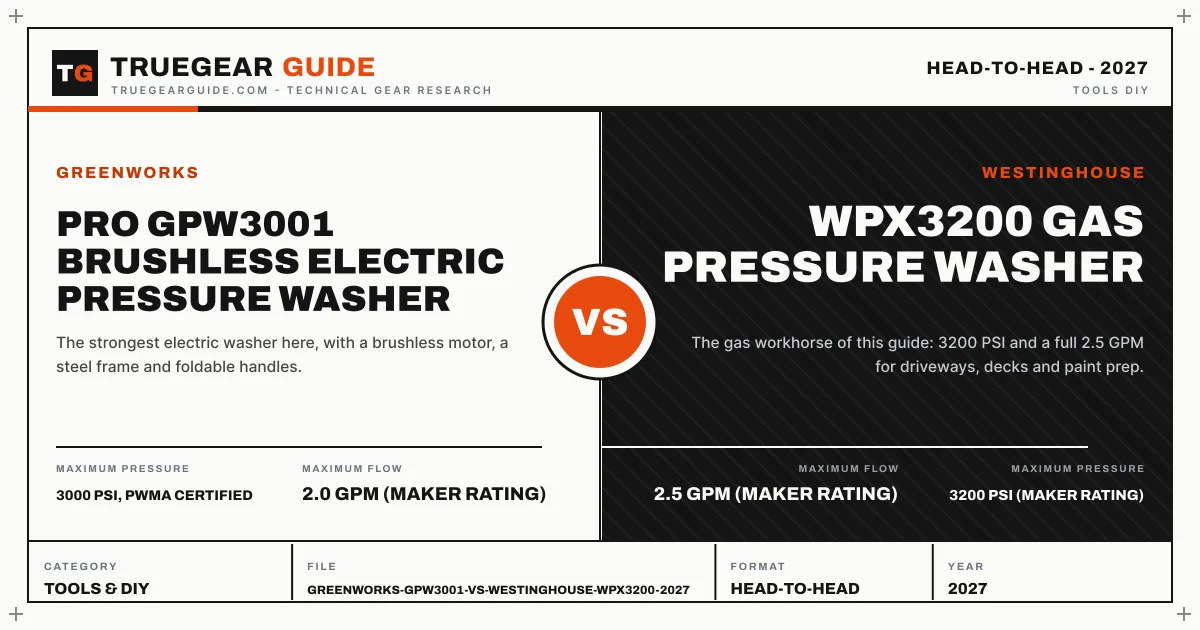

Greenworks Pro GPW3001 Brushless Electric Pressure Washer
The strongest electric washer here, with a brushless motor, a steel frame and foldable handles.
- Maximum pressure: 3000 PSI, PWMA certified
- Maximum flow: 2.0 GPM (maker rating)

Westinghouse WPX3200 Gas Pressure Washer
The gas workhorse of this guide: 3200 PSI and a full 2.5 GPM for driveways, decks and paint prep.
- Maximum pressure: 3200 PSI (maker rating)
- Maximum flow: 2.5 GPM (maker rating)
What owners report
Most praised
- Driveway owners describe the jump from a 2000 PSI electric as the difference between scrubbing and rinsing
- The foldable handles win over buyers who store the washer upright in a crowded shed or garage corner
- The metal gun feels like a step up to people replacing a washer whose plastic gun cracked in storage
Common complaints
- The weight surprises buyers who expected an electric washer to be light just because it has no engine
- Some owners found the turbo nozzle too aggressive for deck boards and switched to a wider fan quickly
- The gap between maximum and rated flow confuses first-time buyers reading the box
What owners report
Most praised
- Owners moving up from an electric washer talk most about rinse speed, not pressure, on long concrete runs
- The never-flat wheels get credit from people who roll the machine over gravel and lawn edges without flats
- First pulls in spring earn praise from owners who follow the fuel and storage notes in the manual
Common complaints
- Winter storage trips up owners who skip fuel stabilizer and then fight a gummed carburetor in spring
- The recoil start frustrates buyers who assumed a gas washer in this class would start with a button
- Some buyers found the included hose shorter than they wanted for wrapping a large house
Our recommendation
Choose by fuel, not by PSI. The Greenworks GPW3001 at 3000 PSI nearly matches the Westinghouse WPX3200 at 3200 PSI on pressure, but the gas machine wins the job on flow: 2.5 GPM against a 1.1 GPM rated electric flow, which means the driveway rinses roughly twice as fast. The electric wins everything else: silence, no fuel, no oil, no winterizing, and a plug-in start. Buy the Greenworks if you refuse gas or wash near neighbors early. Buy the Westinghouse if the property is large and the clock matters more than the noise.
Pressure is close, flow is not
3000 PSI electric against 3200 PSI gas looks like a tie, and on stain-breaking it nearly is. The real gap is flow: the WPX3200 moves 2.5 gallons a minute, while the GPW3001 rates 1.1 GPM at working pressure despite a 2.0 GPM maximum. On a driveway that gap decides the afternoon. On siding and decks, where pressure matters more than rinse volume, the gap narrows and the electric holds its own.
Noise, fumes and neighbors
The Greenworks hums; the Westinghouse roars, with exhaust to match. Electric washing at dawn is a courtesy; gas washing at dawn is a complaint. Properties with close neighbors, noise rules or early schedules argue electric regardless of the spec sheet, and this is the strongest argument the Greenworks has beyond simplicity.
Upkeep and lifespan
The Greenworks asks for almost nothing: flush after soap, drain before frost, keep the filter clear. The Westinghouse asks for fuel, oil, stabilizer, winterizing and recoil-start care, and rewards that care with long service. The brushless electric motor and steel frame on the Greenworks are built for years of plug-in use; the gas engine is built for years of maintained use. Both last, but only one lasts without attention.
Weight, storage and price
Both machines are heavy, the Greenworks over 50 lb and the gas machine heavier still, so neither is a carry. The electric stores cleaner, with no fuel smell and no spill risk, while the gas machine needs ventilation and fuel storage rules. Price tiers sit close, premium electric against premium gas, so the decision is genuinely about fuel philosophy rather than budget.
Choose Greenworks Pro GPW3001 Brushless Electric Pressure Washer if…
- You will not run a gas engine, for noise, fumes or maintenance reasons
- Your property has outlets within reach of the work and no huge concrete slabs
- PWMA certified figures and a brushless motor matter more than rinse speed
- Storage is indoors, where fuel smell and spill risk are unwelcome
Choose Westinghouse WPX3200 Gas Pressure Washer if…
- A large driveway, deck or paint prep job is the main work
- Rinse speed matters, and halving the job time is worth the noise
- Outlets are far from the work, or the property has no convenient outdoor power
- You accept gas maintenance and want the highest flow in this guide
Questions, answered
Can the Greenworks really replace a gas washer?
For siding, decks, fences and maintained driveways, yes, for most owners. For large stained concrete and heavy paint prep, it replaces the gas machine only if you accept a slower rinse. The honest test is property size: a typical suburban lot, yes; a long rural driveway, only with patience.
Which one costs more to run?
Gas costs more per hour in fuel and maintenance, while electric costs a small amount of electricity and almost no upkeep. Over years of occasional use the difference is modest against the purchase price, but the gas machine also costs time: fuel runs, oil checks and winterizing that the electric never asks for.
Which one is better for paint prep?
The gas WPX3200, on flow and sustained pressure for stripping loose paint from large areas. The Greenworks handles paint prep on a house exterior too, but slower, and with more care needed on soft wood. Either way, test a hidden spot first and never use a pinpoint jet on wood you intend to keep.
Every guide on Pressure Washers15 pages
- Topic hubPressure Washers
- Best ofThe Best Pressure Washers (2027)
- Car washing inverts the usual pressure ranking. The jet must be strong enough to lift road film and gentle enough to leave clear coat alone, which means wide fans, soap delivery and flow matter more than headline PSI. This ranking rewards foam cannons, onboard soap, a 40 or 65 degree rinse option and a body that moves around a vehicle without scratching it, and it penalizes pinpoint jets and heavy gas machines that have no business near paint.The Best Pressure Washers for Cars (2027)
- Driveways punish low flow. Concrete holds oil, algae and tire marks in its pores, and the job is mostly rinsing: pressure breaks the stain loose, flow carries it off the slab. This ranking therefore weights GPM above PSI, rewards turbo nozzles and surface-cleaner compatibility, and treats hose length as a first-class feature, since a driveway is exactly where a short hose costs the most time.The Best Pressure Washers for Driveways (2027)
- Electric-only buyers have already made the important decision, so this ranking judges electrics on their own terms: pressure and flow without an engine, noise beside a house wall, storage in a small garage, and whether the cord and hose reach the work. Gas machines are excluded entirely, which lets the strongest electrics, not the strongest machines, take the top spots.The Best Electric Pressure Washers (2027)
- ReviewSun Joe SPX3000-RED Electric Pressure Washer Review (2027)
- ReviewWestinghouse ePX3500 Electric Pressure Washer Review (2027)
- ReviewGreenworks Pro GPW3001 Brushless Electric Pressure Washer Review (2027)
- ReviewWestinghouse WPX3200 Gas Pressure Washer Review (2027)
- ReviewCRAFTSMAN CMEPW1700 Electric Pressure Washer Review (2027)
- ReviewSun Joe SPX3500 Brushless Electric Pressure Washer Review (2027)
- Head to headSun Joe SPX3000-RED vs Westinghouse ePX3500 (2027)
- Buying guidePressure Washer Buying Guide (2027)
- Fix itPressure Washer Has No Pressure? Fixes (2027)