In-depth review
Hompres 11.1V Heated Gloves Review (2027)
Hompres breaks the 7.4V pattern with an 11.1V system and four heat levels. Our research verdict on the voltage outlier.
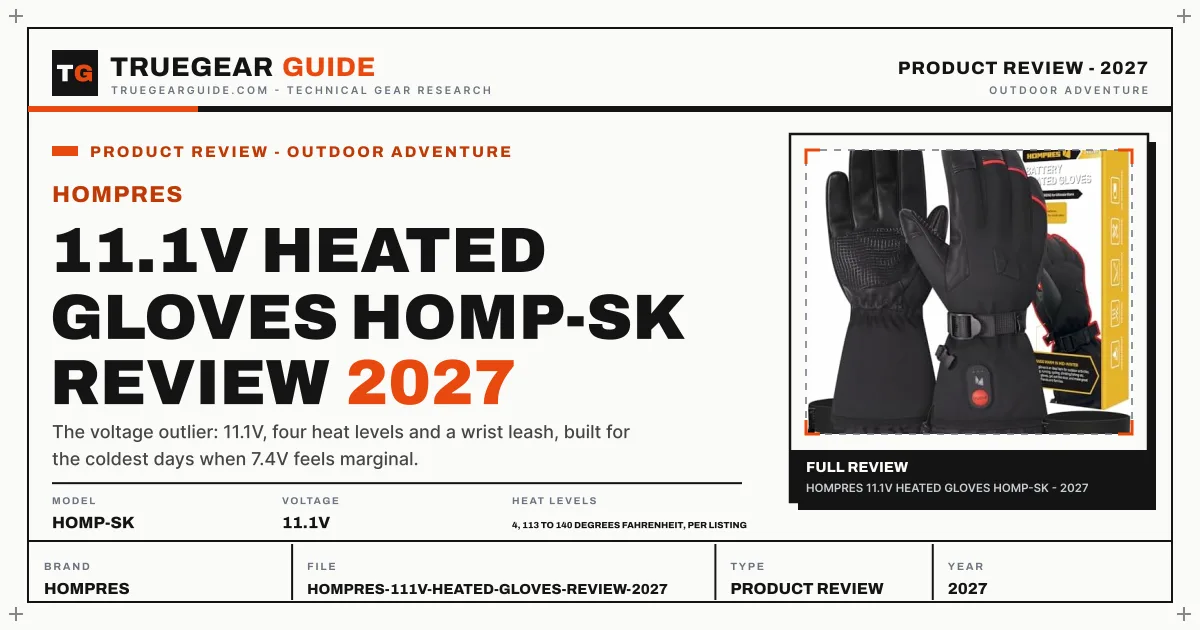

Hompres 11.1V Heated Gloves HOMP-SK
The voltage outlier: 11.1V, four heat levels and a wrist leash, built for the coldest days when 7.4V feels marginal.
Our verdict
The Hompres gloves are the most interesting pick here, because they change the question from which 7.4V glove to whether a higher voltage is worth it. At 11.1V with four levels, they offer stronger heat and finer control than the three-setting standard, with a maker-stated 2.5 hours even on high. The costs are real: a heavier battery system, a 3 to 4 hour recharge, and a platform that shares nothing with 7.4V packs. For the coldest days, for riders facing wind chill, and for wearers whose hands stay cold on standard gloves, that trade is worth making.
What we like
- 11.1V heating system, higher than the 7.4V standard here, with a maker claim of stronger heat output
- Four heating levels from 113 to 140 degrees Fahrenheit, with a 1.5-second press to change level, per the listing
- Runtime up to 6.5 hours overall, and 2.5 hours even at the highest setting, per the listing
- PU leather with a wrist leash and touchscreen fingertips, plus a three-level remaining-power indicator
What to watch out for
- Higher voltage means a heavier battery system and more heat to manage, not just more warmth for free
- Recharge takes 3 to 4 hours, per the listing, so a flat pack mid-trip is not fixed quickly
- Four levels add a little learning curve over the simple three-button pattern most gloves use
What owners report: Hompres 11.1V Heated Gloves HOMP-SK
Synthesized from recurring themes in long-term owner feedback.
Most praised
- Owners in harsh cold say the extra voltage shows, with heat arriving fast and staying strong
- The four levels get credit for letting wearers fine-tune between too cool and too hot
- The wrist leash is popular with skiers who drop a glove on a lift and do not want to chase it
Common complaints
- Some owners find the battery pack heavier than the 7.4V packs they are used to
- A few report the highest setting being too hot for mild days, so it sits unused
- Owners note the system is its own platform, so spare packs must match Hompres, not a generic 7.4V pack
Who it is for
Wearers in harsh cold, motorcycle riders facing wind chill, and anyone whose hands stay cold on standard 7.4V gloves.
What 11.1V actually changes
Voltage is not just a bigger number on a box. A higher voltage can push more heat through the same elements, which shows as faster warm-up and stronger heat on the highest setting. It also changes the battery: a larger, heavier pack that needs its own charger and spares. The Hompres system pairs that voltage with four levels instead of three, so the wearer can step between 113 and 140 degrees Fahrenheit in finer increments, rather than jumping from too cool to too hot. For mild days that finesse is unnecessary; for harsh days it is the point.
The wrist leash and power indicator are not gimmicks
A wrist leash sounds like an accessory until a glove is dropped from a lift or a motorcycle at speed, and then it is the feature that saves a day. The three-level remaining-power indicator similarly saves a day in a quieter way: it tells the wearer, before setting out, whether the pack will last the outing or needs a charge. Both features show a maker thinking about how gloves are actually used, not just how they heat on a test bench.
The weight and recharge trade
Heavier packs are felt on the wrist over a long day, and a 3 to 4 hour recharge means a flat pack cannot be rescued between morning and afternoon sessions without planning. Buyers should treat Hompres like a system: charge overnight, carry the indicator in mind, and use the lower levels for most of the day, reserving high for warm-up and the coldest stretches. Used that way, the voltage advantage is real; used on high all day, every glove here disappoints, and this one is no exception.
Key specifications
- Model
- HOMP-SK
- Voltage
- 11.1V
- Heat levels
- 4, 113 to 140 degrees Fahrenheit, per listing
- Runtime
- Up to 6.5 hours, 2.5 hours on high, per listing
- Recharge
- 3 to 4 hours, per listing
- Material
- PU leather, wrist leash, touchscreen
Also consider

Volt Resistance Heated Leather Work Gloves 7V
Volt's leather work glove on its own 7V system, built for hunting and work rather than for the ski lift.
Why consider it: The leather work glove for buyers who want a traditional shape rather than a voltage outlier
- Part number: GL-7V-WK
- Voltage: 7V

SAVIOR HEAT Leather Heated Ski Gloves 3000mAh
Savior's leather ski glove on the larger battery: 3000mAh, Thinsulate insulation and a waterproof shell claim.
Why consider it: The insulated leather ski glove for buyers who want warmth from insulation as well as from voltage
- Battery: 7.4V 3000mAh, per listing
- Shell: Leather, waterproof per listing
Research-based assessment. TrueGear has not hands-on tested this product; this evaluation synthesizes manufacturer specifications, retailer documentation, and published expert reviews.
Questions, answered
Is 11.1V safe in a glove?
The system is designed as a glove system, with its own batteries, charger and controls, and the maker states the voltage and levels for that system. Use only Hompres packs and chargers for these gloves, and do not substitute a generic 7.4V pack, which will not match the system's design.
How long do Hompres gloves last on high?
Up to 2.5 hours on high, per the listing, and up to 6.5 hours overall across settings. The practical pattern is high to warm up, then a lower level for the rest of the outing, which stretches the day considerably.
Are four heat levels better than three?
For most wearers, three levels are enough. Four levels help wearers who find the jump between medium and high too large, or who want a level between low and medium for long, mild outings. It is a refinement, not a revolution, and the voltage is the bigger differentiator here.
Every guide on Heated Gloves16 pages
- Topic hubHeated Gloves
- Best ofThe Best Heated Gloves (2027)
- Skiing tests a heated glove differently from walking. Hands alternate between gripping poles, sitting still on lifts and handling zips and passes, and the glove must seal against snow while staying usable with cold fingers. This ranking therefore weights cuff design, insulation that works unheated, and controls that can be found without looking, ahead of headline temperature alone.The Best Heated Gloves for Skiing (2027)
- Liners are judged on a different test from gloves: how little they disturb the outer glove. Thinness, flexibility and a battery pocket that does not fight a tight shell matter more than weather protection, because the shell provides that. This ranking favours liners that disappear under a glove the wearer already trusts.The Best Heated Glove Liners (2027)
- Riding and working punish a glove in ways skiing does not: sustained wind at speed, grip on bars and tools, abrasion, and hours of continuous wear. This ranking therefore weights palm grip, leather or tough synthetic construction, and a cuff that seals against wind, ahead of softness or ski-specific features.The Best Heated Gloves for Motorcycle and Work (2027)
- ReviewORORO 3-in-1 Heated Gloves Review (2027)
- ReviewSAVIOR HEAT Leather Heated Ski Gloves Review (2027)
- ReviewSNOW DEER Upgraded Heated Mittens Review (2027)
- ReviewVolt Heated Leather Work Gloves Review (2027)
- ReviewWASOTO Heated Ski Gloves Review (2027)
- Head to headORORO 3-in-1 vs SAVIOR HEAT Leather Heated Gloves (2027)
- Head to headSNOW DEER Upgraded Mittens vs SNOW DEER Mittens 3000mAh (2027)
- Buying guideHeated Gloves Buying Guide (2027)
- Fix itHeated Gloves Battery Dies Fast: Fixes (2027)
- Fix itHeated Gloves Not Heating: Fixes (2027)