Buying guide
Kayak Racks Buying Guide (2027)
How to buy a kayak rack in 2027: carrier types, load capacity, crossbar fit, loading aids and tie-downs explained without the marketing.
Weigh the boat rigged, then choose
Before comparing carriers, weigh your kayak the way it travels: seat fitted, fish finder and battery aboard, anchor, rod holders and gear in place. A bare hull of 60 lb can reach 90 lb to 110 lb rigged, and the rating must cover the rigged weight, not the catalogue weight. Most recreational boats sit under 75 lb rigged and suit the J-cradles and saddles here. Fishing kayaks often pass 100 lb rigged and need the MegaWing's 150 lb rating or the Stacker's 150 lb total. If the rating is close, buy the next class up, and remember the roof bars themselves have a rating too: the lowest of the carrier, bar and roof ratings decides the load.
Carrier types: J-cradle, saddle, stacker, roller, lift-assist
A J-cradle holds the boat on its side and saves roof width, which suits two-boat households, but it asks for a lift to roof height and a tilt. A saddle holds the boat flat on its hull, lower and more stable, but takes the full roof width for one boat. A stacker post carries up to four boats on their sides and asks for patience loading the top ones. A roller rack lets the boat slide on from the rear, which suits flat hulls and rear loading. A lift-assist carrier lowers the cradle to waist height and carries up to 40 lb of the boat for you, which suits bad backs and tall SUVs. The carrier type is a loading decision first and a carrying decision second, so choose by how you load, not just by how the boat sits.
Crossbar fit: measure before you order
Round, square, aero and factory bars all take different mounts, and a rack that fits your bars is the only rack that works. Universal hardware like Yakima's tool-free mounts and Malone's JAWZ adapters covers most bar shapes, which is why they are safe defaults. The Hullavator Pro is the exception that proves the rule: it only fits Thule load bars, so factory crossbars are out and a buyer without Thule bars faces a second purchase. Measure your bars, width and height, before ordering, and check the mount hardware against the shape you own, not the shape in the listing photo.
Straps, bow and stern lines, and the second boat
Straps hold the boat to the carrier; bow and stern lines hold the boat to the car, and they are not optional on a highway, where wind lift can peel a kayak off a rack that held fine at town speeds. Most carriers here include straps and bow and stern lines for one boat, but several two-boat carriers ship straps for one kayak only, including the premium XTR and JayLow, so a second boat needs a second strap set bought with the rack. Check the box contents before the trip, not at the water, and replace sun-faded straps before they fail: a strap is cheap, a kayak on the highway is not.
Folding arms, padding and storage
A rack that folds flat when the boat is off is quieter, fits under a garage door and does not turn the roof into a permanent sail, which is why owners praise folding arms on nearly every carrier that has them. Padding matters too: thick foam and padded touch points keep hulls free of scuffs, while thin budget padding marks them and needs replacing. And do not forget storage: a kayak that lives on the garage floor gets damaged, so a wall rack like the RAD Sportz hangers or a freestanding rack earns its place in the same purchase as the roof carrier.
Start with our top 3
The three highest-ranked products in our full kayak racks ranking. Read the in-depth review where one exists, or jump to the product in the ranked list.

The folding J-cradle that switches to a two-boat stacker.
- Load capacity: 130 lb total
- Kayaks: 1 in J-cradle, 2 stacked
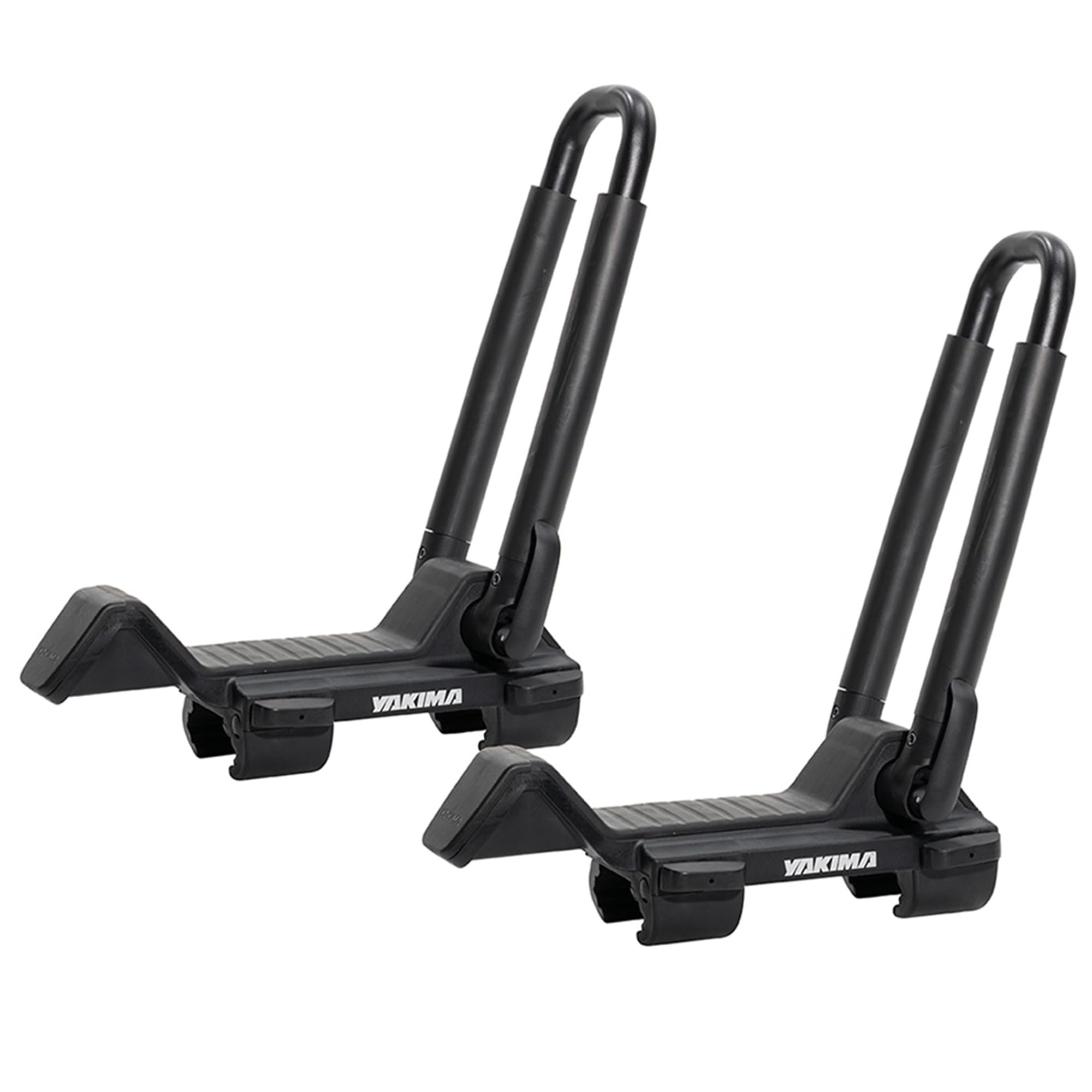
The fold-down J-cradle with an adjustable angle for different hull widths.
- Load capacity: 80 lb single, 110 lb total
- Kayaks: 1 in J-cradle, 2 stacked
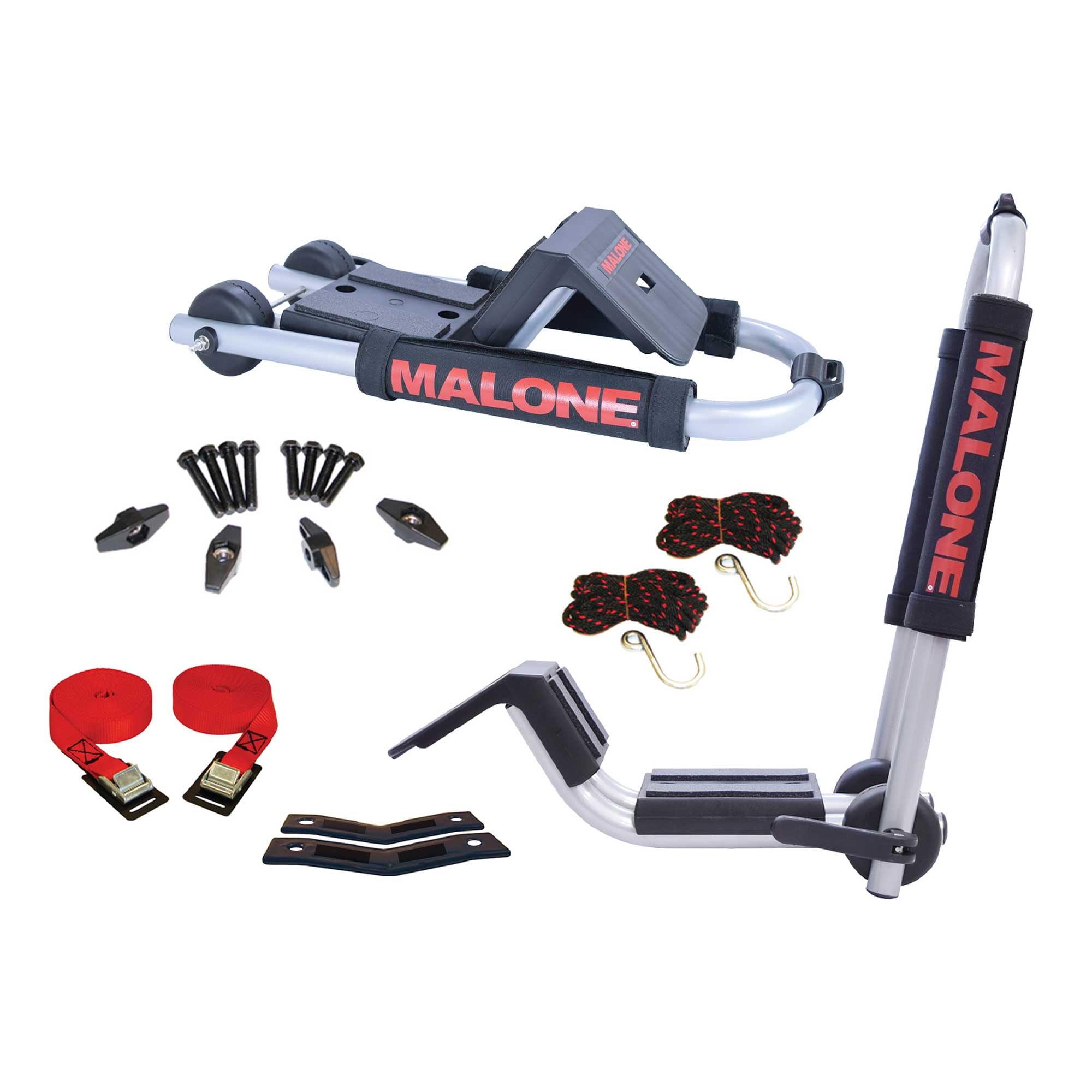
The folding J-cradle with a built-in ramp for easier solo loading.
- Load capacity: 75 lb
- Kayaks: 1 kayak
Questions, answered
How much kayak rack do I actually need?
Match the rating to your rigged boat weight, then the carrier type to your loading. A recreational kayak under 75 lb rigged suits a folding J-cradle like the JayLow or the DownLoader. A fishing kayak over 100 lb rigged needs the MegaWing. A household with two boats needs a dual-position carrier or a two-pair set, and a family with four boats needs a stacker.
Are bow and stern tie-downs really necessary?
Yes, on any drive above town speeds. Straps hold the boat to the carrier, but bow and stern lines stop the boat lifting and shifting in crosswinds and under braking. Every carrier in this guide includes them or expects them, and skipping them is the most common cause of a kayak moving on the roof.
Can I leave a kayak rack on the car all year?
Yes, if it folds flat and the mounts are checked regularly. Fixed racks add wind noise and drag on every empty-roof drive, and all racks deserve a bolt and strap check after the first drive and periodically through the season. Remove the rack in winter if you do not paddle, and store it dry.
What is the best kayak rack for a beginner?
The Yakima JayHook or the Malone SeaWing, for a single recreational kayak: simple, sturdy, with straps and tie-downs in the box and nothing to adjust. Solo beginners should take the Malone DownLoader instead, for its loading ramp, and budget beginners should take the TMS two-pack if two boats are involved.
Every guide on Kayak Racks15 pages
- Topic hubKayak Racks
- Best ofThe Best Kayak Racks (2027)
- Two kayaks change the ranking. The question is no longer whether the carrier holds a boat, but whether it holds two boats without a second purchase, a second carrier or a second set of straps. This ranking weights total capacity and the honesty of the two-boat setup first, then roof width, then price. A carrier that claims two boats but ships straps for one is marked down for it.The Best Kayak Racks for Two Kayaks (2027)
- Loading alone is the hardest part of kayaking, and this ranking is built on it. A carrier that helps you load is worth more than a carrier that merely holds the boat, so the ranking weights loading aids first, then capacity, then price. A fixed J-cradle with no help at all is marked down here even if it carries beautifully, because carrying is not the problem solo paddlers face.The Best Kayak Racks for Solo Loading (2027)
- Fishing kayaks break the usual kayak rack ranking, because they are wide, heavy and rigged. A 70 lb saddle and a 75 lb J-cradle both fail on a boat that weighs 100 lb with its seat, fish finder and gear fitted, so this ranking weights rigged capacity first, then hull width support, then rear loading, which is how heavy boats actually get onto a roof. A carrier that cannot take the rigged weight is excluded from the top of this ranking, however good it is for recreational boats.The Best Kayak Racks for Fishing Kayaks (2027)
- ReviewThule Hull-a-Port XTR Review (2027)
- ReviewYakima JayLow Review (2027)
- ReviewMalone DownLoader Review (2027)
- ReviewThule Hullavator Pro Review (2027)
- ReviewMalone SeaWing Review (2027)
- ReviewTMS Kayak Roof Racks for 2 Kayaks Review (2027)
- Head to headHull-a-Port XTR vs JayLow (2027)
- Head to headDownLoader vs SeaWing (2027)
- Fix itKayak Rack Loading and Fit Problems? Fixes (2027)