Head to head
Milwaukee 2727-20 vs DEWALT DCCS672X1 (2027)
Two battery flagships compared: Milwaukee's 16 inch M18 FUEL 2727-20 against DEWALT's 18 inch 60V FLEXVOLT DCCS672X1, for 2027 buyers cutting firewood.
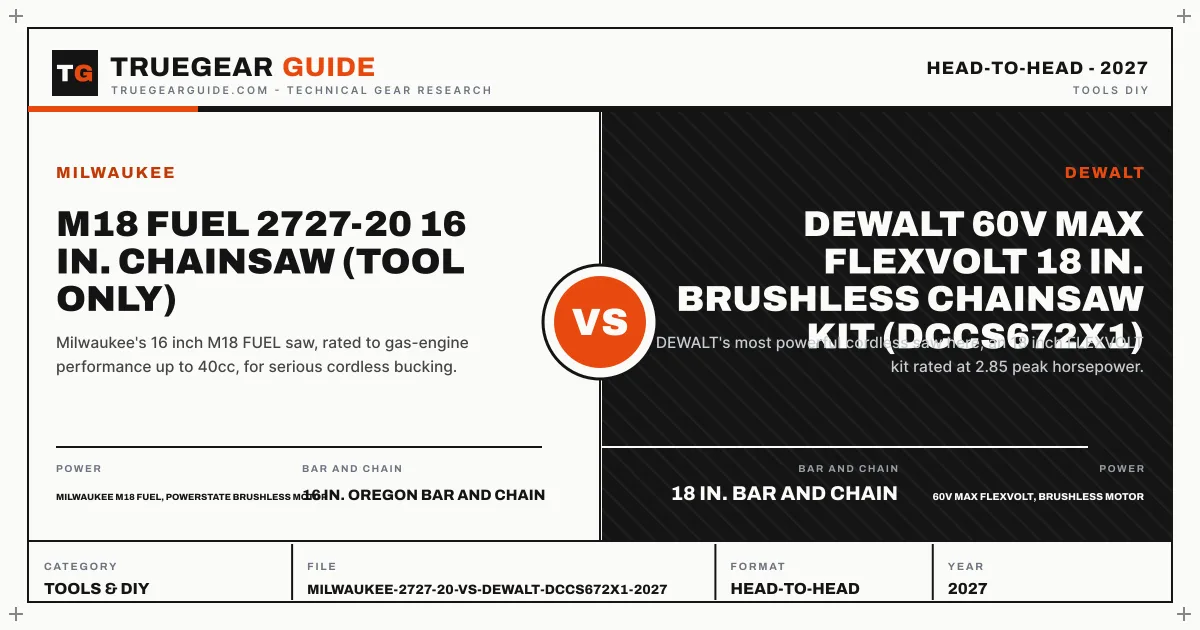

Milwaukee M18 FUEL 2727-20 16 in. Chainsaw (Tool Only)
Milwaukee's 16 inch M18 FUEL saw, rated to gas-engine performance up to 40cc, for serious cordless bucking.
- Power: Milwaukee M18 FUEL, POWERSTATE brushless motor
- Bar and chain: 16 in. Oregon bar and chain

DEWALT DEWALT 60V MAX FLEXVOLT 18 in. Brushless Chainsaw Kit (DCCS672X1)
DEWALT's most powerful cordless saw here, an 18 inch FLEXVOLT kit rated at 2.85 peak horsepower.
- Power: 60V MAX FLEXVOLT, brushless motor
- Bar and chain: 18 in. bar and chain
What owners report
Most praised
- Firewood cutters report it replacing a small gas saw for routine bucking, with none of the starting ritual
- The onboard scrench storage gets singled out by owners tired of hunting for the tool mid-job
- It holds speed through a cut instead of bogging, which owners notice most on the second and third logs
Common complaints
- The saw feels nose-heavy with the big pack fitted, and wrists notice it on overhead limbing
- Small M18 packs drain fast enough that owners end up buying the HD12.0 anyway
- The price of admission for non-M18 households, tool plus large battery, surprises first-time buyers
What owners report
Most praised
- Owners cutting firewood say it is the first battery saw that stopped them reaching for the gas saw
- The dual retention studs hold the bar steady under hard bucking, owners report
- Kit buyers value the sheath and tensioning tool being in the box rather than separate purchases
Common complaints
- The amp-hour labelling across 20V and 60V confuses buyers comparing batteries
- Tooled tensioning slows chain adjustments compared with the tool-free dials on smaller DEWALT saws
- The saw's weight with the FLEXVOLT pack fitted tires arms on long limbing sessions
Our recommendation
Choose the platform first; both saws deserve flagship status. The DEWALT DCCS672X1 posts the bigger power figure, 2.85 peak horsepower, and the longer 18 inch bar, with a maker claim of cutting a 17 inch white oak log in as fast as 24 seconds. The Milwaukee 2727-20 answers with a higher cuts-per-charge claim, 150 on the HD12.0 pack against the DEWALT's 65, and a lighter, better-balanced 16 inch body. If your worst rounds define the purchase, take the DEWALT. If session length and handling matter more, take the Milwaukee. If you own neither platform, the tiebreaker is the rest of the catalog you will buy into.
Bar length and the wood it covers
The DEWALT's 18 inch bar covers rounds the Milwaukee's 16 inch bar must cut from both sides, and that two-inch gap decides large firewood rounds outright. The Milwaukee's shorter bar is lighter, handier in brush and easier to control on limbing work. For rounds under 14 inches the difference never appears; above that, it is the whole comparison.
Power claims and what they measure
DEWALT rates peak horsepower at 2.85 with the DCB609 battery, while Milwaukee rates a 40cc gas equivalent. These are different yardsticks, not directly comparable numbers, and both are maker claims. The DEWALT's white oak speed claim and the Milwaukee's 150-cut claim are the more useful figures, and they point in opposite directions: the DEWALT cuts bigger wood faster, the Milwaukee cuts longer per charge.
Batteries and kit form
The Milwaukee is a bare tool, and its rated output assumes the HD12.0 pack bought separately. The DEWALT is a kit with the DCB609 battery, DCB115 charger, bar sheath and tensioning tool in the box. For a buyer starting from zero on either platform, the DEWALT box is the more complete purchase; for an existing M18 owner with big packs, the Milwaukee's bare price is the better value.
Handling and daily use
The Milwaukee is the lighter, better-balanced saw in hand, with onboard scrench storage and a variable trigger that reaches full throttle in under a second. The DEWALT is heavier with the FLEXVOLT pack fitted and uses tooled chain tensioning, which slows adjustments. Over a long limbing day the Milwaukee's handling wins; over a short, hard bucking session the DEWALT's power wins.
Choose Milwaukee M18 FUEL 2727-20 16 in. Chainsaw (Tool Only) if…
- You already own M18 batteries, ideally the HD12.0 pack
- Session length and cuts per charge matter more than maximum bar length
- Lighter handling and balance matter for limbing as well as bucking
- You prefer tool-free working ends and onboard tool storage
Choose DEWALT DEWALT 60V MAX FLEXVOLT 18 in. Brushless Chainsaw Kit (DCCS672X1) if…
- You already own DEWALT 20V MAX or FLEXVOLT batteries
- Large rounds and 18 inch cutting capacity define your work
- Maximum battery cutting power is the specification you are buying
- A complete kit with battery, charger, sheath and tool appeals to you
Questions, answered
Which one cuts firewood better?
For large rounds, the DEWALT: its 18 inch bar and peak power rating cover wood the Milwaukee must work around. For longer sessions of moderate rounds, the Milwaukee's 150-cut claim on the HD12.0 pack gives it the stamina edge.
Which is better for a mixed-use property?
The Milwaukee, on handling and session length, since property work mixes limbing, cleanup and bucking. Owners whose work is dominated by big firewood rounds lean DEWALT for the bar and power.
Do these saws need special batteries?
They run on standard packs from their platforms, but rated output assumes the large packs: the HD12.0 for Milwaukee, the DCB609 for DEWALT. Budget for at least one big pack with either saw.
Every guide on Chainsaws15 pages
- Topic hubChainsaws
- Best ofThe Best Chainsaws (2027)
- This ranking covers only battery saws, because the battery decision is the whole purchase. The ranking separates on three things: bar length against the wood you cut, the battery platform you already own, and whether the box is a bare tool or a working kit. A flagship on a small pack is ranked below its headline, and a kit with a small included battery is flagged for it. Gas saws are excluded here, not judged inferior, because they answer a different question.The Best Battery Chainsaws (2027)
- Firewood cutting is the hardest honest test in this guide, because it combines diameter, volume and duration. A pruning saw cannot fake it, and a battery saw with one small pack cannot sustain it. This ranking weights bar length for the rounds you actually buck, sustained output over a session, and refuel or battery-swap stamina. Pruning specialists are excluded even when they are excellent saws, because firewood is not their job.The Best Chainsaws for Firewood (2027)
- Pruning rewards the opposite virtues from firewood: light weight, short bars, easy starting and control in tight spaces. This ranking excludes the heavy gas saws and the long-bar battery saws, even though they can prune, because carrying them through brush all day is the wrong tool for the job. Weight, balance, tensioning ease and starting effort decide this ranking more than peak power.The Best Chainsaws for Pruning and Limbing (2027)
- ReviewDEWALT 20V MAX XR DCCS620B 12 in. Compact Chainsaw Review (2027)
- ReviewMilwaukee M18 FUEL 2727-20 16 in. Chainsaw Review (2027)
- ReviewEGO Power+ CS1611 16 in. Chainsaw Kit Review (2027)
- ReviewGreenworks Pro 80V 18 in. Brushless Chainsaw Review (2027)
- ReviewMakita 18V X2 (36V) LXT 14 in. Chain Saw Kit Review (2027)
- ReviewDEWALT 60V MAX FLEXVOLT DCCS672X1 18 in. Chainsaw Kit Review (2027)
- Head to headWORX WG322.9 vs BLACK+DECKER LCS1020 (2027)
- Buying guideChainsaw Buying Guide (2027)
- Fix itChainsaw Won't Start or Cuts Poorly? Fixes (2027)