Head to head
Newborn 250 Super Smooth Rod Revolving Frame vs Newborn 930-GTD Drip-Free Smooth Hex Rod (2027)
The two Newborn manual guns compared: the 250 smooth-rod classic against the 930-GTD drip-free gun, on thrust, drip control and the jobs each suits.
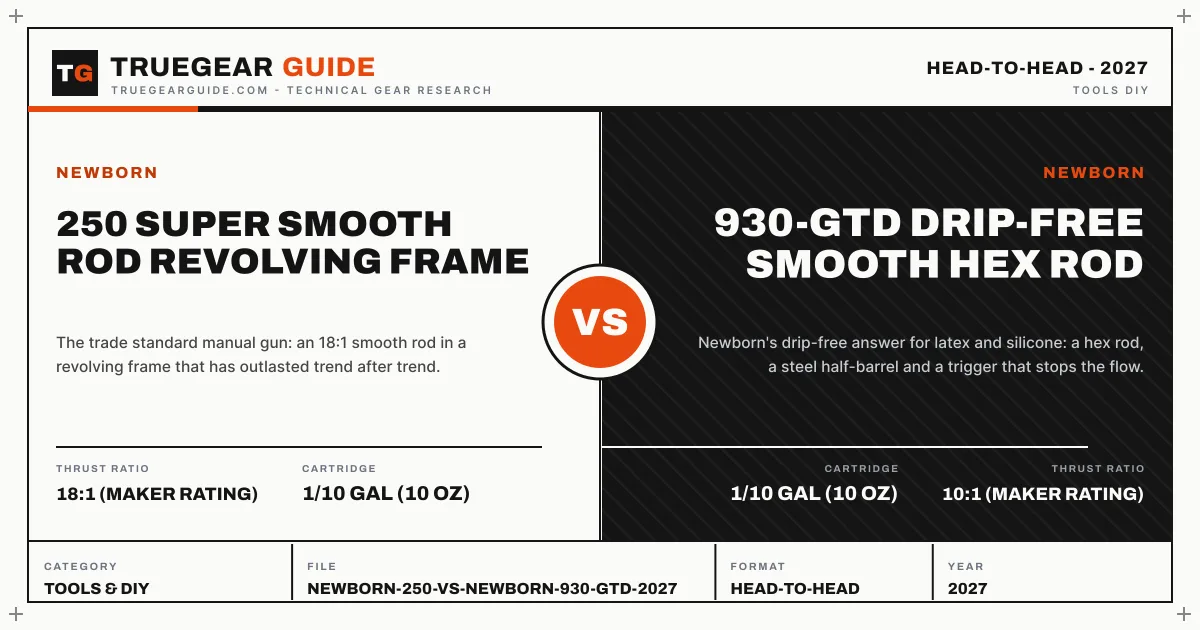

Newborn 250 Super Smooth Rod Revolving Frame
The trade standard manual gun: an 18:1 smooth rod in a revolving frame that has outlasted trend after trend.
- Thrust ratio: 18:1 (maker rating)
- Cartridge: 1/10 gal (10 oz)

Newborn 930-GTD Drip-Free Smooth Hex Rod
Newborn's drip-free answer for latex and silicone: a hex rod, a steel half-barrel and a trigger that stops the flow.
- Thrust ratio: 10:1 (maker rating)
- Cartridge: 1/10 gal (10 oz)
What owners report
Most praised
- The smooth rod action makes long beads feel effortless compared with ratchet guns owners used before
- The revolving barrel is the feature owners reach for first when sealing around corners and window trim
- It keeps pushing cold and stiff tubes that stalled cheaper guns in the same drawer
Common complaints
- Caulk keeps creeping out after the trigger is released unless the thumb latch is pressed every time
- The weight is noticeable on overhead and all-day sealing work
- The built-in cutter is too thick to open tube tips as cleanly as a knife
What owners report
Most praised
- The drip-free stop is the first thing owners mention: beads end cleanly without a blob at the corner
- The hex rod feels stiffer and more precise than the round rods on cheaper guns
- The comfort grip keeps hands fresher through a full bathroom reseal
Common complaints
- Thick adhesive and cold tubes demand far more squeeze than owners expected from a 10:1 gun
- The fixed barrel forces wrist twists on inside corners that a revolving frame would avoid
- The drip-free mechanism is less convincing on heavier silicone than on thin latex
Our recommendation
Buy the 250 if your materials are thick or mixed, because 18:1 thrust beats 10:1 on every stiff tube, and the revolving barrel helps on corners. Buy the 930-GTD if your work is mostly thin latex and silicone in visible places, because its drip-free mechanism ends beads cleanly and the 250 cannot. The honest answer for a busy household is both: the 250 for adhesive and mixed work, the 930-GTD for the bathroom and kitchen silicone that everyone sees. If you can buy only one, choose by your hardest material, not your most common one.
Thrust ratio: 18:1 against 10:1
The 250's 18:1 ratio gives nearly double the mechanical advantage of the 930-GTD's 10:1, which is the difference between a steady one-hand squeeze and a hand workout on stiff polyurethane and construction adhesive. On thin latex and silicone the gap never shows, and both guns lay equally good beads. The ratio decides the hard jobs, not the easy ones.
Drip control: thumb release against a mechanism
The 930-GTD releases pressure after every squeeze, so beads stop where you stop. The 250 has no such mechanism and relies on a thumb release you must press after every bead. Owners who forget the release on the 250 wipe blobs off trim; owners of the 930-GTD rarely think about dripping at all. This is the single biggest practical difference between the two guns.
Rod and frame: smooth rod against hex rod
Both rods are smooth, but they differ in shape and job. The 250's round smooth rod runs in a revolving barrel that spins to keep the nozzle aimed around corners. The 930-GTD's hex rod resists bending and twisting under load, and sits in a steel half-barrel cradle that holds the tube firmly. The 250's frame suits long runs and corners; the 930-GTD's frame suits precise, visible work.
Materials each gun honestly covers
The 250 covers the full range: acrylic, silicone, polyurethane, asphalt, cement and construction adhesive. The 930-GTD is tuned for low-viscosity latex and silicone, and it is honest about that on its own listing. A buyer who pushes adhesive with the 930-GTD will blame the gun for a problem the ratio caused; a buyer who seals bathrooms with the 250 will blame the gun for blobs the missing drip-free mechanism caused. Each gun is excellent inside its range and ordinary outside it.
Choose Newborn 250 Super Smooth Rod Revolving Frame if…
- Your materials include thick polyurethane or construction adhesive
- You want the highest thrust ratio in a manual gun
- Revolving barrel corner work matters to you
- You seal long runs where hand fatigue is the limit
Choose Newborn 930-GTD Drip-Free Smooth Hex Rod if…
- Your work is mostly thin latex and silicone in visible places
- Clean bead ends matter more than raw pushing power
- Bathroom and kitchen sealing is the main job
- You want drip-free operation without learning a thumb-release habit
Questions, answered
Can I own both Newborn guns?
Yes, and many experienced owners do: the 250 for adhesive and mixed work, the 930-GTD for visible silicone. Together they cost less than one cordless gun and cover every manual caulking job a household is likely to meet.
Which one is better for a beginner?
The 930-GTD, because its drip-free mechanism forgives the most common beginner mistake, which is forgetting to release pressure at the end of a bead. The 250 is the better gun, but it asks the beginner to learn the thumb-release habit from the first tube.
Do they take the same tubes?
Yes. Both take standard 1/10 gallon, 10 oz cartridges, so the same box of tubes works in either gun. The choice between them is about thrust and drip control, never about cartridge format.
Every guide on Caulk Guns15 pages
- Topic hubCaulk Guns
- Best ofThe Best Caulk Guns (2027)
- Bathroom sealing is the one caulking job where the end of the bead is on display forever. A blob at the corner of a tub stays visible for years, so this ranking weights drip control and fine bead control above raw thrust. It also weights size: the space behind a toilet and inside a vanity cabinet defeats full-size guns, which is why the compact pick ranks higher here than it does in the main guide. Thick adhesive power barely matters, because bathroom work is almost entirely silicone and latex.The Best Caulk Guns for Bathrooms (2027)
- Heavy adhesive inverts the usual ranking. Thin latex control does not matter when the material is a stiff polyurethane or a cold subfloor adhesive, and the only question is force: how much push the gun delivers, and whether your hand or a motor delivers it. This ranking weights thrust ratio and dispensing force above everything else, and it excludes guns below 18:1 or 400 lb of force from the top half, because they simply stall on the materials this guide is about.The Best Caulk Guns for Heavy-Duty Adhesives (2027)
- Budget here means value per job, not the cheapest gun in the drawer. A gun that costs very little and ruins a tube of silicone is not a bargain. This ranking weights honest performance on standard latex and silicone above everything else, and it rewards guns that do one job well over guns that promise everything. The two cordless entries appear because they are the cheapest way onto a powered gun for households that already own the batteries, not because a first-time buyer should buy a platform for one bathroom.The Best Budget Caulk Guns (2027)
- ReviewNewborn 250 Super Smooth Rod Revolving Frame Review (2027)
- ReviewNewborn 930-GTD Drip-Free Smooth Hex Rod Review (2027)
- ReviewDripless ETS3000 ErgoTech Composite Review (2027)
- ReviewMilwaukee M12 2441-20 Caulk and Adhesive Gun Review (2027)
- ReviewDEWALT 20V MAX DCE560B Adhesive Gun Review (2027)
- ReviewMakita 18V LXT XGC01Z Caulk and Adhesive Gun Review (2027)
- Head to headMilwaukee M12 2441-20 Caulk and Adhesive Gun vs DEWALT 20V MAX DCE560B Adhesive Gun (2027)
- Buying guideCaulk Gun Buying Guide (2027)
- Fix itCaulk Gun Leaving an Uneven Bead? Fixes (2027)