Buying guide
Outdoor Speaker Buying Guide (2027)
How to buy outdoor speakers in 2027: portable against wired, IP ratings, coverage, battery honesty and mounting explained without the marketing.
Portable or wired: decide the venue first
List the places the speaker will actually play before comparing sound quality. One venue, fixed seating, and a willingness to run cable point to a wired pair like the Klipsch AW-650 or Polk Atrium 6, which cover a patio permanently and never need charging. Several venues, rented housing, or a mix of patio, pool and trail point to a portable like the Charge 5 or Flip 6. Buyers who skip this step often buy a portable for a patio that needed a pair, or a pair for a lifestyle that needed a portable, and end up buying twice.
Read the IP rating against the real risk
IP67 means dust-tight and submersible, IP56 means dust-protected and jet-resistant, and IPX7 means submersible without a dust claim. Match the rating to the risk: pools need submersion and ideally floating, beaches need dust sealing as much as water sealing, and patios mainly need rain and UV endurance. Wired pairs use All-Weather certification instead of IP ratings, tested against salt fog, UV and temperature extremes, which is the right promise for a speaker that stays mounted all year.
Coverage outdoors is a different problem
Open air has no walls to return sound, so volume and bass fall away with distance and a single loud direction leaves the edges quiet. Wide-dispersion designs, horn tweeters, 360-degree portables and stereo pairs all exist to solve this one problem. Walk the listening area in your mind: where will people sit, how far apart, and will they talk over the music? A moderate speaker that spreads evenly usually beats a loud speaker that beams, and two modest speakers in stereo usually beat one flagship alone.
Battery figures, amplifier budgets and the hidden costs
Portable playtimes assume typical volume, so party use shortens them, and a phone that supplies the music needs its own charge plan, which is why powerbank speakers earn their keep. Wired pairs hide their cost differently: the amplifier, outdoor-rated cable, brackets and mounting time all sit beyond the speaker price, and a second pair for a large yard doubles the speaker cost but not the amplifier cost if impedance is checked. Budget the whole system, not the headline product, whichever kind you buy.
Mounts, placement and seasonal care
Mount wired pairs high enough to clear heads, angle them slightly down toward seating, and check that the bracket holds its aim through a season of weather. Place portables where they project at the group, not at a wall, and keep them off sand and grit where radiators and port covers collect debris. After salt or chlorinated water, rinse portables with fresh water and dry them before charging, and check wired pairs each spring for grille, bracket and cable condition. A little placement and care buys years of outdoor sound.
Start with our top 3
The three highest-ranked products in our full outdoor speakers ranking. Read the in-depth review where one exists, or jump to the product in the ranked list.
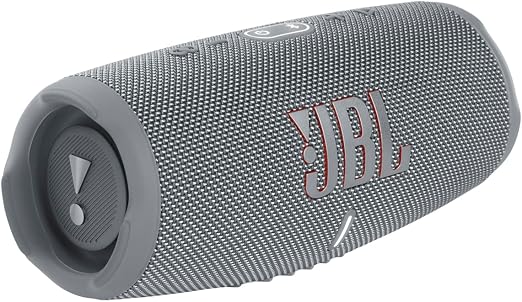
JBL Charge 5 Portable Speaker, IP67 Waterproof
The all-round portable: strong bass for its size, a powerbank for the phone, and sealing that shrugs off pool splashes.
- Output: 40 watts (maker rating)
- Playtime: Up to 20 hours

Klipsch AW-650 Indoor/Outdoor Speaker, Pair (Black)
The patio flagship pair: a horn-loaded tweeter, a big woofer and a cabinet built to live outside for years.
- Woofer: 6.5-inch injection-molded graphite
- Tweeter: 1-inch titanium dome on Tractrix horn

Sonos Move 2 Portable Speaker, Wi-Fi and Bluetooth
The patio smart speaker: true stereo from dual tweeters, home Wi-Fi grouping, and a charging base it lives on.
- Playtime: Up to 24 hours (maker rating)
- Weather sealing: IP56 dust and water resistant
Questions, answered
How much outdoor speaker do I actually need?
Match the speaker to the venue and the group. Solo and small-group listening: a compact portable like the Flip 6 or SoundLink Flex 2. Patio and pool gatherings: a Charge 5 or a wired pair like the Atrium 4. Large yard parties: an Xtreme 4 or a larger wired pair like the AW-650 or Atrium 6, possibly two pairs for a big space.
Can I use indoor speakers outside temporarily?
For a single dry afternoon under cover, an indoor speaker will play, but it lacks sealing, UV resistance and weather-hardened grilles, so rain, sun and humidity will damage it over time. For regular outdoor use, buy a speaker built for it; the cost difference is smaller than replacing a ruined indoor pair.
Do I need a subwoofer for outdoor speakers?
Outdoors, bass escapes fastest, so bass lovers often want one, especially with compact wired pairs or small portables. Larger wired pairs like the Atrium 6 and party portables like the Boom 2 and Xtreme 4 carry enough low end for most gatherings without a subwoofer. Add a subwoofer only if bass is the priority and the rest of the system already covers the space evenly.
What wire do I need for wired outdoor speakers?
Use outdoor-rated speaker wire for any exposed or buried run, keep runs as short as practical, and match the gauge to the run length and the speakers' impedance, with thicker wire for longer runs. Protect connections from water with sealed connectors or junction boxes, and leave a service loop at each speaker so brackets can be adjusted without rewiring.
Every guide on Outdoor Speakers15 pages
- Topic hubOutdoor Speakers
- Best ofThe Best Outdoor Speakers (2027)
- This ranking includes only speakers that can genuinely get wet, and it ranks them on the water question first: what happens when the speaker goes in, not just near, the water. Submersion survival, floating ability and dust sealing outrank raw volume, because a loud speaker at the bottom of a pool is a sunk cost in both senses.The Best Waterproof Outdoor Speakers (2027)
- Landscape sound is not about one loud box; it is about even sound across a space where people move, sit apart and talk over the music. This ranking favours pairs that spread sound, mounts that aim precisely, and cabinets that survive seasons mounted outside, with portables included only where they genuinely serve a patio rather than a trail.The Best Outdoor Landscape Speakers (2027)
- Portable means carried, not just battery-powered, so this ranking weighs size and weight alongside sound. A speaker that stays home because it is heavy has failed as a portable, whatever its output, while a tiny speaker that travels everywhere earns its place even with modest bass.The Best Portable Outdoor Speakers (2027)
- ReviewJBL Charge 5 Portable Speaker Review (2027)
- ReviewKlipsch AW-650 Indoor/Outdoor Speaker Review (2027)
- ReviewSonos Move 2 Portable Speaker Review (2027)
- ReviewJBL Xtreme 4 Portable Speaker Review (2027)
- ReviewBose SoundLink Flex (2nd Gen) Speaker Review (2027)
- ReviewAnker Soundcore Boom 2 Speaker Review (2027)
- Head to headJBL Charge 5 vs JBL Xtreme 4 (2027)
- Head to headKlipsch AW-650 vs Polk Atrium 6 (2027)
- Fix itOutdoor Speaker Sounds Quiet Outside? Fixes (2027)