Buying guide
Patio Umbrella Buying Guide (2027)
How to buy a patio umbrella in 2027: canopy size and shape, centre pole against cantilever, base weight, lift and tilt mechanisms and solar lights explained without the marketing.
Size the canopy to the furniture, not the patio
Measure the furniture, then add two feet: a six-foot table needs an eight to nine foot canopy, and a seating area needs ten to eleven feet. A canopy that exactly matches the table leaves every chair in the sun, and a canopy two feet wider shades the chairs too. Shape matters as much as size: a rectangular table needs a rectangular canopy, a wall-side table needs a half-round canopy, and a lounge needs a cantilever that hangs the shade over the people. The biggest canopy that fits is not the best canopy; the canopy that covers the furniture is.
Centre pole or cantilever: pick the shape first
A centre-pole market umbrella is cheap, simple and easy to open, and the pole goes through the table hole it was designed for. A cantilever hangs the canopy over a seating area with the pole to one side, which changes how the space is used, but it costs more, needs a heavier base, a clear swing area and more effort to close. Tables take centre poles. Lounges, hot tubs and dining sets take cantilevers. Decide the shape before the size, because a nine-foot market umbrella and an eleven-foot cantilever are not alternatives to each other; they are answers to different questions.
The base is half the purchase and all of the wind rating
An umbrella without a base is a sail, and market umbrellas almost never include one. Budget for a base of at least 50 lb for a nine-foot umbrella and 100 lb or more for an eleven-foot cantilever, with fillable bases reaching 374 lb when filled with sand and water. A cross base is a frame, not a weight, and it needs additional weight for real wind. Check the base status in the listing before ordering, and close the umbrella in strong wind regardless of the base, because no base makes an open umbrella safe in a storm.
Lift and tilt: crank, pulley and push-button
Crank lift is the standard for a reason: one person opens the canopy against a breeze and holds it at any height. Pulley lift is older, slower and cheaper, and it still works for umbrellas that stay open all season. Push-button tilt angles the canopy against a low sun, rotation tracks the sun across the afternoon, and both are worth having on a patio that gets sun from more than one direction. These mechanisms fail first on cheap umbrellas, so a smooth crank and a tilt that holds its position matter more than a fifth rib or a prettier colour.
Fabric, solar lights and the evening
Polyester is the standard fabric: waterproof, UV protected and fade resistant for a few seasons. Sunbrella is the premium: a ten-year non-fading claim and the fabric for a patio where the umbrella is permanent. Solar LEDs light the table after dark with no wiring, and light count matters: eighteen LEDs suit a small table, twenty-four light a large one. They charge by day and glow by night, which means a cloudy week leaves the evening dimmer. Buy the umbrella for its shade first and treat the lights as a fair-weather bonus.
Start with our top 3
The three highest-ranked products in our full patio umbrellas ranking. Read the in-depth review where one exists, or jump to the product in the ranked list.
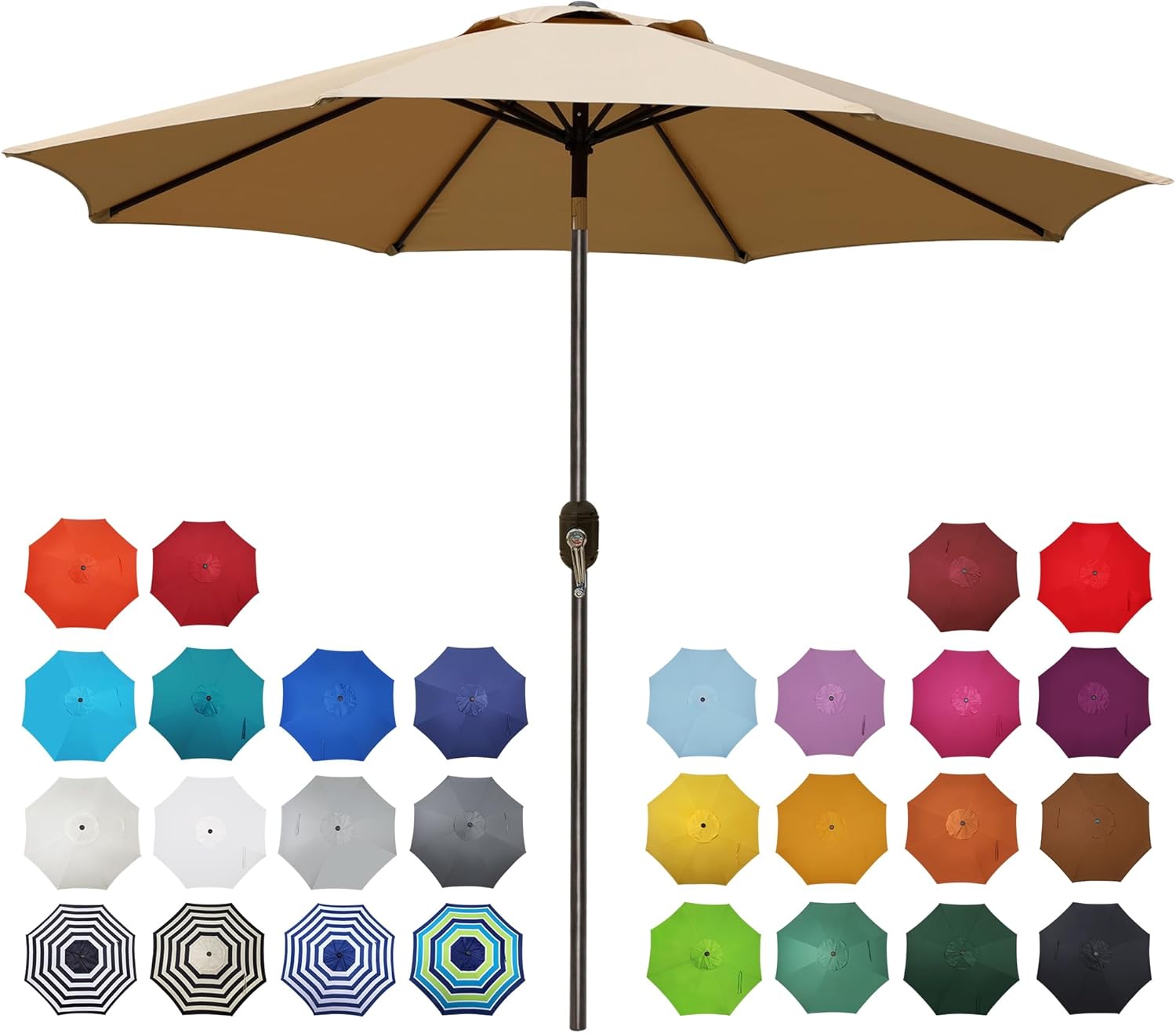
Blissun 9ft Market Patio Umbrella Tan
The classic nine-foot market umbrella: crank lift, push-button tilt and eight ribs at the lowest honest price here.
- Canopy: 9 ft round, 108 in dia.
- Lift: Crank lift

Grand patio 11ft Cantilever Umbrella with Base Champagne
An eleven-foot cantilever with a wheeled fillable base, a 2.4 inch aluminum pole and tilt to ninety degrees.
- Canopy: 11 ft round
- Lift: Crank lift

PURPLE LEAF 9 x 11.5ft Cantilever Umbrella with Base Beige
A rectangular cantilever with the base included, 360-degree rotation and five tilt positions, ready to shade on arrival.
- Canopy: 9 ft x 11.5 ft rectangular
- Lift: Crank system
Questions, answered
What size umbrella do I need for a six-seat table?
Nine to ten feet. A six-seat table is roughly six feet across, and a nine-foot canopy shades the table and the chairs, while a ten-foot canopy shades them comfortably through the afternoon. An eleven-foot canopy suits a larger dining set or a seating area, and a 7.5 foot canopy suits four seats at most.
How do I keep an umbrella from blowing away?
Weight the base properly, close the umbrella in strong wind, and never leave it open unattended in a storm. A heavy base holds the umbrella in a breeze; nothing holds an open umbrella in a storm. Vented and double-top canopies help in a breeze by letting gusts escape, but closing is the only reliable answer in real wind.
Can I leave a patio umbrella out all winter?
No. Close it, clean the canopy, let it dry completely, and store it indoors or under a cover. Winter wind, snow load and freeze-thaw cycles damage the fabric, the ribs and the mechanism, and a single winter outside can end an umbrella that would otherwise last years.
Is Sunbrella worth the premium?
For a sun-drenched patio where the umbrella stays out all season, yes: the ten-year non-fading claim and the fade resistance mean the fabric still looks new when a polyester canopy has faded. For a sheltered patio or a seasonal umbrella that is stored half the year, standard polyester is the better value.
Every guide on Patio Umbrellas15 pages
- Topic hubPatio Umbrellas
- Best ofThe Best Patio Umbrellas (2027)
- A cantilever is bought for one reason: the pole is not in the middle of the seating area. Everything else is a trade for that freedom. The canopy needs a heavy base, a clear swing area and more effort to close, and the price climbs with the size. This ranking weights the base honesty first, because a cantilever without a base is a very expensive sail, then canopy shape, rotation and tilt, because those decide whether the shade follows the sun or the furniture has to.The Best Cantilever Patio Umbrellas (2027)
- A solar umbrella is two products: a daytime shade and a nighttime light, and the second half depends entirely on the first half's weather. Light count matters, but so does the canopy the lights hang from, and the base that holds it. This ranking weights light count and runtime where the listing states them, then canopy size and shape, then the base, because a beautiful solar umbrella without a base is still a sail. Cloudy-week performance is stated plainly, because solar lights are honest about the sky in a way no other feature is.The Best Solar Patio Umbrellas (2027)
- A balcony is a wall, a railing and very little floor, which rules out nearly every umbrella shape. A full round canopy hangs over the edge or the neighbours. A cantilever needs a swing area the balcony does not have. What works is a half-round canopy flat against the wall, or a compact 7.5 foot umbrella on a small table. This ranking weights shape and footprint ahead of size, because the biggest canopy that fits a balcony is the wrong answer if it does not fit at all.The Best Patio Umbrellas for Small Balconies (2027)
- ReviewBlissun 9ft Market Patio Umbrella Review (2027)
- ReviewPURPLE LEAF 11ft Round Cantilever Umbrella Review (2027)
- ReviewPURPLE LEAF 9 x 11.5ft Cantilever Umbrella Review (2027)
- ReviewBest Choice Products 10ft Solar LED Cantilever Review (2027)
- ReviewGrand patio 11ft Cantilever Umbrella with Base Review (2027)
- ReviewGrand patio 11ft Sunbrella Patio Umbrella Review (2027)
- Head to headPURPLE LEAF 11ft vs Grand patio 11ft Cantilever (2027)
- Head to headBlissun 9ft vs Abba Patio 9ft Market Umbrella (2027)
- Fix itPatio Umbrella Won't Open or Close? Fixes (2027)