Buying guide
Roof Racks Buying Guide (2027)
How to buy roof rack crossbars in 2027: roof types, bar length, aero against steel, load limits and locks explained without the marketing.
Start with the roof, not the bar
Every roof rack decision starts with the roof type, because it eliminates most bars in one stroke. Raised rails have a gap underneath that a clamp can wrap around, and they take universal clamp-on bars. Flush rails sit flat on the roof with no gap, fixed points are small covered sockets, and a bare roof has none of these. The last three need a modular system, Thule or Yakima, with the right feet and fit kit. Look at the roof from the side, slide a finger under the rail if there is one, and identify the type before comparing a single bar.
Bar length and spread: measure twice
Two measurements decide the bar. Roof width at the mounting points decides the length: the bar should end near the roof edge, not overhang it by inches. Bar spread, the distance between the front and rear bars, decides what fits: a roof box needs a minimum spread, and most boxes state it in their manual. A 150 cm bar on a narrow roof is a mistake, and a 50-inch bar on a wide roof leaves no room for two carriers. Measure both numbers with a tape before ordering, and check the box or carrier manual for its spread requirement.
Aero or steel: quiet against grip
Aero bars use a teardrop or wing profile that slips through the air quietly, and they suit long highway drives and owners who leave the rack on all year. Steel rectangular bars are louder but grip clamp-on carriers better, because a clamp bites a flat face instead of sliding on a curve. If your carriers are clamp-on and your trips are short, steel is the practical choice. If you drive long distances with an empty rack, aero pays for itself in quiet on every trip.
Load limits: the manual governs, not the bar
A bar rated at 220 lb does not give a car a 220 lb roof. The vehicle's own roof load limit, printed in the owner's manual, governs the whole system, and the bar, the feet, the carriers and the cargo all count against it. Some cars cap the roof at 75 kg or less, which a heavy box can reach on its own. Check the manual first, subtract the weight of the bars and carriers, and treat what remains as the cargo budget. Overloading a roof is a safety problem, not a warranty problem.
Locks, T-tracks and the total system price
Three details separate a good purchase from a frustrating one. Locks stop the bars being lifted off the car and stop accessories being taken from the bars, and they are worth having even on a budget bar. A T-track or T-slot lets accessories slide on without clamps, which saves time and protects the bar's finish. And the total system price, bars plus feet plus fit kit, is the only honest price for modular bars. A premium bar that looks affordable as bars only can cost more than a complete universal system once the feet are added.
Start with our top 3
The three highest-ranked products in our full roof racks ranking. Read the in-depth review where one exists, or jump to the product in the ranked list.
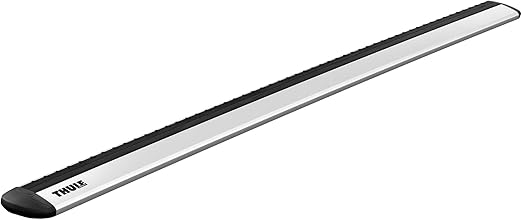
Thule WingBar Evo 150 Load Bars
Thule's quietest aero bar in the long 60-inch length, built for wide roofs and wide loads.
- Model: 711500
- Length: 150 cm (60 in)

Yakima JetStream 60-Inch Crossbars
Yakima's quiet aero bar: JetFlow shaping, JetTruss strength, and a T-slot that swallows accessories.
- Part number: 8000426
- Load capacity: 165 lb, per listing

Yakima HD Bar 68-Inch Crossbars
Yakima's burliest bar: a heavy-duty aluminum crossbar with T-slots top and bottom for rooftop tents and big loads.
- Length: 68 in
- Material: Aluminum, heavy-duty
Questions, answered
Can I fit roof rack crossbars myself?
Yes, in most cases. Universal clamp-on bars fit with ordinary tools in under an hour, and modular bars fit with the foot pack instructions and a torque wrench. The jobs that need care are measuring the roof, spacing the bars correctly and torquing the clamps evenly. If the roof has fixed points hidden under covers, read the manual first so the covers are removed correctly.
Should I remove the bars when I am not using them?
Yes, if you can. Removing the bars cuts wind noise, saves fuel and stops the bars ageing in sun and rain. It also removes the theft risk. The cost is the fitting time on the next trip, which is why many owners leave universal bars on all year and remove only modular bars, whose feet make refitting slower.
Will crossbars fit my roof box and bike carrier?
Almost always, if the bar profile matches. Roof boxes and most carriers clamp to aero, square and round bars, and T-track carriers slide into slotted bars. Check the carrier's fit guide against the bar profile before ordering, and check the bar spread against the box manual. A carrier that fits a square bar may not fit an aero bar without an adapter.
Do I need a roof rack for a cargo bag?
Yes, for most bags. Soft cargo bags strap to crossbars or raised rails, and they need that structure to sit securely. A few bags strap through door frames on a bare roof, but that is a compromise for occasional use. A proper crossbar pair is the honest foundation for any roof cargo, bag or box.
Every guide on Roof Racks17 pages
- Topic hubRoof Racks
- Best ofThe Best Roof Racks (2027)
- Quiet is the test here, not load. An empty roof rack lives on the car for weeks between trips, and a bar that whistles at 70 mph ruins every one of those drives. This ranking therefore weights aero shaping, rubber T-slot strips and owner noise reports ahead of raw load rating, and it treats a bar that is quiet only when loaded as a partial answer.The Best Aerodynamic Roof Racks (2027)
- Budget buyers get punished twice when a cheap bar turns out to be incomplete: once at the till and again when the missing feet arrive as a second order. This ranking therefore weights completeness first, a bar that arrives ready to fit, then fit range, locks and load rating. A budget bar that needs extra parts is not a budget bar.The Best Budget Roof Racks (2027)
- Raised rails are the easiest roof to fit and the easiest to get wrong. The rail has a gap underneath, so a clamp can wrap around it, but rail tube shapes and rail spacing differ between SUVs, and a clamp that fits one rail profile can sit crooked on another. This ranking favours bars with wide fit ranges, shaped feet and locking clamps, and it keeps the modular premium bars in the list for owners who want to move their system between vehicles.The Best Roof Racks for SUVs with Raised Rails (2027)
- ReviewWingBar Evo 150 Review (2027)
- ReviewJetStream 60 Review (2027)
- ReviewHD Bar 68 Review (2027)
- ReviewVortex SX100 Kit Review (2027)
- ReviewWingBar Evo 127 Review (2027)
- ReviewProBar Evo 200 Review (2027)
- Head to headWingBar Evo 150 vs JetStream 60 (2027)
- Head to headHD Bar 68 vs ProBar Evo 200 (2027)
- Fix itRoof Rack Whistling? Wind Noise Fixes (2027)
- Fix itRoof Rack Slipping or Loosening? Fixes (2027)
- Fix itRoof Rack Not Fitting? Wrong Fit Fixes (2027)