Buying guide
Shoe Rack Buying Guide (2027)
How to buy a shoe rack in 2027: capacity maths, hallway measurement, open against closed storage, materials and the boot problem, explained without the marketing.
Count your pairs honestly, then add a third
Count every pair the household actually owns, including boots, sports shoes and the pairs by the back door, then add a third for growth and guests. Listing pair counts are measured with slim shoes, so a rack that claims fifty pairs holds fifty pairs of flats and far fewer boots. The right size is the one that holds the daily rotation plus the out-of-season pairs you refuse to store elsewhere, because a rack that holds exactly your collection is already too small the day a guest arrives with shoes.
Measure the hallway before the rack
Measure the wall width, the depth you can spare without blocking the walk, and the door swing. A rack under 12 inches deep leaves a usable walkway in most halls; a cabinet under 10 inches deep hugs the wall; a tower needs a clear circle if it spins. Height matters too: a rack under 24 inches tall keeps a narrow entry feeling open, while a 63 inch tower needs a full wall and a ceiling that does not crowd it. Tape the footprint on the floor before ordering, because a rack that blocks the door is a return, not a purchase.
Open, covered or closed: pick your mess
Open racks give instant access and show every pair and every speck of dust. Covered racks hide the collection behind fabric that sags and tears over time. Closed cabinets look like furniture and keep dust out, but boots do not fit them and owners forget what is inside the bottom drawer. There is no right answer, only a household answer, and the deciding question is boots: if tall boots are daily wear, open racks and benches are the honest choice, because most closed storage cannot fit them.
Materials: steel, wood, fabric and resin
Steel tube frames with rated shelf loads are the workhorses, and they survive garages and mudrooms. MDF and particleboard cabinets look like furniture but dislike damp and heavy loads. Fabric shelves and covers are light and cheap but sag under heavy shoes and stain with mud. Resin slat shelves drain water and shrug off mud, which makes them the garage and mudroom material. Wire grids are the cheapest option and the one that marks soft soles and swallows thin heels. Match the material to the room, not the photograph.
The boot problem, solved separately
Most racks space tiers about 6.75 inches apart, which fits trainers and flats. Ankle boots need 8 to 10 inches, tall boots need 14 inches or more standing upright. No standard rack tier fits tall boots, so stop fighting the spacing: buy a rack with adjustable or removable shelves, keep boots on the top surface or the floor beside the rack, or add a boot tray by the door. A rack that holds your shoes and a tray that holds your boots is a better system than a rack that pretends to hold both.
Start with our top 3
The three highest-ranked products in our full shoe racks ranking. Read the in-depth review where one exists, or jump to the product in the ranked list.

SONGMICS 10-Tier Shoe Rack with Dustproof Cover URXJ36G
Ten tiers behind a dustproof cover, the highest pair count per square foot in this guide.
- Tiers: 10 tiers
- Capacity: 40-50 pairs (listing)
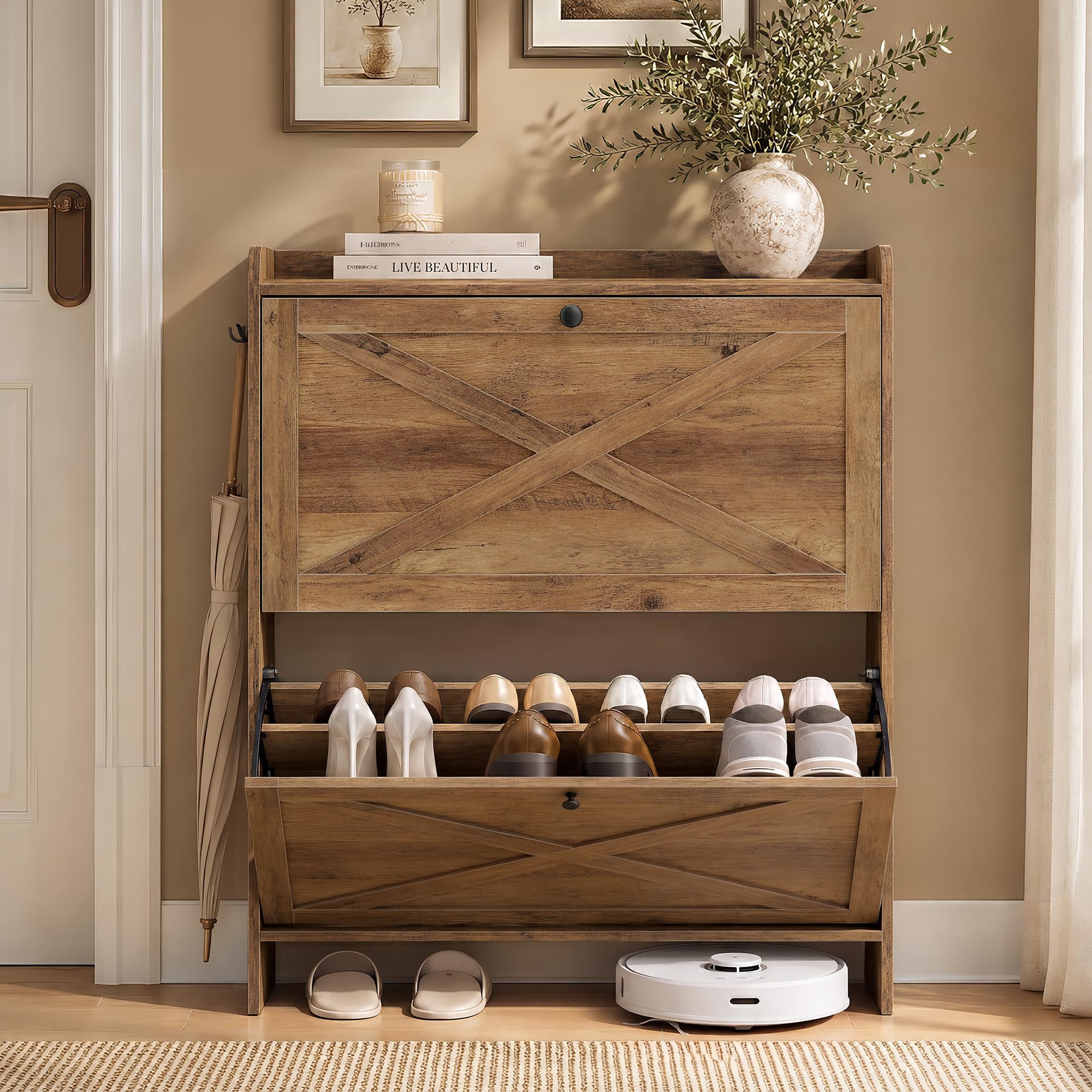
VASAGLE Shoe Storage Cabinet 2 Flip Drawers UHSC203KB01S
A narrow farmhouse cabinet with two flip drawers that hides up to sixteen pairs behind closed doors.
- Drawers: 2 flip drawers
- Capacity: 14 men's / 16 women's pairs
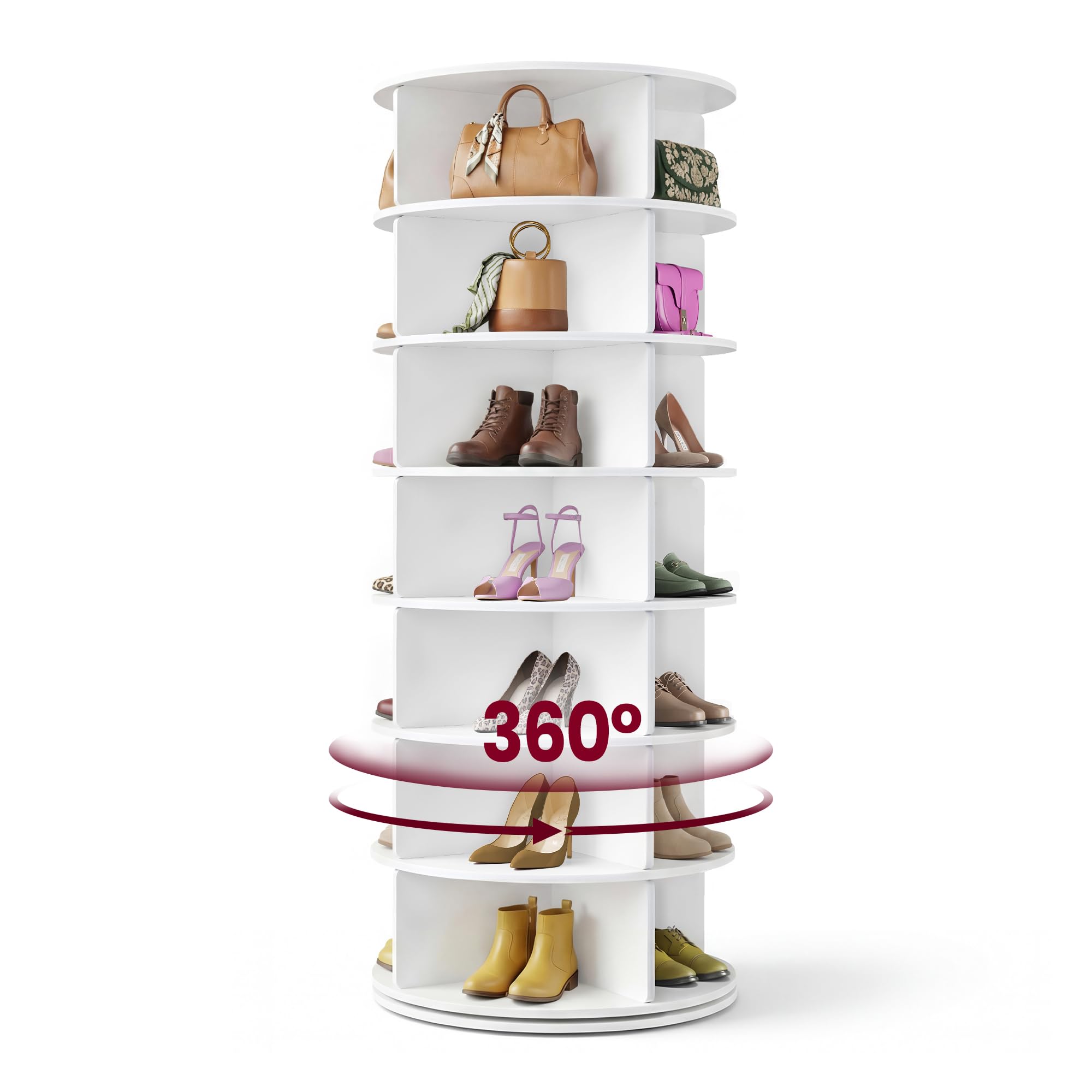
VASAGLE 7-Tier Rotating Shoe Rack Tower ULBS047WZ01
A seven-tier tower that spins 360 degrees, turning a dead corner into twenty-eight pairs of storage.
- Tiers: 7 tiers, 360 degree rotation
- Capacity: 28 pairs (listing table)
Questions, answered
What size shoe rack do I need?
Count your pairs, add a third for growth and guests, and check the result against tier height for your tallest shoes. A couple needs roughly twelve to sixteen pairs of capacity, a family of four needs twenty-five to thirty, and a family of five needs thirty-five to forty. Buy capacity for the collection you will have in a year, not the one you have today.
How deep should a shoe rack be?
Most shoes need 11 to 12 inches of depth lying flat, which is why the common rack depths are 11 to 14 inches. Cabinets that store shoes angled or upright can go as shallow as 9.4 inches. Anything under 9 inches forces shoes sideways and cuts capacity sharply, so treat very slim racks as display for a few pairs, not storage for a household.
Do shoe racks need to be anchored to the wall?
Tall racks over 48 inches should be anchored, especially in homes with children, because a loaded top-heavy rack can tip when a pair is pulled out in a hurry. Low racks and heavy cabinets are stable without anchoring, but a small anti-tip strap costs little and removes the worry entirely.
How do I keep a shoe rack from smelling?
Airflow and dryness. Open racks ventilate better than closed cabinets, and a covered rack traps odour more than either. Keep wet shoes out of closed storage until they are dry, use a boot tray for muddy pairs, and air the rack out regularly. A rack that smells is usually a rack holding wet shoes, not a rack problem.
Every guide on Shoe Racks15 pages
- Topic hubShoe Racks
- Best ofThe Best Shoe Racks (2027)
- Small-space storage is a geometry problem, not a capacity problem. A rack that is 9.4 inches deep fits a wall that a 14.6 inch rack blocks. A tower that spins uses a circle a flat rack cannot. A door organizer uses a surface that is not floor at all. This ranking weights depth, footprint and vertical use ahead of raw pair counts, and it says plainly where each pick cheats: a rack that holds twenty pairs in a closet is not a rack that holds twenty pairs in a hallway.The Best Shoe Racks for Small Spaces (2027)
- An entryway rack is furniture in the first room a guest sees, and it also has to survive the worst daily use in the house. This ranking weights looks and behaviour equally: a bench that nobody sits on is a shelf, a cabinet that hides shoes but blocks the door is a mistake, and an open rack that shows every muddy pair is honest but unwelcoming. Coats, keys and sitting down count here, because the entryway is a routine, not a shelf.The Best Shoe Racks for the Entryway (2027)
- A large family does not have a shoe problem, it has a shoe volume problem, and the maths are brutal: four people at four pairs each is sixteen pairs before boots, school shoes and sports kit. This ranking weights total capacity and per-person organisation ahead of looks, because a beautiful rack that holds half the family is a second rack waiting to be bought. Cubbies and labelled tiers count, because the real failure in a family entry is not capacity but the daily hunt for the missing left shoe.The Best Shoe Racks for Large Families (2027)
- ReviewSONGMICS 10-Tier Shoe Rack with Dustproof Cover Review (2027)
- ReviewVASAGLE Shoe Storage Cabinet 2 Flip Drawers Review (2027)
- ReviewVASAGLE 7-Tier Rotating Shoe Rack Tower Review (2027)
- ReviewAmazon Basics 50-Pair Rolling Shoe Rack Review (2027)
- ReviewHOOBRO Shoe Storage Bench with Cushion Review (2027)
- ReviewTribesigns Shoe Cabinet with Doors Review (2027)
- Head to headSONGMICS URXJ36G vs VASAGLE UHSC203KB01S (2027)
- Head to headHOOBRO WT112HX01 vs Prepac WUSR-0009-1 (2027)
- Fix itShoe Rack Wobbling? Fixes (2027)