In-depth review
Sony TOUGH CFexpress Type A 160GB Review (2027)
In-depth review of the Sony TOUGH CFexpress Type A 160GB: VPG400 sustained writes, 800 MB/s reads, IP57 sealing and Sony hybrid body fit.
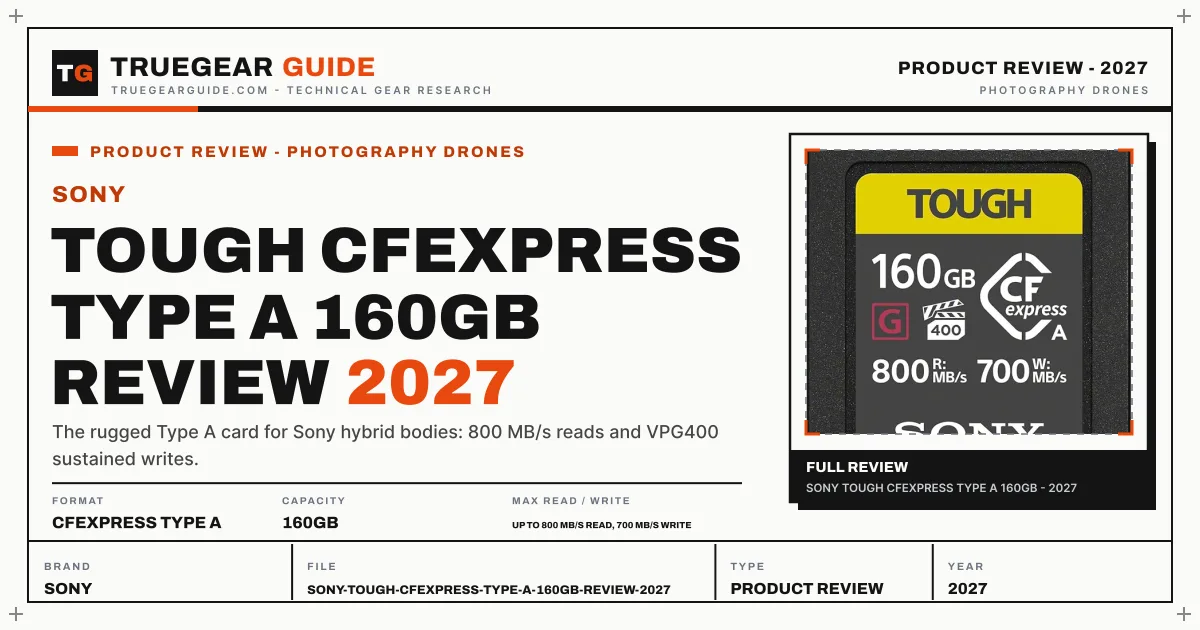

Sony TOUGH CFexpress Type A 160GB
The rugged Type A card for Sony hybrid bodies: 800 MB/s reads and VPG400 sustained writes.
Our verdict
For Sony's Type A bodies there is no substitute category: this is the card the A7S III and FX line were built around, with a VPG400 guarantee that covers their highest bitrate modes and a TOUGH shell that treats pockets and weather as non-events. The 160GB capacity and premium cost per gigabyte are the honest trade-offs.
What we like
- VPG400 certification guarantees sustained writes for high-bitrate cinema modes
- Up to 800 MB/s read and 700 MB/s write per Sony specifications
- TOUGH construction rated beyond the Type A standard for drop and bend resistance
- IP57 dust and water protection with a heat sink design for long recordings
What to watch out for
- Type A capacities top out well below Type B, so long RAW days need a rotation
- Fits only Sony Type A combo slots; no use in Type B bodies
- Peak reads need a Type A reader, an extra purchase for SD upgraders
What owners report: Sony TOUGH CFexpress Type A 160GB
Synthesized from recurring themes in long-term owner feedback.
Most praised
- VPG400 headroom ends write-speed anxiety in the highest bitrate Sony modes
- The rigid shell shrugs off pocket, bag and field abuse that flexes ordinary cards
- Fast offloads through a Type A reader keep small crews moving
Common complaints
- Cost per gigabyte stings when a two-card rotation is the sensible buy
- Capacities feel small next to Type B cards on long cinema days
- The format locks the card to Sony bodies, limiting sharing across a mixed kit
Who it is for
Sony hybrid and cinema shooters recording high-bitrate video or long bursts to Type A slots.
VPG400 is the point
Video Performance Guarantee 400 certifies a minimum sustained write far beyond what Sony's most demanding codecs consume, so dropped frames from media are off the table. Peak writes reach 700 MB/s and reads 800 MB/s per Sony, keeping both recording and offload fast.
TOUGH construction, smaller format
The Type A shell keeps the TOUGH formula: resistance rated at several times the standard for drops and bending, plus IP57 dust and water protection. A heat sink design helps the card hold performance through long recordings in warm bodies.
Capacity planning
At 160GB, high-bitrate 8K and RAW stills days need a rotation rather than a single card, and dual-slot Sony bodies make mirroring or overflow strategies easy. Budget for two cards from the start and the capacity stops being a limitation.
Key specifications
- Format
- CFexpress Type A
- Capacity
- 160GB
- Max read / write
- Up to 800 MB/s read, 700 MB/s write
- Video guarantee
- VPG400
- Durability
- IP57 rated, TOUGH bend and drop resistance
- Model
- CEA-G160T
Sources: Amazon product listing, Sony
Also consider

The bend-proof CFexpress card with 1,900 MB/s reads for flagship bodies.
Why consider it: Choose the Type B TOUGH only if your body takes Type B; the two formats are not interchangeable.
- Format: CFexpress Type B
- Max read / write: Up to 1,900 MB/s read, 1,500 MB/s write class

Lexar Professional CFexpress Type B Gold
High-capacity CFexpress Gold with strong sustained writes for 8K RAW.
Why consider it: Choose the Lexar Gold for multi-terabyte Type B cinema days in Nikon, Canon or Panasonic flagships.
- Format: CFexpress Type B
- Max read: Up to 1,900 MB/s
Research-based assessment. TrueGear has not hands-on tested this product; this evaluation synthesizes manufacturer specifications, retailer documentation, and published expert reviews.
Questions, answered
Which cameras use CFexpress Type A?
Sony's recent hybrid and cinema bodies, including the A7S III, FX3, FX30, A7 IV and A7R V, use combo slots that accept Type A cards or SD media.
Can I use SD cards instead in the same slots?
Yes, the combo slots accept UHS-II SD, but high-bitrate video modes and burst clearing step down to SD ceilings. Type A is what unlocks the bodies' top recording modes.
Is 160GB enough for a shoot day?
For stills and moderate 4K, comfortably. For 8K or high-frame-rate days, plan a second card and mid-day offloads; the format's capacities top out below Type B.
Every guide on Memory Cards17 pages
- Topic hubMemory Cards
- Best ofThe Best Memory Cards (2027)
- For 8K videoThe Best Memory Cards for 8K Video (2027)
- For drones and action camerasThe Best Memory Cards for Drones (2027)
- For wedding photographersThe Best Memory Cards for Wedding Photography (2027)
- ReviewProGrade Digital SDXC V90 Review (2027)
- ReviewSony TOUGH CFexpress Type B Review (2027)
- ReviewSamsung PRO Plus microSD Review (2027)
- ReviewSanDisk Extreme PRO microSDXC 128GB Review (2027)
- ReviewSamsung EVO Plus microSDXC 128GB (2024) Review (2027)
- ReviewKingston Canvas React Plus SDXC UHS-II 128GB Review (2027)
- ReviewSamsung EVO Select microSDXC 128GB Review (2027)
- Head to headProGrade V90 vs Angelbird AV PRO SD MK2 V90 (2027)
- Head to headSanDisk Extreme Pro UHS-I vs Lexar 2000x UHS-II (2027)
- Buying guideMemory Cards Buying Guide (2027)
- Fix itMemory Card Errors, Slowness or Corruption? Fixes (2027)