In-depth review
Stealth Cam Deceptor Max 2.0 Review (2027)
The Stealth Cam Deceptor Max 2.0 pairs a 16 AA battery bay with live streaming. Our research verdict on the remote-site workhorse.
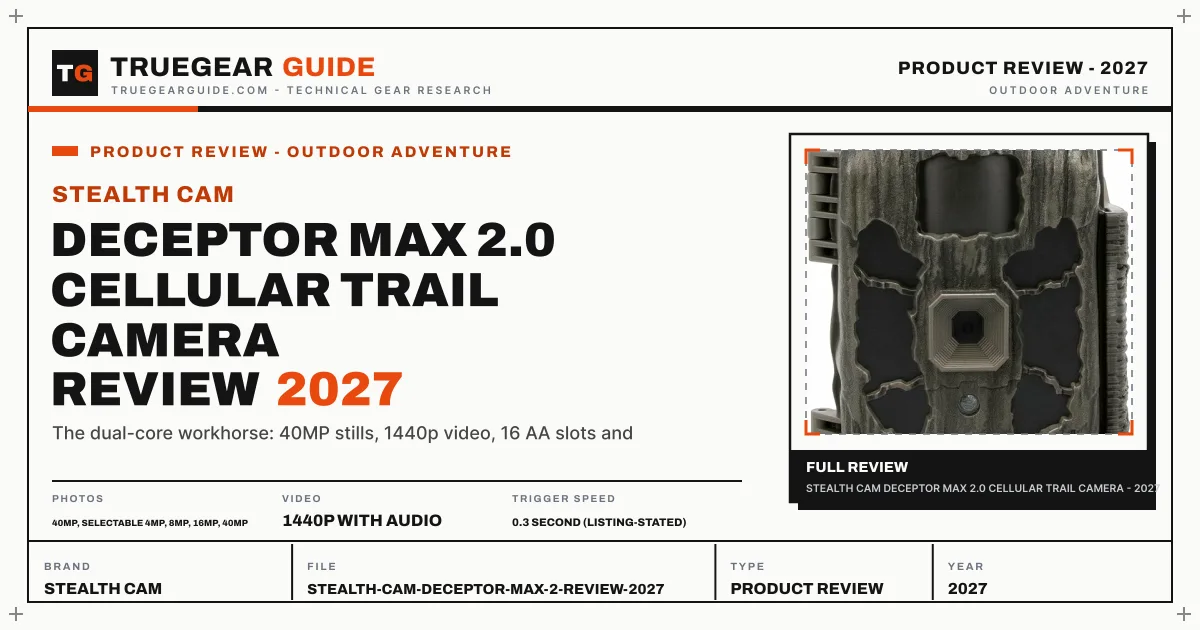

Stealth Cam Deceptor Max 2.0 Cellular Trail Camera
The dual-core workhorse: 40MP stills, 1440p video, 16 AA slots and on-demand live streaming from the tree.
Our verdict
The Deceptor Max 2.0 is built for the camera you visit least. Sixteen AA slots stretch the interval between trips, dual-core processing keeps capture and upload from tripping over each other, and on-demand live streaming lets an owner look in without waiting for motion. The cost is weight, battery spend and a settings menu that rewards a careful first read. Owners who check cameras weekly will not feel its strengths; owners who check twice a season will feel nothing else. For far ground, it is the most practical camera in this guide.
What we like
- Dual-core processing captures and uploads at the same time, so the camera is less likely to miss the next animal
- 40MP photos and 1440p video with audio, with bursts of up to 9 photos per trigger
- Room for 16 AA batteries stretches the interval between visits on far-flung cameras
- On-demand live streaming lets owners look in on a site without waiting for the next motion trigger
What to watch out for
- Sixteen batteries per camera add weight and a real restocking cost across a fleet
- Live streaming leans on signal strength, so it shines near coverage and struggles far from it
- The feature set takes longer to learn than a basic cellular camera's
What owners report: Stealth Cam Deceptor Max 2.0 Cellular Trail Camera
Synthesized from recurring themes in long-term owner feedback.
Most praised
- Owners running far cameras say the big battery bay is what lets them leave a unit alone for months
- The live check-in feature gets mentioned by property owners who want eyes on a gate without driving out
- Burst mode earns praise for turning a fast crossing into a sequence rather than a single half-animal frame
Common complaints
- Some owners grumble about buying 16 batteries per camera when restocking several units at once
- A few report the app settings taking a couple of sessions to feel natural
- Owners in fringe coverage say live streaming stutters where still uploads still get through
Who it is for
Owners of far stands, remote cabins and rarely visited posts who want long intervals between trips and live check-ins.
Sixteen batteries is a strategy, not a spec
Most cameras run on 8 or 12 AAs, and the Deceptor's 16 looks like overkill until the camera sits a mile from the truck through winter. The extra capacity is what turns a monthly battery run into a seasonal one, and for a far camera the saved trips are worth more than the battery bill. The trade is honest: every restock costs more and weighs more, so this camera suits a small number of far posts rather than a big fleet near home.
Dual-core processing in plain terms
A single-core camera captures, then uploads, then arms again, and the gap between those steps can swallow the next animal. Dual-core processing lets the Deceptor capture and upload at the same time, so the camera re-arms faster and misses less. On a busy trail the difference shows up as sequences instead of single frames; on a quiet post it shows up as nothing at all, which is fine, because quiet posts do not need it.
Live streaming and its limits
On-demand live streaming is the feature that changes how a remote camera feels, turning a diary into a window. But it is also the feature most dependent on signal: on strong coverage it is smooth, on fringe coverage it stutters while still photos still arrive. Buy this camera for its battery bay and capture first, and treat live streaming as a bonus that shines where signal allows.
Key specifications
- Photos
- 40MP, selectable 4MP, 8MP, 16MP, 40MP
- Video
- 1440p with audio
- Trigger speed
- 0.3 second (listing-stated)
- Detection and flash range
- 100 ft
- Flash
- 36-piece 940nm no-glow LED array
- Power
- 16 AA batteries
- Storage
- 16GB internal memory
- Model
- STC-DCPTRX2
Also consider

SPYPOINT Flex-S-Dark Solar Cellular Trail Camera
The camera that feeds itself: a built-in solar panel and internal battery for sites visited once a season.
Why consider it: The solar alternative, for sunny posts where a panel beats a battery bay
- Photos: 40MP
- Video: 1080p with sound

Tactacam Reveal Pro 3.0 Cellular Trail Camera
The no-glow flagship with a screen on the camera: 4K stills, on-demand video and GPS, tuned for pressured ground.
Why consider it: The no-glow flagship with a screen, for pressured ground where invisibility matters most
- Photos: 4K definition, 2.5K selectable (maker-stated)
- Video: 1080p, 10, 15 or 30 second clips
Research-based assessment. TrueGear has not hands-on tested this product; this evaluation synthesizes manufacturer specifications, retailer documentation, and published expert reviews.
Questions, answered
Is 16 batteries really better than 8?
For far cameras, yes: the interval between visits roughly doubles, and a missed visit costs less. For near cameras checked weekly, it is unnecessary weight and spend. Match the battery bay to the visiting pattern, not to the biggest number.
Does live streaming use much battery?
Yes, more than still-only operation, because the camera powers its radio and sensor continuously during a stream instead of waking briefly per trigger. Use live check-ins sparingly on far cameras, and save long streams for posts with strong signal and fresh batteries.
What is burst mode good for?
Burst mode takes up to 9 photos per trigger, which turns a fast crossing into a sequence: entry, centre, exit. That sequence identifies animals, shows direction and catches the frame where the animal is fully in view, where a single shot might catch only a tail.
Every guide on Trail Cameras17 pages
- Topic hubTrail Cameras
- Best ofThe Best Trail Cameras (2027)
- Deer hunting changes the ranking. Flash invisibility matters more than on a security post, because a spooked buck may not return. Trigger speed matters more than on a feeder, because a crossing deer gives half a second. And battery life matters more than on a backyard camera, because the best stands are the farthest walk. This ranking therefore leads with no-glow cameras, weighs trigger speed heavily, and treats a camera's app as a scouting tool, not a gadget.The Best Cellular Trail Cameras for Deer Hunting (2027)
- Security flips the hunting ranking. A still photo hours later is less useful than a live look right now, so livestreaming jumps to the top. GPS tracking matters because a security camera is a theft target itself. Solar power matters because a gate camera may sit for a season. And night flash invisibility matters because a visible flash tells an intruder exactly where the camera hangs.The Best Trail Cameras for Property Security (2027)
- Budget trail cameras force an honest trade, and this ranking names it for each pick. The cheapest cellular cameras give up video resolution, screens or live view, but they keep the core job: a motion-triggered photo sent to your phone. The no-plan camera gives up remote viewing entirely, but it also gives up the monthly bill forever. Buy the trade you can live with, not the cheapest box.The Best Budget Trail Cameras (2027)
- ReviewTactacam Reveal Pro 3.0 Review (2027)
- ReviewMoultrie Edge 3 Review (2027)
- ReviewTactacam Reveal Ultra Review (2027)
- ReviewSPYPOINT Flex-S-Dark Review (2027)
- ReviewMoultrie Edge 2 Pro Review (2027)
- Head to headTactacam Reveal Pro 3.0 vs Stealth Cam Deceptor Max 2.0 (2027)
- Head to headMoultrie Edge 3 vs Tactacam Reveal X 3.0 (2027)
- Buying guideTrail Camera Buying Guide (2027)
- Fix itTrail Camera Not Sending Photos? Fixes (2027)
- Fix itTrail Camera False Triggers and Empty Photos? Fixes (2027)
- Fix itTrail Camera Battery Draining Fast? Fixes (2027)