Buying guide
Travel Backpack Buying Guide (2027)
How to buy a travel backpack in 2027: capacity, carry-on rules, opening styles, harness quality, laptop fit and packing systems explained without the marketing.
Start with trip length, not litres
A weekend needs 20 to 27 litres, a long weekend to a week needs 27 to 35 litres with careful packing, and a full week without checked luggage needs 35 to 46 litres. Count your longest regular trip, not your dream trip: a bag bought for a month-long adventure will be half empty on every weekend away, and a bag bought for weekends will force a second bag on every week away. The packs in this guide span 20 to 46 litres precisely so the trip length can choose the bag.
Carry-on rules are a packed-size test
Airlines measure the packed bag, not the empty spec, and strict carriers enforce smaller limits than major ones. A 40 litre bag packed sensibly fits most bins; the same bag overpacked past its stated size gets gate-checked. Use compression straps, keep the shape tidy, and check your specific carrier's limits before a strict flight. Travellers who fly budget carriers often should favour 35 litres over 46, even if the bigger bag tempts.
Opening style: clamshell, panel or top
Clamshell bags open flat like a suitcase and suit travellers who pack once and live out of the bag. Panel loaders open from one side and suit travellers who unpack and repack daily. Top loaders suit minimalists with one compartment and no patience for zips. The Peak Design, Cotopaxi and YETI are clamshell; the Osprey pair are panel loaders with a full back opening. Match the opening to your packing habit and the bag will feel obvious from the first trip.
Harness quality decides long walks
A framed harness with a hipbelt moves weight to the hips, which is why the Osprey pair lead this guide on comfort. Unframed bags rely on shoulder straps and tire faster under a full load, though they weigh less empty and pack flatter for storage. If your trips involve stations, old towns and long walks, pay for the harness. If your trips are airport to taxi to hotel, a simpler harness is enough and the saved weight is welcome.
Laptop fit, packing systems and the extras
Check laptop fit first: sleeves here stop at 15, 16 or 17 inches, and an inch short cannot be fixed. Then decide on a packing system: cubes divide big compartments like the Osprey pair's, while clamshell bags need them less. The LOVEVOOK includes cubes; other bags expect a separate purchase. Finally, weigh the extras that earn their keep: a luggage pass-through strap for roller cases, a water bottle pocket for station days, and a rain cover for wet climates, since several packs here omit one.
Start with our top 3
The three highest-ranked products in our full travel backpacks ranking. Read the in-depth review where one exists, or jump to the product in the ranked list.

Osprey Farpoint 40 Travel Backpack, Black (40L)
The default one-bag answer: a hiking-derived harness, a stowaway suspension and a 40 litre body sized for most carry-on rules.
- Capacity: 40 litres
- Weight: 3.47 lb, per Amazon fields

Peak Design Travel Backpack 45L, Expandable 35-45L, Sage
The expandable creator's carry-on: 35 litres at standard size, 45 expanded, with rear access and room for camera cubes.
- Capacity: Standard 35L, compressed 30L, expanded 45L, per maker specs
- Weight: 2.05 kg (4.5 lb), per maker specs
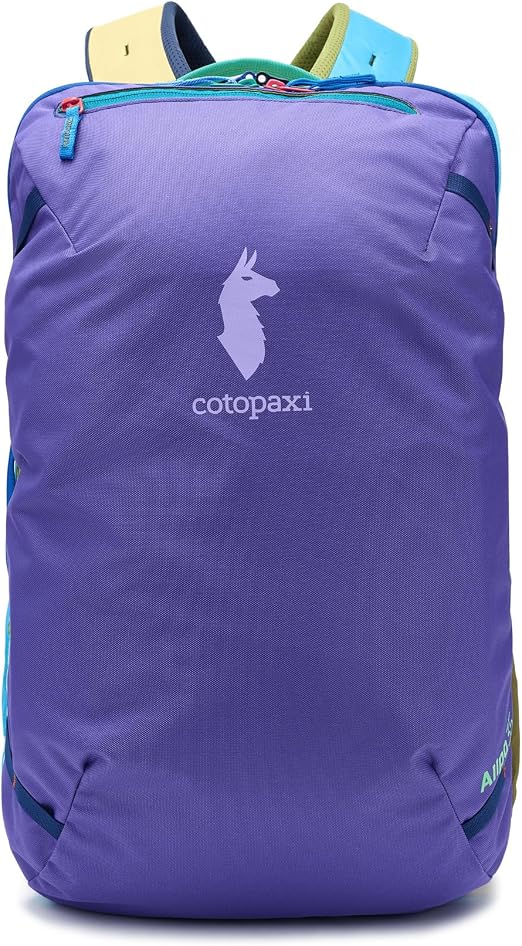
Cotopaxi Allpa 35L Travel Pack, Del Dia
The cheerful week-long pack: 35 litres of recycled fabric, a suitcase opening and a colourway no one else will own.
- Capacity: 35 litres (2135 cu in), per maker specs
- Weight: 2 lb 15 oz (1.33 kg), per maker specs
Questions, answered
How many litres do I need for a week in a travel backpack?
Thirty-five to 40 litres with careful packing, or 46 litres if you pack heavy or travel in cold weather. The Cotopaxi Allpa 35L and the Osprey Farpoint 40 cover most week-long trips; the Sojourn Porter 46L covers the rest. Beyond that, a checked bag is the honest answer.
Should I buy an expandable travel backpack?
Buy expandable if your return load reliably exceeds your outbound load, through souvenirs, gifts or extra layers. The Peak Design, Nomatic, Amazon Basics and LOVEVOOK packs all expand, and owners praise the feature most on trips home. If your load never changes, expansion adds weight and zips you will never use.
What is the difference between a travel backpack and a hiking backpack?
Travel backpacks open like luggage, protect laptops and fit overhead bins; hiking backpacks carry heavier loads further with better suspension but pack from the top and ignore laptops. The Osprey Farpoint and Fairview borrow hiking suspension while keeping travel openings, which is why they lead this guide: they are travel bags with hiking carry, not hiking bags with a laptop sleeve.
Do travel backpacks need a rain cover?
Water-resistant shells handle drizzle, not downpours, and several packs here omit a rain cover. If you travel in wet climates or walk long distances in rain, add a cover or a dry bag for electronics. The cost is small and the protection covers the most expensive thing in the bag.
Every guide on Travel Backpacks15 pages
- Topic hubTravel Backpacks
- Best ofThe Best Travel Backpacks (2027)
- Budget travel backpacks are judged here on capacity per dollar first and refinement second. A budget bag that cannot hold a trip is not a bargain at any price, so every pick states its litres plainly, and the ranking is honest about where cheaper materials and simpler harnesses show their limits on heavy, frequent use.The Best Budget Travel Backpacks (2027)
- This ranking starts from fit, not from shrinking a men's bag and changing the colour. A women's-specific harness, a manageable empty weight and a shape that sits well on a shorter torso matter more than a litre count, which is why the Fairview leads and why every pick here states its weight and fit plainly.The Best Travel Backpacks for Women (2027)
- Carry-on ranking is a discipline test, not a capacity contest. Every pack here is sized to fly without checked luggage, and the ranking rewards bags that stay within limits when packed, not bags that only meet the spec sheet when empty. Gate-check risk is treated as a real cost, not a footnote.The Best Carry-On Travel Backpacks (2027)
- ReviewOsprey Farpoint 40 Travel Backpack Review (2027)
- ReviewPeak Design Travel Backpack 45L Review (2027)
- ReviewCotopaxi Allpa 35L Travel Pack Review (2027)
- ReviewOsprey Fairview 40 Women's Travel Backpack Review (2027)
- ReviewOsprey Sojourn Porter 46L Travel Backpack Review (2027)
- ReviewNomatic Travel Pack 20L Review (2027)
- Head to headOsprey Farpoint 40 vs Fairview 40 (2027)
- Head to headPeak Design Travel Backpack 45L vs Cotopaxi Allpa 35L (2027)
- Fix itTravel Backpack Digging Into Your Shoulders? Fixes (2027)