Buying guide
Walkie Talkie Buying Guide (2027)
How to buy a walkie talkie in 2027: range reality, FRS versus GMRS licences, channels and privacy codes, battery options and water ratings explained.
Range: read the conditions, not the number
Every radio here claims 20 to 38 miles, and every one of those figures was measured in ideal conditions. Motorola splits its T600 figure honestly: 35 miles mountain to valley, 6 miles over open water, 2 miles in a neighbourhood. That split is the template for reading all of them. On a wooded trail, in hills or in a town, plan for a mile or two, and treat anything beyond that as a bonus from open terrain. If range is your top need, buy GMRS with repeater access for large sites, raise your antenna position by standing high, and keep the group together, because no handheld repeals terrain.
FRS versus GMRS: licence first, channels second
FRS is licence-free in the US, limited to 2 watts, and shares 22 channels with GMRS. GMRS adds higher power on some channels and repeater channels, but it requires an FCC GMRS licence that covers a household and has no test. The licence is not hard to get, but it is a step, and a group that will not take it should buy FRS. A GMRS radio bought without a licence plan is a radio that cannot legally be used as intended, whatever its channel count promises.
Channels, privacy codes and presets
Channels are frequencies, and privacy codes are sub-tones that filter out strangers on the same channel. Two radios must share both to talk, and a code does not encrypt a conversation. More channels help on busy land, where 50 GMRS channels beat 22 FRS channels, and preset combinations, like the Cobra RX680 with 60 presets, trade flexibility for speed: fewer menus, faster setup, less to teach. For a first pair, presets and simple controls beat a long channel list that nobody in the group will learn.
Battery: rechargeable, AA fallback, or both
Rechargeable packs are cheapest over time and simplest for daily use, especially with dock or USB-C charging. An AA fallback matters on multi-day trips, where a charger may not exist, which is why dual power appears on most top picks. Battery life figures are maker-stated and assume moderate use: heavy transmitting, cold weather and high volume all shorten them. For a long trip, start full, carry spares, turn radios off when together, and agree check-in times instead of leaving radios on all day.
Water ratings: rain, splash, dunk and float are different claims
IPX4 handles rain. IP54 handles splashes and dust. IP67 handles a dunk in up to a metre of water for up to 30 minutes. Floating handles a drop overboard, which is a different problem from a dunk. Listings blur these words, so read the rating, not the adjective: a radio called waterproof in a headline may be IP54 splashproof in its specification, as the Cobra RX680 shows, while a radio called weatherproof may be IPX4. Match the rating to the water you meet, and bag any radio whose rating you do not trust.
Fit, controls and the group that will use it
A radio is worn, carried and operated, often with gloves, in cold, wet or noisy conditions. Large buttons and displays suit gloved hands and older users. A carabiner clip suits climbers. A shoulder mic suits crews. A pocket radio suits shop staff who refused a bulky unit. Before buying a set, picture the smallest, coldest and busiest hands that will use it, and buy for those hands, not for the product photo. A radio that is hard to operate is a radio that stays in a pocket when it is needed.
Start with our top 3
The three highest-ranked products in our full walkie talkies ranking. Read the in-depth review where one exists, or jump to the product in the ranked list.

Motorola Talkabout T600 H2O Waterproof Radio Pair
The water-ready Talkabout: a floating, waterproof pair with a whistle belt clip for lakes, rivers and wet weather.
- Service: FRS, licence-free
- Channels: 22 channels, 121 privacy codes
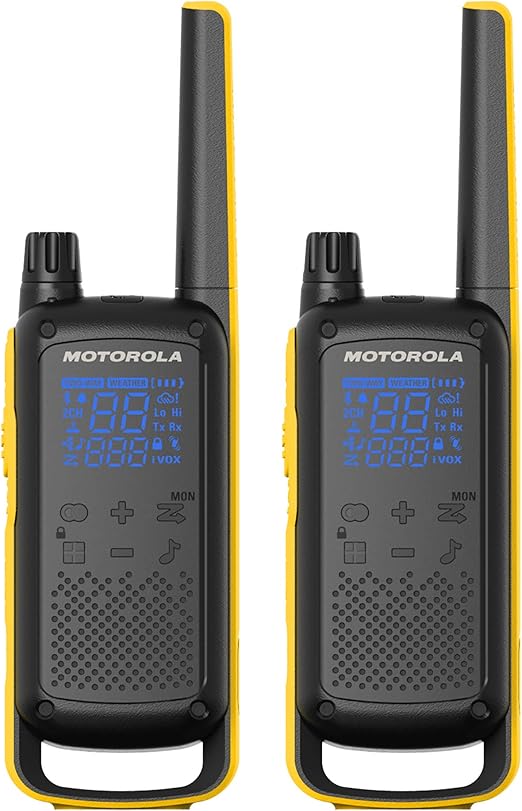
Motorola Talkabout T470 Weatherproof Radio Pair
The rugged travel Talkabout: weatherproof, flashlight-equipped and built for rough treks and high peaks.
- Service: FRS, licence-free
- Channels: 22 channels, 121 privacy codes

Motorola Talkabout T802 Bluetooth Radio Pair
The connected Talkabout: Bluetooth pairing turns the pair into an off-grid text and location messenger.
- Service: FRS, licence-free
- Channels: 22 channels
Questions, answered
How many radios do I need for a group?
One per person who needs to talk or listen, plus one spare for a group leader if the trip is long or remote. A pair covers two people, a trio like the Midland T51 covers three, and a four-pack like the Retevis RT22 or RT86S covers a small team in one purchase. Buying a spare pair is cheaper than cutting a trip short for a lost or flat radio.
Do walkie talkies work with phones?
Most do not, by design: they are radio-to-radio devices with no phone connection. The exception here is the Motorola T802, which pairs by Bluetooth to a phone app for off-grid texting and location sharing, while voice stays radio-only. For emergency contact with the outside world, carry a phone with coverage or a satellite messenger alongside, not instead of, a radio.
What should I check before a trip?
Charge every radio, test every radio on the agreed channel and code, check that privacy codes match, and confirm that headsets, clips and spare batteries are packed. Walk to the far end of a garden or a car park and test range in something like real conditions, not just across a room. A five-minute test at home prevents a failed conversation on the trail.
Are cheap walkie talkies worth buying?
For close-quarters use, yes: the Retevis RT22 four-pack and the Motorola T210 pair cover shops, campsites and families well at a budget tier. For mountains, water or work sites, cheap radios cost more in the end, through short range, dead batteries and broken clips. Spend for durability and battery life where the trip depends on it, and save where the use is a building, a garden or a campsite.
Every guide on Walkie Talkies16 pages
- Topic hubWalkie Talkies
- Best ofThe Best Walkie Talkies (2027)
- Long range is the most inflated claim in this category, so this ranking reads the figures the way makers actually measured them. Mountain-to-valley and open-water numbers top the list, neighbourhood numbers sit at the bottom, and GMRS radios earn their place through higher power and repeater channels, not through a bigger box number. Radios that only claim range without a licence or repeater story to back it are ranked below radios that explain how the range is achieved.The Best Long Range Walkie Talkies (2027)
- Hiking ranks radios on weight, weather handling, battery endurance and glove-friendly controls, not on headline range alone. A radio that dies, drowns or cannot be operated with cold hands fails on a trail whatever its box figure says. This ranking therefore puts waterproofing, battery life and simple operation ahead of channel counts, and it treats app features as a bonus, not a requirement, since a phone battery is another thing to protect on a long walk.The Best Walkie Talkies for Hiking (2027)
- GMRS is bought for a reason, not for a number: more channels, higher power on some channels, and repeater access for large properties and busy land. This guide therefore ranks GMRS radios on channel count, repeater capability and crew features, and it puts the licence front and centre, because a GMRS radio bought by someone who will not get a licence is a purchase that cannot legally be used as intended. FRS radios appear only as the contrast: what you give up, and what you save, by staying licence-free.The Best GMRS Walkie Talkies (2027)
- ReviewMotorola T600 H2O Review (2027)
- ReviewMotorola T802 Review (2027)
- ReviewMidland GXT1000VP4 Review (2027)
- ReviewDEWALT DXFRS800 Review (2027)
- ReviewRocky Talkie Mountain Radio Review (2027)
- ReviewRetevis RT22 Review (2027)
- Head to headMotorola T600 H2O vs Midland GXT1000VP4 (2027)
- Head to headMotorola T802 vs Rocky Talkie Mountain Radio (2027)
- Fix itWalkie Talkie No Sound? Fixes (2027)
- Fix itWalkie Talkie Short Range? Fixes (2027)