Buying guide
Wheelbarrow Buying Guide (2027)
How to choose a wheelbarrow in 2027: capacity, wheels, tires, tray material and dumping, explained so the cart you buy matches your ground and your loads.
Capacity: buy for your bulkiest load
Capacity is measured in cubic feet, and it decides how many trips a job takes. Five to six cubic feet suits most home gardens. Four suits small gardens and patios. Six to seven suits large properties and landscaping. But capacity without load rating is a trap: a big tub of wet soil can exceed the frame, so read cubic feet and pounds together, and buy the tub for your bulkiest load and the rating for your densest one.
Wheels: one, two or four
One wheel is nimble and tips easily. Two wheels are stable, need room, and suit beginners and uneven ground. Four wheels barely tip at all and dump with a lever, but need the most room to turn and store. Match the wheel count to your ground and your balance: narrow paths and job sites suit one wheel and a steady hand, while lawns, slopes and older gardeners suit two or four.
Tires: pneumatic or no-flat
Pneumatic tires ride soft and absorb ruts, but they go flat and need air. No-flat tires never puncture but ride firmer. The choice is a maintenance decision, not a comfort one: a cart that is always flat is a cart that is never used, so owners on thorny, rough ground should weigh flat-free designs seriously. All-terrain tread helps on gravel and ruts, whatever the tire type.
Tray material: poly or steel
Poly trays never rust, weigh less, and suit soil, mulch, plants and compost. Steel trays dent less and suit bricks, concrete and sharp stone, but they rust if scratched and weigh more. For garden work, poly is the honest choice. For construction work, steel earns its weight. A poly tray that flexes under a dense load is a sign the load, not the tray, is wrong.
Dumping and stands: the features you feel
A dump lever on a four-wheel cart and a built-in stand on a two-wheel cart are the two features owners mention most, because both remove effort from every single load. A cart that dumps with a lever saves your back; a cart that stands on its own lets you shovel with both hands. When two carts look equal on capacity and price, choose the one with the better dumping or stand.
When to buy a tow-behind instead
If your property is large enough that a mower already works it, a tow-behind trailer like the Garden Star moves more per trip than any hand barrow, with no pushing at all. It needs a mower or ATV with a hitch and open ground to turn, so it suits acreage, not gardens. For most homes a hand barrow is right; for acreage, a tow trailer is the honest answer.
Start with our top 3
The three highest-ranked products in our full wheelbarrows ranking. Read the in-depth review where one exists, or jump to the product in the ranked list.
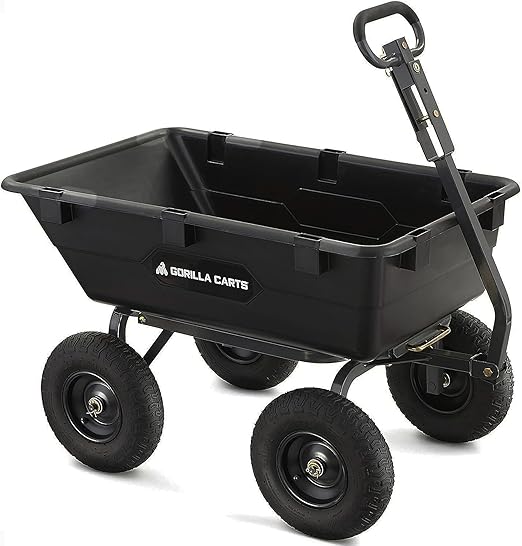
Gorilla Carts Gorilla Carts GOR6PS Poly Dump Cart 6 Cu Ft
The 6 cubic foot poly dump cart with a 1,200 pound haul and a quick-release dump, the barrow that made four wheels normal.
- Capacity: 6 cubic feet
- Haul capacity: 1,200 pounds

WORX WORX WG050 Aerocart 8-in-1 Yard Cart
Eight tools in one: a wheelbarrow, a dolly, a yard cart and a bag holder, for small spaces and many jobs.
- Load capacity: 300 pounds
- Volume: 3 cubic feet

Gorilla Carts Gorilla Carts 7GCG-NF Poly Dump Cart 7 Cu Ft
Seven cubic feet with no-flat tires and a 1,200 pound haul, the biggest Gorilla cart that never needs a pump.
- Capacity: 7 cubic feet
- Haul capacity: 1,200 pounds
Questions, answered
What size wheelbarrow should I buy?
Five to six cubic feet for most home gardens, four for small gardens and patios, six to seven for large properties and landscaping. Then check the load rating against your densest material: wet soil and gravel are heavy, and a big tub of them can exceed a light frame.
Are wheelbarrows with two wheels worth it?
For most gardeners, yes: two wheels stop the sideways tipping that ruins a loaded single-wheel barrow, and they need far less balance from the user. The trade is width and turning room. If your paths are narrow, a single wheel still wins; if your ground is uneven, two wheels win.
How do I maintain a wheelbarrow?
Pump pneumatic tires before use and check for thorns after each job. Wash the tray after muddy or compost loads, and store the barrow under cover or upside down so water does not pool. Oil the axle and the dump mechanism once a season, and tighten bolts after the first few uses, since new carts settle.
Can I use a wheelbarrow for concrete?
Yes, in a heavy-duty cart rated for it, but keep the load within the rating and move it promptly, because wet concrete is dense and sets fast. A 6 cubic foot tub of wet concrete can exceed 1,000 pounds, so load less than full and push on flat ground. For large pours, a tow-behind trailer or a mixer is safer.
Every guide on Wheelbarrows16 pages
- Topic hubWheelbarrows
- Best ofThe Best Wheelbarrows (2027)
- Gardening changes the ranking: loads are light and bulky, paths are narrow, and the user is often alone. This guide therefore leads with light weight, stability and easy dumping, and treats maximum haul as secondary, because a garden rarely needs 1,200 pounds but always needs a barrow that turns in a tight bed.The Best Wheelbarrows for Gardening (2027)
- Two wheels change everything about a barrow: it stands on its own, it resists tipping, and it asks far less balance from the user. This ranking therefore leads with stability and tire size, then capacity, and it is honest about the trade, which is turning room and width against balance.The Best Dual-Wheel Wheelbarrows (2027)
- Heavy duty means the load, not the marketing: dense soil, wet gravel, stone and firewood. This ranking therefore leads with load rating and tire size, then tub volume, and it treats light garden comfort as irrelevant, because a heavy-duty cart that cannot carry the load is not heavy duty at all.The Best Heavy-Duty Wheelbarrows (2027)
- ReviewGorilla Carts GOR6PS Review (2027)
- ReviewWORX WG050 Aerocart Review (2027)
- ReviewGorilla Carts 7GCG-NF Review (2027)
- ReviewMarathon Yard Rover Review (2027)
- ReviewBest Choice Products Dual-Wheel Wheelbarrow Review (2027)
- ReviewBILT HARD 900 Lb Poly Garden Dump Cart Review (2027)
- Head to headGorilla Carts GOR6PS vs WORX Aerocart (2027)
- Head to headMarathon Yard Rover vs Best Choice Dual-Wheel (2027)
- Fix itWheelbarrow Tire Flat: Fixes (2027)
- Fix itWheelbarrow Hard to Push: Fixes (2027)