Buying guide
Alarm Clock Buying Guide (2027)
How to buy an alarm clock in 2027: decibel honesty, wake-up channels, power backup, display brightness and snooze behaviour, with the mistakes to avoid.
Read decibels as maker ratings, not lab results
Every loud clock in this guide carries a maker rating, and makers measure differently: different distances, different rooms, different tones. A high-pitched beep carries further than a low tone at the same measured figure, and a rating taken an inch from the speaker is not the same as one taken across a bedroom. Treat 113 and 115 dB as a class marker, not a ranking: both figures mean very loud, and the difference between them is not audible in a real room. Judge a clock by its wake-up channel and its alarm behaviour, not by a single decibel number.
Pick the wake-up channel that matches the sleeper
Sound wakes light and normal sleepers. Vibration wakes sleepers who do not hear sound, including deaf and hard-of-hearing users, and it wakes a heavy sleeper without waking the whole house. Light helps sleepers who respond to brightness, and the sunrise clocks in our sleep category cover that channel. Movement wakes the snooze-hitter who silences every beep in their sleep. The clocks that fail are usually the ones with one channel aimed at the wrong problem, so start from the sleeper, not from the specification sheet.
Check what happens in a power cut
Most plug-in digital clocks keep only the time on battery backup. The display goes dark and the alarm stays silent until mains power returns, which means a power cut at 3 a.m. is a missed alarm. The DreamSky DS2208 is the exception in this guide: its backup keeps the alarm sounding, though the display still goes dark. Battery-powered clocks like CLOCKY and the twin-bell Peakeep have no such gap, because the battery is the power source. If your power is unreliable, check the backup behaviour before you buy, or keep a phone alarm as a second line.
Display brightness decides whether you sleep
A clock that lights the bedroom is a clock that costs sleep every night, and the display matters as much as the alarm. Look for a dimmer with enough steps to go genuinely dark: the Peakeep MHP6010 has five brightness levels, the DreamSky DS2208 has six, and the USCCE UE-188 has a 0 to 100 percent dial that can be set exactly as dim as you want. Large digits help owners who read the time without glasses, and a mirror face like the Peakeep MHP6030 looks smart but shows fingerprints. Test the dimmest setting in a dark room before the return window closes.
Snooze behaviour and placement
A nine-minute snooze is the industry default and it appears on most of the digital clocks here, but the edges matter. The Sonic Bomb lets the snooze stretch to 30 minutes and the alarm to 59, CLOCKY allows a single snooze before rolling away, and the twin-bell Peakeep has no snooze at all. Placement matters as much as settings: a clock within arm's reach will be silenced in sleep, so put it across the room, or buy a clock that moves. A loud clock next to the bed is a loud clock that gets switched off; the same clock across the room is an alarm that works.
Start with our top 3
The three highest-ranked products in our full alarm clocks ranking. Read the in-depth review where one exists, or jump to the product in the ranked list.

Sonic Alert Sonic Bomb Dual Alarm Clock with Bed Shaker
The heavy-sleeper benchmark: a 113 dB alarm, flashing lights and a bed shaker that fires together or separately.
- Alarm volume: 113 dB (maker rating)
- Wake channels: Sound, vibration, flashing light
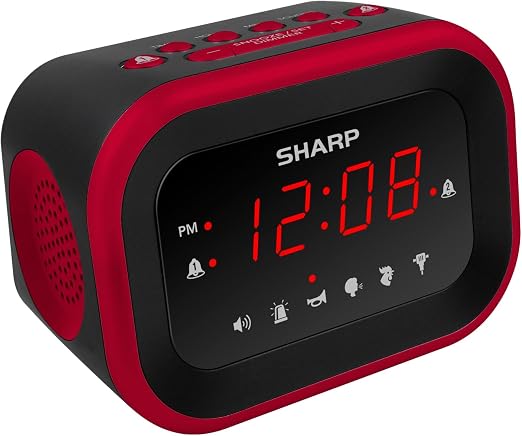
A 115 dB sound-only brute with six alarm sounds and a big red display, no shaker and no app.
- Alarm volume: 115 dB (maker rating)
- Alarm sounds: 6 sounds, rooster to siren

CLOCKY CLOCKY Rolling Alarm Clock
The snooze-hitter's cure: it rolls off the nightstand and hides, so silencing it means getting up.
- Wake method: Rolls and jumps off furniture
- Snooze: One press, then it rolls again
Questions, answered
What is the best alarm clock overall in 2027?
For a heavy sleeper, the Sonic Bomb Dual: a 113 dB alarm, flashing lights and a bed shaker that fire together, with an alarm length adjustable to 59 minutes. For a normal sleeper, the Peakeep MHP6010: big digits, five brightness levels, five volume steps and a USB port at a budget price. There is no single best clock, because the right answer depends on whether the sleeper needs volume, vibration, movement or simply a readable display.
Do I still need an alarm clock if I have a phone?
Yes, as a backup at least. Phones die overnight, go on silent by accident, or get buried under a blanket where the speaker is muffled. A plug-in clock with a battery backup keeps the time through a power cut, and a bed shaker works even if the phone is dead. Many owners use both: the clock as the primary alarm and the phone as a second line, set a few minutes later.
How much should I spend on an alarm clock?
A budget of around the price of a takeaway buys a good simple clock like the DreamSky DS312 or the Peakeep MHP6010, which covers the normal-sleeper job completely. The mid tier buys a bed shaker, the USCCE UE-188 or the Sonic Bomb Dual, which is the right spend for a heavy sleeper. The premium tier buys an app-paired pebble shaker, the iLuv SmartShaker 3 or the Bellman Vibio, which is worth it for shift workers, travellers and deaf or hard-of-hearing users. Spending more than that buys design, not waking power.
Can an alarm clock help with oversleeping on workdays?
Only if it changes the behaviour, not just the volume. A louder alarm does not fix a sleeper who silences it in their sleep; CLOCKY does, by rolling away and forcing the sleeper upright. A bed shaker fixes the sleeper who does not hear sound. And a consistent wake time, a clock placed across the room and a single alarm instead of a chain of snoozes do more than any single product. The clock is a tool; the routine is the fix.
Every guide on Alarm Clocks16 pages
- Topic hubAlarm Clocks
- Best ofThe Best Alarm Clocks (2027)
- This ranking starts from the admission that volume alone fails most heavy sleepers. The clocks that earn the top spots add a second wake-up channel: vibration under the pillow, flashing lights, or a clock that rolls away and forces the sleeper upright. Sound-only clocks are included only at the loudest end of the scale, and the note says plainly that they are a weaker answer for the sleepers this guide is for.The Best Alarm Clocks for Heavy Sleepers (2027)
- This guide covers only the clocks with a genuine vibration channel, which is four products out of the twelve in the main ranking. The comparison is between two kinds of shaker: the bedside clocks with a wired puck, the Sonic Bomb Dual and the USCCE UE-188, and the app-paired pebbles, the iLuv SmartShaker 3 and the Bellman Vibio. The wired pucks are stronger and simpler; the pebbles are quieter, more portable and far richer in alarms.The Best Bed-Shaker Alarm Clocks (2027)
- A dorm clock has different priorities from a bedroom clock. The nightstand is tiny, the room is shared, and a 115 dB alarm at 7 a.m. is a roommate problem, not a personal one. This ranking weights compact size, a dimmer that keeps the room dark, a USB port for phone charging, and vibration options that wake one person without waking the room. The loudest clocks in the main guide are deliberately left out of the top spots here.The Best Alarm Clocks for Dorms and Small Nightstands (2027)
- ReviewSonic Bomb Dual Alarm Clock with Bed Shaker Review (2027)
- ReviewSharp Big Bang Alarm Clock Review (2027)
- ReviewCLOCKY Rolling Alarm Clock Review (2027)
- ReviewUSCCE UE-188 Dual Alarm Clock with Bed Shaker Review (2027)
- ReviewiLuv SmartShaker 3 Review (2027)
- ReviewPeakeep MHP6010 Large Numbers Alarm Clock Review (2027)
- Head to headSonic Bomb Dual vs USCCE UE-188 (2027)
- Head to headSharp Big Bang vs Acedeck 115dB (2027)
- Fix itAlarm Clock Too Quiet or Slept Through? Fixes (2027)
- Fix itAlarm Clock Losing Time or Not Sounding? Fixes (2027)