Head to head
Amazon Basics 100-Foot 3-Prong Vinyl Outdoor Cord vs Amazon Basics 50-Foot 3-Prong Vinyl Outdoor Cord (2027)
Two Amazon Basics outdoor cords compared: the 100 ft cord against the 50 ft cord, on reach, amperage, gauge and honest load limits, for 2027 buyers.
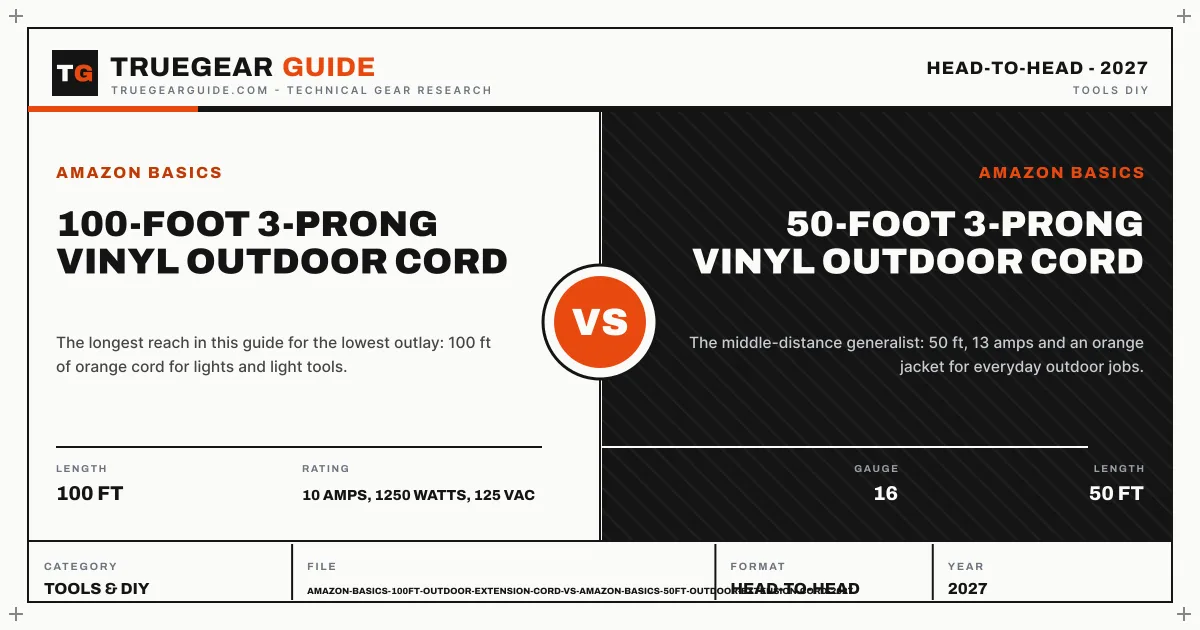

Amazon Basics 100-Foot 3-Prong Vinyl Outdoor Cord
The longest reach in this guide for the lowest outlay: 100 ft of orange cord for lights and light tools.
- Length: 100 ft
- Rating: 10 amps, 1250 watts, 125 VAC

Amazon Basics 50-Foot 3-Prong Vinyl Outdoor Cord
The middle-distance generalist: 50 ft, 13 amps and an orange jacket for everyday outdoor jobs.
- Length: 50 ft
- Gauge: 16
What owners report
Most praised
- Owners say it finally reaches the far tree and the back fence without chaining two cords together
- For holiday and string lights, owners call it the cheapest way to light a whole yard
- The orange jacket is easy to find in grass when it is time to coil it up
Common complaints
- Owners who tried a saw or a heater at the far end found the tool weak or the cord warm
- Without a lighted end, owners waste time checking the outlet when a light string stays dark
- Coiling 100 ft neatly after use is a job owners dread, and kinks form fast
What owners report
Most praised
- Owners say 50 ft is the length that covers a normal yard without excess cord to trip over
- For lights, fans and small tools, owners call it the cord they reach for first
- The orange jacket is easy to spot and easy to find when it is time to put it away
Common complaints
- Owners who ran a mower or a saw at the far end found the tool sluggish on 16 gauge wire
- Without a lighted end, owners check the outlet first when a tool will not start
- Cold-weather stiffness is the recurring complaint in winter use
Our recommendation
These two cords are the same family answering two different questions. The 100 ft cord answers reach: it puts power at the far tree and the far fence from one outlet. The 50 ft cord answers capacity: 13 amps on a shorter run, for light tools as well as lights. Buy the 100 ft cord when the job is distance and the load is light, and buy the 50 ft cord when the job is a normal yard and the load includes a tool. Buying the 100 ft cord for a saw is the mistake this comparison exists to prevent, and buying the 50 ft cord for the far fence is the other one.
Reach against capacity
The 100 ft cord reaches twice as far, and that is its whole argument. The 50 ft cord carries 13 amps against the 100 ft cord's 10 amps, and over half the distance its voltage drop is far smaller. A light tool that runs fine at 50 ft will sag at 100 ft on the thinner run. Reach and capacity trade against each other in every cord, and these two are the cleanest example in this guide.
Gauge and what it allows
The 50 ft cord uses 16 gauge wire rated at 13 amps, while the 100 ft cord is a thinner wire rated at 10 amps. The difference decides the job list: the 50 ft cord handles lamps, fans, chargers and light yard tools, while the 100 ft cord is honestly a lights-and-light-tools cord. Neither is a saw cord at its stated length, but the 50 ft cord is closer to one.
Coiling, storage and daily use
Fifty feet is a manageable coil that hangs on a hook and unrolls without a fight. One hundred feet is a chore to coil, a tangle waiting to happen and a heavy armful to carry to the far corner. Owners dread coiling the 100 ft cord after use, and kinks form fast if it is wound carelessly. The 50 ft cord is the cord you reach for weekly; the 100 ft cord is the cord you reach for seasonally.
Price and the honest buy
Both are budget cords, and the 100 ft cord costs little more than the 50 ft cord for twice the length, which is why buyers reach for it. The honest buy is the shorter cord when it reaches, because it carries more current, coils easier and lasts longer. Buy the 100 ft cord only when 50 ft genuinely does not reach, and accept its 10 amp limit when you do.
Choose Amazon Basics 100-Foot 3-Prong Vinyl Outdoor Cord if…
- The far tree, the far fence or the far corner needs power
- The load is string lights, landscape lights or holiday displays
- You need one cord to cover a large lot from one outlet
- Seasonal use justifies a cord that is a chore to coil
Choose Amazon Basics 50-Foot 3-Prong Vinyl Outdoor Cord if…
- Fifty feet reaches every job in your yard
- Light yard tools join the lights on the same cord
- You want the higher 13 amp rating for a bit more headroom
- Weekly use favours a cord that coils and stores easily
Questions, answered
Can I chain the 50 ft cord to the 100 ft cord for 150 ft?
You can, but you should not. Every connection adds resistance and a point of failure, and the thinnest cord in the chain decides the safe load. Buy one cord of the right length and gauge instead, or move the work closer to an outlet.
Which one is better for Christmas lights?
The 100 ft cord, when the display is far from the house. Light strings draw very little current, so the 10 amp limit never matters and the reach is the whole point. For a display near the house, the 50 ft cord does the same job and coils easier.
Can either cord run a mower?
A light electric mower, on the 50 ft cord, if its draw is under 13 amps. On the 100 ft cord the same mower may sag, because the voltage drop over 100 ft of thin wire is large. For mowers, the Southwire 12 gauge cord is the honest answer.
Every guide on Extension Cords15 pages
- Topic hubExtension Cords
- Best ofThe Best Extension Cords (2027)
- Outdoor use inverts the indoor ranking. The plug shape barely matters and the jacket, gauge and lighted end decide everything, because the cord lives in sun, rain, mud and mower paths, and the tools at the far end have motors that punish voltage drop. This ranking weights gauge first, jacket second and lighted ends third, and it caps thin-wire cords at the light loads they can honestly carry, however long they reach.The Best Extension Cords for Outdoor Use (2027)
- Indoor use flips the outdoor ranking on its head. Gauge barely matters, because household loads are small, and the plug is the product, because a standard plug sticks out an inch and a half, pushes furniture off the wall and blocks the second outlet. This ranking weights plug shape and outlet count first, length second and gauge third, and it treats a cord that hides behind furniture as a better cord than a cord that does not.The Best Extension Cords for Indoor Use (2027)
- Power tools are the use case where the wrong cord does real damage: a motor fed low voltage runs hot, loses power and dies early, and a cord fed past its rating heats up. This ranking is built on one measurement, the voltage drop across the run, which is decided by gauge and length together. Thin-wire and long cords are excluded from the top of this ranking however cheap they are, and the picks are ordered by the heaviest honest load they can carry at their stated length.The Best Extension Cords for Power Tools (2027)
- ReviewSouthwire 2588SW0002 50-Foot 12/3 SJTW Outdoor Cord Review (2027)
- ReviewDEWALT 12/3 SJTW Click-to-Lock Lighted Cord 50-Foot Review (2027)
- ReviewAmazon Basics 100-Foot 3-Prong Vinyl Outdoor Cord Review (2027)
- ReviewBayco SL-800 Retractable Metal Cord Reel 30-Foot Review (2027)
- ReviewSouthwire 2687SW0002 25-Foot 10 Gauge Outdoor Cord Review (2027)
- ReviewGE UltraPro Adapt 12-Outlet Surge Protector Review (2027)
- Head to headSouthwire 2588SW0002 50-Foot 12/3 SJTW Outdoor Cord vs DEWALT 12/3 SJTW Click-to-Lock Lighted Cord 50-Foot (2027)
- Buying guideExtension Cord Buying Guide (2027)
- Fix itExtension Cord Not Powering Your Tool? Fixes (2027)