Head to head
Southwire 2588SW0002 50-Foot 12/3 SJTW Outdoor Cord vs DEWALT 12/3 SJTW Click-to-Lock Lighted Cord 50-Foot (2027)
Two 50 ft 12 gauge outdoor cords compared: Southwire's 2588SW0002 against DEWALT's click-to-lock cord, on locking ends, lights, build and price, for 2027 buyers.
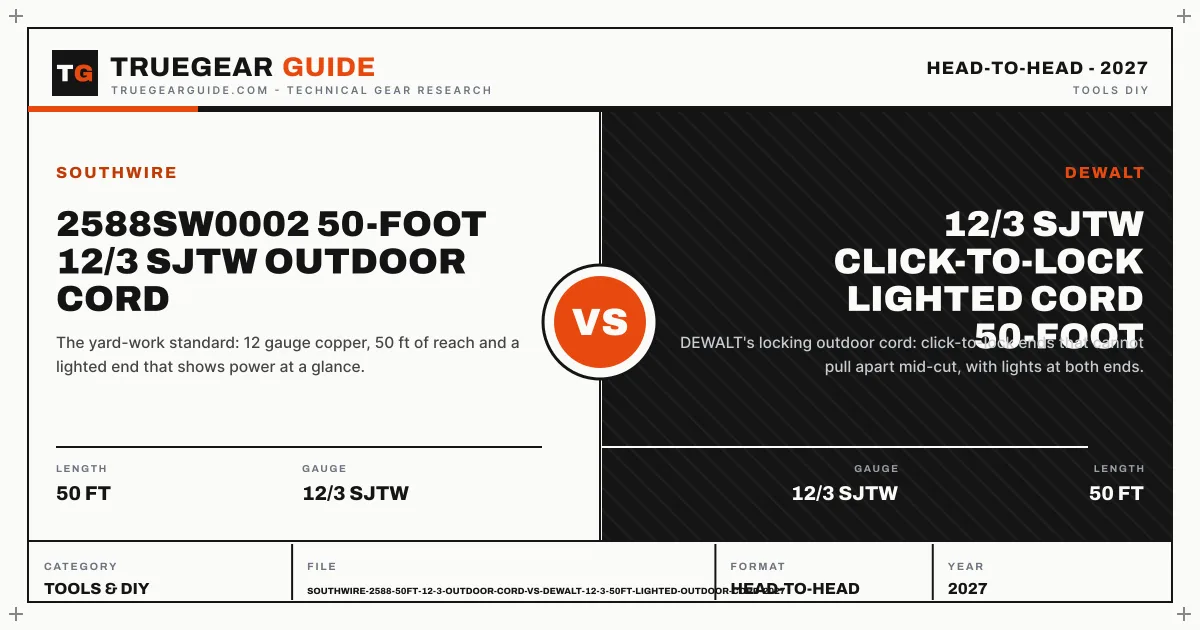

Southwire 2588SW0002 50-Foot 12/3 SJTW Outdoor Cord
The yard-work standard: 12 gauge copper, 50 ft of reach and a lighted end that shows power at a glance.
- Length: 50 ft
- Gauge: 12/3 SJTW

DEWALT 12/3 SJTW Click-to-Lock Lighted Cord 50-Foot
DEWALT's locking outdoor cord: click-to-lock ends that cannot pull apart mid-cut, with lights at both ends.
- Length: 50 ft
- Gauge: 12/3 SJTW
What owners report
Most praised
- Owners say their mowers and saws run at full strength at the far end of the yard, where thinner cords sagged
- The lighted end is the feature owners mention most, since it settles the live-or-dead question instantly
- The yellow jacket survives seasons outdoors without fading into the grass the way orange cords do
Common complaints
- Cold mornings turn the cord stiff and springy, and it resists lying flat on a driveway
- The coil is heavy enough that owners with bad shoulders notice carrying it to the far corner
- A single outlet at the end frustrates owners who want to run two yard tools from one run
What owners report
Most praised
- Owners say the locking ends ended the mid-cut disconnects that used to stop a saw at the worst moment
- The lights at both ends make fault-finding a glance instead of a walk back to the outlet
- The plug strain relief holds up to jobsite dragging that destroyed the owner's previous cords
Common complaints
- Owners without locking-compatible tools pay for a lock they cannot use
- The cord's weight and stiffness make it the last one owners reach for on quick small jobs
- Some owners find the locking ends fiddly to release with cold or gloved hands
Our recommendation
These two cords are electrically identical: 50 ft of 12 gauge SJTW wire rated at 1875 watts, with lighted ends and yellow jackets. The difference is the DEWALT's click-to-lock ends and its lights at both ends, against the Southwire's lower price. If your cords pull apart mid-job, buy the DEWALT and the lock pays for itself the first time a saw keeps cutting. If your cords sit still while a mower or a light runs, buy the Southwire and keep the difference. Neither cord feeds a tool better than the other; the choice is about the ends, not the wire.
Locking ends against plain ends
The DEWALT's click-to-lock ends lock the cord to a compatible tool plug so vibration and dragging cannot separate the connection mid-cut. The Southwire uses a standard lighted female end that holds a plug by friction alone. On a jobsite where cords get dragged and snagged, the lock is a real safety feature. In a yard where the cord lies still, it is a feature you pay for and never use, and it only locks with compatible plugs anyway.
Lights at one end or both
The Southwire lights its female end, so you can see at the tool whether the cord is live. The DEWALT lights both ends, so you can see power and ground continuity from the outlet and from the tool without walking the run. On a 50 ft cord that is a genuine convenience, and it is the DEWALT's second real advantage after the lock.
Build and strain relief
Both cords use 12 gauge SJTW wire and yellow jackets built for outdoor use. The DEWALT adds heavier strain relief at both plugs, designed for jobsite dragging and yanking, while the Southwire's strain relief is the standard heavy-duty kind that has served yards for years. The DEWALT is the tougher cord in its details; the Southwire is the proven cord in its record.
Price and value
The Southwire costs less for the same electrical performance, which makes it the better value for general yard and garage work. The DEWALT costs more for the lock, the second light and the heavier build. Value depends on the job: a contractor who loses a cut to a disconnect will call the DEWALT cheap, and a homeowner who mows a lawn will call the Southwire the sensible buy. Both are right.
Choose Southwire 2588SW0002 50-Foot 12/3 SJTW Outdoor Cord if…
- Your cords sit still while a mower, a saw or a light runs
- You want the same 12 gauge performance at a lower price
- Your tools use ordinary plugs that would not lock anyway
- General yard and garage work is the whole job list
Choose DEWALT 12/3 SJTW Click-to-Lock Lighted Cord 50-Foot if…
- Your cords pull apart mid-cut on a jobsite
- You want lights at both ends to check power and ground
- Your tool plugs are compatible with the locking ends
- Heavy strain relief and jobsite build matter to you
Questions, answered
Which cord feeds a table saw better?
Neither. Both are 50 ft of 12 gauge wire rated at 1875 watts, so a saw runs identically on either. The difference is the ends: the DEWALT will not pull apart mid-cut, and the Southwire costs less. Choose on the lock, not on the power.
Will the DEWALT locking ends fit my tools?
Ordinary tool plugs fit and work normally, with the lights and strain relief still doing their jobs. The lock itself only engages with compatible plugs designed to match it, so check your tool plugs before buying for the lock.
Which one lasts longer outdoors?
Both use SJTW jackets built for outdoor use, and both will last years if coiled in large loops, kept out of standing water and inspected for cracks. The DEWALT's heavier strain relief gives it an edge where cords are dragged and yanked daily.
Every guide on Extension Cords15 pages
- Topic hubExtension Cords
- Best ofThe Best Extension Cords (2027)
- Outdoor use inverts the indoor ranking. The plug shape barely matters and the jacket, gauge and lighted end decide everything, because the cord lives in sun, rain, mud and mower paths, and the tools at the far end have motors that punish voltage drop. This ranking weights gauge first, jacket second and lighted ends third, and it caps thin-wire cords at the light loads they can honestly carry, however long they reach.The Best Extension Cords for Outdoor Use (2027)
- Indoor use flips the outdoor ranking on its head. Gauge barely matters, because household loads are small, and the plug is the product, because a standard plug sticks out an inch and a half, pushes furniture off the wall and blocks the second outlet. This ranking weights plug shape and outlet count first, length second and gauge third, and it treats a cord that hides behind furniture as a better cord than a cord that does not.The Best Extension Cords for Indoor Use (2027)
- Power tools are the use case where the wrong cord does real damage: a motor fed low voltage runs hot, loses power and dies early, and a cord fed past its rating heats up. This ranking is built on one measurement, the voltage drop across the run, which is decided by gauge and length together. Thin-wire and long cords are excluded from the top of this ranking however cheap they are, and the picks are ordered by the heaviest honest load they can carry at their stated length.The Best Extension Cords for Power Tools (2027)
- ReviewSouthwire 2588SW0002 50-Foot 12/3 SJTW Outdoor Cord Review (2027)
- ReviewDEWALT 12/3 SJTW Click-to-Lock Lighted Cord 50-Foot Review (2027)
- ReviewAmazon Basics 100-Foot 3-Prong Vinyl Outdoor Cord Review (2027)
- ReviewBayco SL-800 Retractable Metal Cord Reel 30-Foot Review (2027)
- ReviewSouthwire 2687SW0002 25-Foot 10 Gauge Outdoor Cord Review (2027)
- ReviewGE UltraPro Adapt 12-Outlet Surge Protector Review (2027)
- Head to headAmazon Basics 100-Foot 3-Prong Vinyl Outdoor Cord vs Amazon Basics 50-Foot 3-Prong Vinyl Outdoor Cord (2027)
- Buying guideExtension Cord Buying Guide (2027)
- Fix itExtension Cord Not Powering Your Tool? Fixes (2027)