Head to head
Anker SOLIX C1000 Gen 2 vs EcoFlow DELTA 3 (2027)
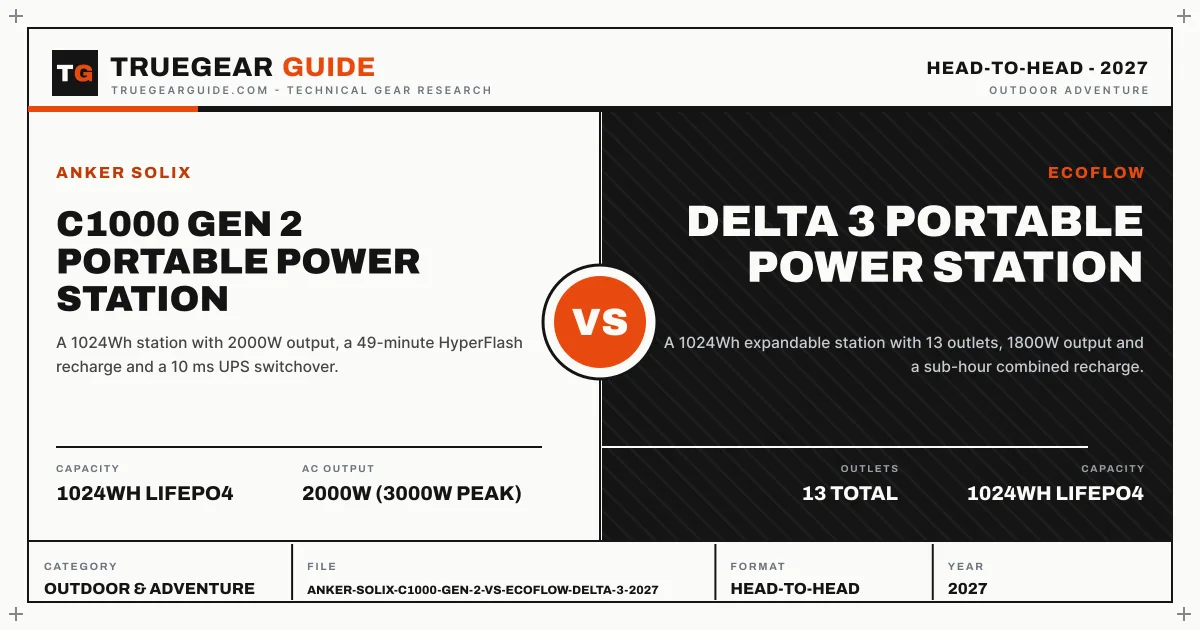
The Anker SOLIX C1000 Gen 2 against the EcoFlow DELTA 3: 2000W output and UPS switchover versus 13 outlets and expansion to 5kWh, for 2027 buyers.

Anker SOLIX C1000 Gen 2 Portable Power Station
A 1024Wh station with 2000W output, a 49-minute HyperFlash recharge and a 10 ms UPS switchover.
- Capacity: 1024Wh LiFePO4
- AC output: 2000W (3000W peak)

EcoFlow DELTA 3 Portable Power Station
A 1024Wh expandable station with 13 outlets, 1800W output and a sub-hour combined recharge.
- Capacity: 1024Wh LiFePO4
- Outlets: 13 total
What owners report
Most praised
- The fastest recharge in this size class, which matters when an outage warning comes late.
- High output for a 1kWh unit, handling kitchen appliances that smaller stations cannot.
- Compact for its output, fitting under a desk or beside a bed without fuss.
Common complaints
- The fastest recharge mode requires the app, and owners who skip the app never see it.
- No battery expansion, so owners who outgrow 1kWh must buy a larger unit instead.
- Bundle variants with panels cause confusion at checkout about what is actually included.
What owners report
Most praised
- The sheer number of ports suits a household that wants everything plugged in at once.
- Recharge speed stands out for a 1kWh unit, cutting waiting time before the next trip.
- Expansion support gives a clear upgrade path instead of replacing the whole unit later.
Common complaints
- Bulkier than the older 1kWh models, so it is more of a garage unit than a carry-anywhere one.
- The app is needed for some settings, which frustrates owners who prefer physical controls only.
- Extra batteries add a lot of cost, so the headline expansion figure is not a cheap upgrade.
Our recommendation
Choose on the question of growth versus power. The Anker SOLIX C1000 Gen 2 gives the stronger 1kWh station today: 2000W output against 1800W, a 49-minute HyperFlash recharge, a 10 ms UPS switchover and a lighter 24.9 lb body. The EcoFlow DELTA 3 gives the station that grows: 13 outlets against 10, and expansion from 1024Wh to 5kWh that the Anker cannot match. If your load list is fixed and your appliances are demanding, take the Anker. If your backup needs may grow, or your household simply plugs in a lot at once, take the EcoFlow and budget for extra batteries later.
Output and UPS cover
The Anker outputs 2000W with a 3000W peak, the strongest 1kWh output here, and switches over in 10 ms as a UPS, so a router keeps running through a brief outage. The DELTA 3 outputs 1800W with X-Boost for higher-draw resistive appliances and offers no stated UPS switchover figure in this guide. For kitchen appliances and uninterrupted loads, the Anker is the stronger hand.
Outlets and expansion
The DELTA 3 offers 13 outlets against the Anker 10 ports, and it expands to 5kWh with extra batteries while the Anker stays fixed at 1024Wh. A household that plugs in a fridge, a router, lights, a fan and chargers at once will feel the DELTA 3 outlet advantage daily, and a household planning a bigger backup later will feel the expansion advantage permanently.
Recharge speed and weight
The Anker refills fully in about 49 minutes at 1600W HyperFlash through the app, while the DELTA 3 refills in about 56 minutes using combined AC and solar input. The Anker is also lighter at 24.9 lb against 27.5 lb, and more compact for its output. Both recharge fast by 1kWh standards; the Anker wins the wall-only race, the DELTA 3 wins when solar joins the wall input.
Choose Anker SOLIX C1000 Gen 2 Portable Power Station if…
- Your appliances need 2000W output or a UPS switchover for a router
- The fastest wall recharge matters, and you will enable HyperFlash in the app
- Your load list is fixed at or below 1kWh
- A lighter, more compact 1kWh body matters for storage
Choose EcoFlow DELTA 3 Portable Power Station if…
- Your household plugs in many devices at once and needs 13 outlets
- You may need more than 1kWh later and want expansion to 5kWh
- Combined AC and solar recharge suits your setup
- You prefer EcoFlow port layout and expansion ecosystem
Questions, answered
Which is better for a fridge?
Both cover a modern fridge for a useful period at 1kWh, but the Anker stronger 2000W output handles startup surges and kitchen appliances better, while the DELTA 3 extra outlets and expansion suit a fridge plus a longer household load list. For a fridge alone, take the Anker; for a fridge plus everything else, take the DELTA 3.
Can either expand past 1kWh?
Only the DELTA 3, which expands to 5kWh with extra batteries. The Anker C1000 Gen 2 has no battery expansion, so outgrowing 1024Wh means buying a larger unit instead.
Which recharges faster?
The Anker, at about 49 minutes fully charged using HyperFlash through the app, against about 56 minutes for the DELTA 3 using combined AC and solar input. Both are fast for the class, and both quoted speeds assume their stated input conditions.
Every guide on Portable Power Stations15 pages
- Topic hubPortable Power Stations
- Best ofThe Best Portable Power Stations (2027)
- Camping splits into two very different jobs, and this ranking keeps them separate. Hiking and walk-in camping need a station under about 10 lb that charges phones and a laptop, with nothing else asked of it. Car camping and RV camping can carry 17 to 27 lb and benefit from several AC outlets, a fan, a lamp and a small cooler. Weight is therefore weighted as heavily as capacity here, and the heaviest home backup stations are left out where their weight buys nothing a tent needs.The Best Portable Power Stations for Camping (2027)
- Home backup is the one use case where capacity and output both matter at full strength, and where small stations are simply excluded. A backup station must run a fridge, a router and a few lights together, recharge fast between outages, and, ideally, switch over without dropping the load. This ranking therefore starts at 768Wh and is dominated by the 1kWh-plus class, with expansion and UPS switchover weighted alongside raw capacity.The Best Portable Power Stations for Home Backup (2027)
- Small means small in this guide: under 300Wh and under about 10 lb, with no exceptions for heavier mid-size units that happen to be compact for their class. The ranking is for buyers whose whole load is phones, laptops, cameras and small DC gear, and it judges these stations on carrying weight, USB-C wattage and how many devices can charge at once, not on appliance output they were never built for.The Best Small Portable Power Stations (2027)
- ReviewAnker SOLIX C1000 Gen 2 Portable Power Station Review (2027)
- ReviewEcoFlow DELTA 3 Portable Power Station Review (2027)
- ReviewJackery Explorer 2000 v2 Portable Power Station Review (2027)
- ReviewEcoFlow DELTA 2 Portable Power Station Review (2027)
- ReviewBLUETTI AC180 Portable Power Station Review (2027)
- ReviewEcoFlow RIVER 2 Pro Portable Power Station Review (2027)
- Head to headEcoFlow DELTA 2 vs Jackery Explorer 2000 v2 (2027)
- Buying guidePortable Power Station Buying Guide (2027)
- Fix itPortable Power Station Not Charging or Not Powering Devices? Fixes (2027)