In-depth review
EcoFlow DELTA 3 Portable Power Station Review (2027)
The EcoFlow DELTA 3 pairs 1024Wh with 1800W output, 13 outlets and expansion to 5kWh. Our research-based verdict on the expandable household pick.
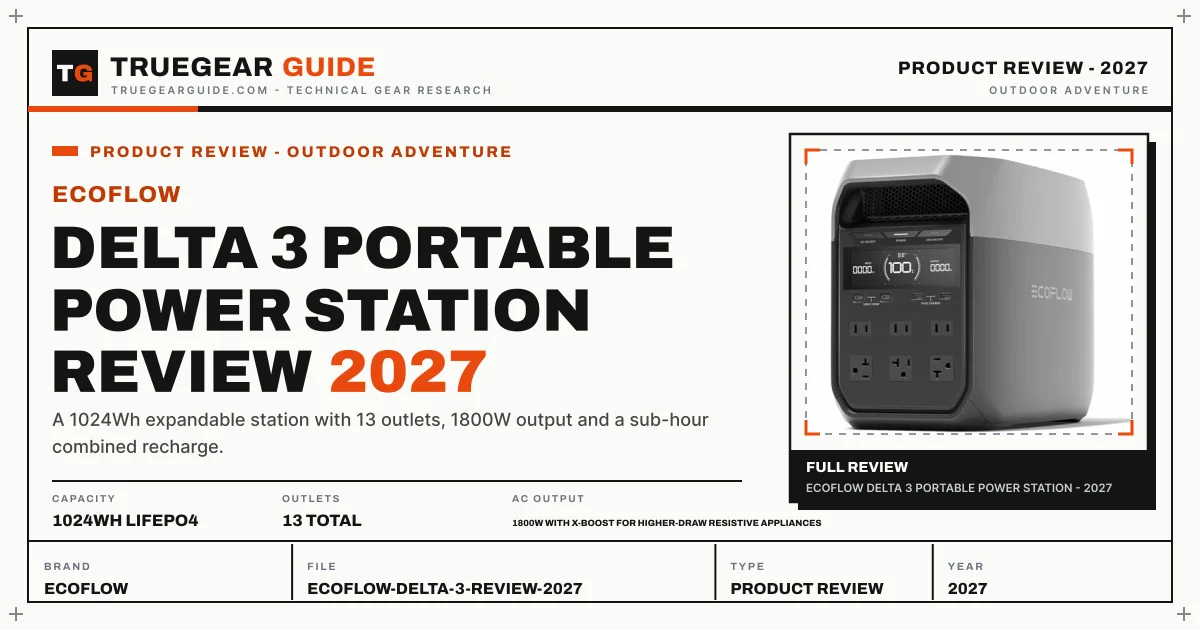

EcoFlow DELTA 3 Portable Power Station
A 1024Wh expandable station with 13 outlets, 1800W output and a sub-hour combined recharge.
Our verdict
The DELTA 3 is the household station for buyers who want everything plugged in at once and room to grow. Its 1024Wh battery, 1800W output and 13 outlets cover a fridge, a router, lights and chargers together, its combined AC and solar recharge refills it in about 56 minutes, and its expansion to 5kWh means a bigger backup later does not require replacing the whole unit. Its bulk is the honest cost: at 27.5 lb it is a garage unit, not a carry-anywhere one.
What we like
- 1024Wh LiFePO4 battery with 1800W AC output and X-Boost for higher-draw resistive appliances
- 13 outlets total suit a household that wants everything plugged in at once
- Full recharge in about 56 minutes using combined AC and solar input
- Expandable to 5kWh with extra batteries, giving a clear upgrade path instead of replacing the whole unit later
What to watch out for
- Bulkier than the older 1kWh models, so it is more of a garage unit than a carry-anywhere one
- The app is needed for some settings, which frustrates owners who prefer physical controls only
- Extra batteries add a lot of cost, so the headline expansion figure is not a cheap upgrade
What owners report: EcoFlow DELTA 3 Portable Power Station
Synthesized from recurring themes in long-term owner feedback.
Most praised
- The sheer number of ports suits a household that wants everything plugged in at once.
- Recharge speed stands out for a 1kWh unit, cutting waiting time before the next trip.
- Expansion support gives a clear upgrade path instead of replacing the whole unit later.
Common complaints
- Bulkier than the older 1kWh models, so it is more of a garage unit than a carry-anywhere one.
- The app is needed for some settings, which frustrates owners who prefer physical controls only.
- Extra batteries add a lot of cost, so the headline expansion figure is not a cheap upgrade.
Who it is for
Households planning a home backup that may grow, and buyers who value many outlets and a fast combined recharge.
Thirteen outlets and what they buy you
Outlet count is where the DELTA 3 separates from the mid-size stations. Thirteen outlets total mean a fridge, a router, a lamp, a fan and chargers can all stay connected without a power strip or a nightly unplugging ritual. For a household backup, that convenience matters as much as capacity, because the station that forces choices during an outage is the station that gets complained about afterwards.
Recharge and expansion, honestly priced
A full recharge in about 56 minutes using combined AC and solar input is fast for a 1kWh unit, and owners single out recharge speed as a standout. Expansion to 5kWh is the longer-term story, but it is not a cheap upgrade: extra batteries add a lot of cost, so buyers should treat the headline 5kWh figure as a path, not as included capacity.
Bulk and app dependence
At 27.5 lb and larger than the older 1kWh models, the DELTA 3 is a unit that lives in a garage or a utility corner and moves to the room that needs it, rather than travelling. Some settings also require the app, which frustrates owners who prefer physical controls only. Buyers who want a station that travels should look at the lighter Jackery 1000 v2 or the mid-size RIVER 2 Pro instead.
Key specifications
- Capacity
- 1024Wh LiFePO4
- Outlets
- 13 total
- AC output
- 1800W with X-Boost for higher-draw resistive appliances
- Recharge
- Full recharge in about 56 minutes using combined AC and solar input
- Expansion
- Expandable to 5kWh with extra batteries
- Weight
- 27.5 lb
Also consider

EcoFlow DELTA 2 Portable Power Station
The long-standing 1024Wh EcoFlow with 1800W output, 15 outlets and expansion to 3kWh.
Why consider it: The proven EcoFlow alternative, with 15 outlets and expansion to 3kWh
- Capacity: 1024Wh LiFePO4
- AC output: 1800W (2700W surge)

Anker SOLIX C1000 Gen 2 Portable Power Station
A 1024Wh station with 2000W output, a 49-minute HyperFlash recharge and a 10 ms UPS switchover.
Why consider it: The stronger-output 1kWh alternative, with 2000W output and a 10 ms UPS switchover
- Capacity: 1024Wh LiFePO4
- AC output: 2000W (3000W peak)
Research-based assessment. TrueGear has not hands-on tested this product; this evaluation synthesizes manufacturer specifications, retailer documentation, and published expert reviews.
Questions, answered
How far does the DELTA 3 expand?
From 1024Wh to 5kWh with extra batteries. The extra batteries are a separate purchase and add a lot of cost, so budget for them separately rather than treating 5kWh as the out-of-box capacity.
How fast does the DELTA 3 recharge?
A full recharge takes about 56 minutes using combined AC and solar input. That combined figure assumes both inputs are feeding the unit, so a wall-only recharge will take longer.
Is the DELTA 3 portable?
It is movable, not carry-anywhere. At 27.5 lb it moves between rooms and rides in a car boot, but it is bulkier than the older 1kWh models and owners describe it as more of a garage unit than a portable one.
Every guide on Portable Power Stations15 pages
- Topic hubPortable Power Stations
- Best ofThe Best Portable Power Stations (2027)
- Camping splits into two very different jobs, and this ranking keeps them separate. Hiking and walk-in camping need a station under about 10 lb that charges phones and a laptop, with nothing else asked of it. Car camping and RV camping can carry 17 to 27 lb and benefit from several AC outlets, a fan, a lamp and a small cooler. Weight is therefore weighted as heavily as capacity here, and the heaviest home backup stations are left out where their weight buys nothing a tent needs.The Best Portable Power Stations for Camping (2027)
- Home backup is the one use case where capacity and output both matter at full strength, and where small stations are simply excluded. A backup station must run a fridge, a router and a few lights together, recharge fast between outages, and, ideally, switch over without dropping the load. This ranking therefore starts at 768Wh and is dominated by the 1kWh-plus class, with expansion and UPS switchover weighted alongside raw capacity.The Best Portable Power Stations for Home Backup (2027)
- Small means small in this guide: under 300Wh and under about 10 lb, with no exceptions for heavier mid-size units that happen to be compact for their class. The ranking is for buyers whose whole load is phones, laptops, cameras and small DC gear, and it judges these stations on carrying weight, USB-C wattage and how many devices can charge at once, not on appliance output they were never built for.The Best Small Portable Power Stations (2027)
- ReviewAnker SOLIX C1000 Gen 2 Portable Power Station Review (2027)
- ReviewJackery Explorer 2000 v2 Portable Power Station Review (2027)
- ReviewEcoFlow DELTA 2 Portable Power Station Review (2027)
- ReviewBLUETTI AC180 Portable Power Station Review (2027)
- ReviewEcoFlow RIVER 2 Pro Portable Power Station Review (2027)
- Head to headAnker SOLIX C1000 Gen 2 vs EcoFlow DELTA 3 (2027)
- Head to headEcoFlow DELTA 2 vs Jackery Explorer 2000 v2 (2027)
- Buying guidePortable Power Station Buying Guide (2027)
- Fix itPortable Power Station Not Charging or Not Powering Devices? Fixes (2027)