Head to head
Apple 140W vs Anker A2697 (2027)
Apple's own 140W adapter against Anker's four-port 140W charger with a display: single-port certainty versus multi-port flexibility.
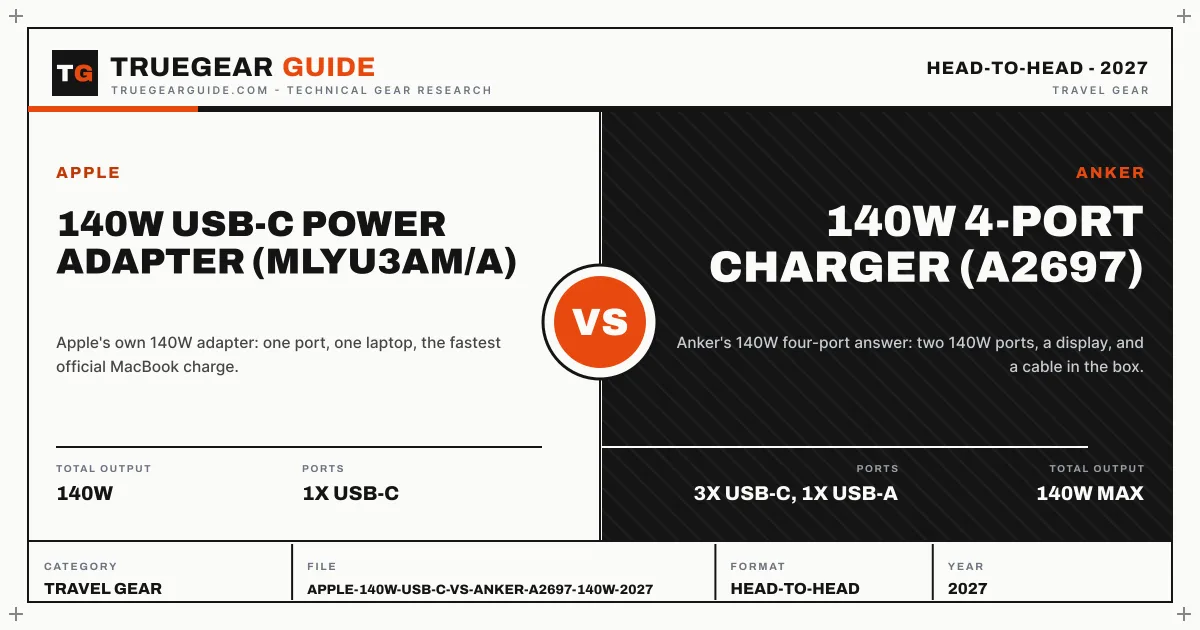

Apple 140W USB-C Power Adapter (MLYU3AM/A)
Apple's own 140W adapter: one port, one laptop, the fastest official MacBook charge.
- Total output: 140W
- Ports: 1x USB-C

Anker 140W 4-Port Charger (A2697)
Anker's 140W four-port answer: two 140W ports, a display, and a cable in the box.
- Total output: 140W max
- Ports: 3x USB-C, 1x USB-A
What owners report
Most praised
- It fast charges a 16 inch MacBook Pro at the speed Apple promises
- Owners trust it as the adapter that will not argue with macOS power management
- The foldable prongs and solid build survive years of daily travel
Common complaints
- A single port feels thin at the price when multi-port bricks cost less
- The missing cable stings on a premium-priced adapter
- Owners who also carry an iPhone end up packing a second charger anyway
What owners report
Most praised
- It charges a 16 inch laptop at full speed while a phone charges beside it
- The display shows which port is actually delivering, which ends cable arguments
- Owners praise the included 240W cable as a real cable, not a short token
Common complaints
- The third USB-C port disappoints owners who hoped for a second laptop port
- The brick is heavy enough that owners notice it in a slim laptop sleeve
- Touch controls can be triggered by accident when the brick is handled
Our recommendation
Choose by the number of devices. The Apple 140W adapter is the right charger for one MacBook and nothing else: the exact official adapter, no splitting, no decisions, and no cable in the box. The Anker A2697 is the right charger for a MacBook plus a phone and a tablet: two 140W ports, a colour display showing live output, and the 240W cable included. If you charge one laptop, buy Apple. If you charge a kit, buy Anker.
Ports and the second device
The Apple adapter has one USB-C port and one job. The Anker has three USB-C ports and one USB-A port, so a phone, a tablet and earbuds charge beside the laptop. That is the whole comparison for most buyers: a single-port adapter against a four-port brick at the same 140W laptop speed.
Cables and the real price
The Anker includes a 5 ft 240W USB-C cable, so its 140W speed works immediately. The Apple adapter ships without a cable, and the USB-C to MagSafe 3 cable is a separate purchase. Once the cable is added, the price gap between them narrows sharply, and in some shops it reverses.
Display and information
The Anker's colour display with touch controls shows live output, which settles the question of whether the laptop is actually fast charging. The Apple adapter shows nothing, which is either elegant or opaque depending on the buyer. Owners who troubleshoot their own charging value the display; owners who plug in and walk away never miss it.
Size, weight and certainty
The Apple adapter is the larger single-purpose brick at 5.52 by 4.64 by 1.28 inches, while the Anker is 2.72 by 2.72 by 1.42 inches and 9.7 oz. The Apple adapter's advantage is not size but certainty: it is the charger Apple designed for the machine, and it never argues with macOS power management. The Anker's advantage is flexibility: four ports and a display for the same laptop speed.
Choose Apple 140W USB-C Power Adapter (MLYU3AM/A) if…
- You charge one MacBook and nothing else
- You want the exact official adapter with no compatibility questions
- A display and extra ports hold no appeal for you
- You already own a MagSafe 3 cable
Choose Anker 140W 4-Port Charger (A2697) if…
- You charge a laptop plus a phone and a tablet from one brick
- You want the 240W cable included in the box
- A live display showing output matters to you
- Two 140W ports suit a shared desk or two laptops
Questions, answered
Does the Anker charge a MacBook as fast as Apple's adapter?
Yes, on its first two USB-C ports, which each reach 140W alone under PD 3.1. Through a 240W-rated USB-C cable, a 16 inch MacBook Pro charges at the same fast-charge speed as on Apple's own adapter. The MagSafe 3 cable is the path Apple specifies, but USB-C charging at 140W is the same speed in practice.
Which one is better for travel?
Neither is the best travel brick in this guide; both are substantial. The Anker is the more useful traveller, since one brick covers the laptop, the phone and the tablet. The Apple adapter is the lighter decision, since it does one job with no choices to make.
Will macOS complain about the Anker charger?
No. macOS negotiates power over USB-C PD with any proper charger, and Anker's PD 3.1 implementation is widely used with MacBooks. The laptop draws what it needs and reports charging normally. The only chargers that draw complaints are unbranded ones with broken PD negotiation, which is not the case here.
Every guide on Portable Laptop Chargers15 pages
- Topic hubPortable Laptop Chargers
- Best ofThe Best Portable Laptop Chargers (2027)
- This ranking is built on one measurement that matters for 16 inch laptops: single-port 140W output under PD 3.1. A brick labelled 140W total is not a 140W laptop charger. Every pick here delivers 140W to one USB-C port, and the ranking separates on what surrounds that port: whether the 240W cable is in the box, how many more ports share the total, and how much the brick costs.The Best 140W Laptop Chargers (2027)
- MacBook charging is a negotiation between the laptop and the charger, and macOS is picky about it. Apple's own adapters are the reference point: 140W for the 16 inch, 96W for the 14 inch. The GaN alternatives here earn their place by matching those speeds on the ports that matter, and the ranking separates on whether the charger also handles the iPhone and iPad beside the MacBook, and whether the MagSafe cable is in the box or bought separately.The Best Portable Laptop Chargers for MacBook (2027)
- A multi-port charger is judged by its split, not its total. A 100W brick that gives the laptop 65W and the phone 30W is a different product from a 100W brick that gives the laptop 100W and the phone nothing. This ranking weights the laptop port's share when other ports are loaded, and the number of genuinely useful ports, and reserves the top spots for bricks whose split figures are published and honest.The Best Multi-Port Laptop Chargers (2027)
- ReviewAnker 737 GaNPrime 120W Charger Review (2027)
- ReviewUGREEN Nexode 140W GaN Charger Review (2027)
- ReviewAnker 140W 4-Port Charger Review (2027)
- ReviewApple 140W USB-C Power Adapter Review (2027)
- ReviewSatechi 165W USB-C 4-Port GaN Charging Station Review (2027)
- ReviewBaseus PicoGo 140W Charger Review (2027)
- Head to headAnker 737 vs UGREEN Nexode 140W (2027)
- Buying guidePortable Laptop Charger Buying Guide (2027)
- Fix itLaptop Charger Not Charging? Fixes (2027)