Head to head
Midea MAD50C1ZWS 50-Pint Dehumidifier vs hOmeLabs HME020031N 50-Pint Dehumidifier (2027)
The two leading 50-pint dehumidifiers compared: Midea's MAD50C1ZWS against hOmeLabs' HME020031N, on capacity, tank, warranty and noise.
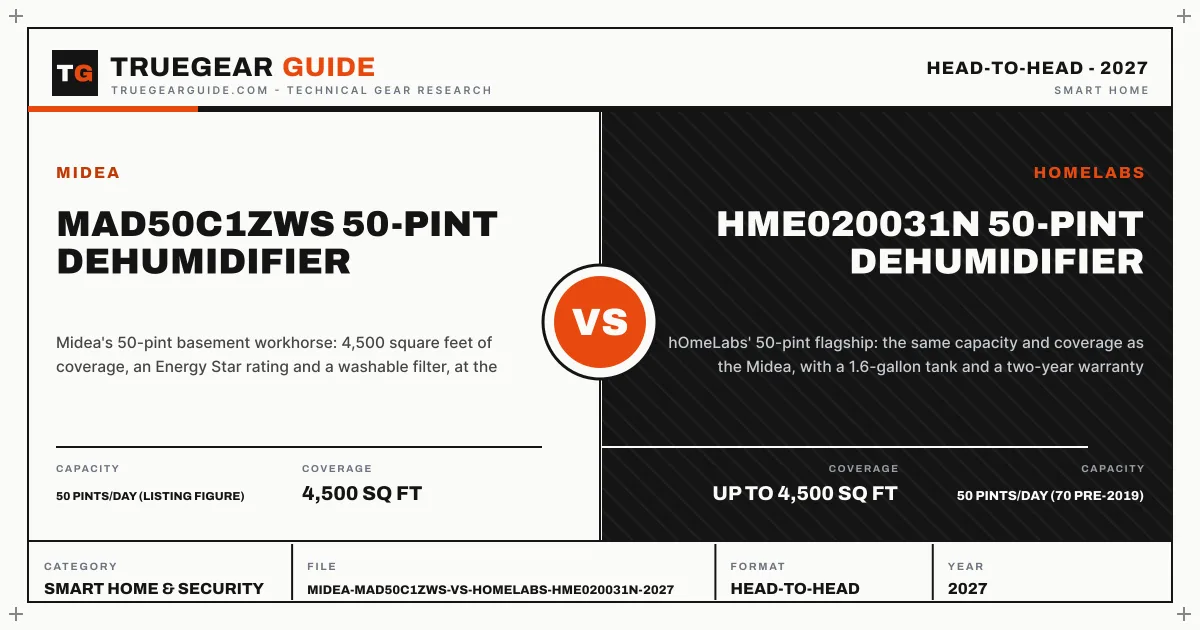

Midea MAD50C1ZWS 50-Pint Dehumidifier
Midea's 50-pint basement workhorse: 4,500 square feet of coverage, an Energy Star rating and a washable filter, at the tier the flagships fight over.
- Capacity: 50 pints/day (listing figure)
- Coverage: 4,500 sq ft

hOmeLabs HME020031N 50-Pint Dehumidifier
hOmeLabs' 50-pint flagship: the same capacity and coverage as the Midea, with a 1.6-gallon tank and a two-year warranty behind it.
- Capacity: 50 pints/day (70 pre-2019)
- Coverage: Up to 4,500 sq ft
What owners report
Most praised
- The capacity is the story: owners report a damp basement drying out within days of the unit arriving
- The washable filter earns praise because it rinses clean and never needs a replacement order
- The drain hose connection means the bucket never has to be carried, once the hose is run to a drain
Common complaints
- Owners without a floor drain were caught out by the missing pump and ended up carrying the bucket daily
- The unit is heavy to move between rooms, and the handles are the first thing owners complain about
- The humidity display reads higher than a separate hygrometer in some rooms, which owners find confusing
What owners report
Most praised
- The big tank is the feature owners notice first, because it means fewer trips to the sink
- Owners call it the quietest 50-pint unit they have owned, and it sits in living spaces without complaint
- The two-year warranty gives owners confidence, and the brand's support gets mentioned by name
Common complaints
- The missing pump is the main complaint, and owners who expected one bought the wrong model number
- The 70-pint figure on old listings misleads buyers into expecting more than the current 50-pint rating
- The unit is bulky for a bedroom, and owners say it belongs in a basement or a large room
Our recommendation
These two units are the closest rivals in this guide, and the choice is a choice of priorities, not of quality. The Midea MAD50C1ZWS is the better unit for a basement with a floor drain, because its drain hose connection and washable filter make it a fit-and-forget machine. The hOmeLabs HME020031N is the better unit for a room without a drain, because its 1.6-gallon tank runs longer between empties, and its two-year warranty is the longest among the 50-pint units. If the room has a drain, take the Midea. If it does not, take the hOmeLabs. If both are available at the same tier, the tiebreaker is the warranty.
Capacity: the same 50 pints, different tests
Both units claim 50 pints a day under the current test, and both cover up to 4,500 square feet. The difference is history: the hOmeLabs was once listed at 70 pints under the old pre-2019 test, while the Midea has always been listed at 50. In practice the two dry a basement at the same rate, and the capacity figure does not decide this comparison. What decides it is what happens after the water is collected, which is the tank and the drain.
Tank against drain hose
The hOmeLabs has the bigger tank: 1.6 gallons against the Midea's bucket, which is not published as a separate figure. In a room without a drain, that tank means fewer trips to the sink, and owners who hated bucket duty notice the difference immediately. The Midea answers with a drain hose connection that the hOmeLabs matches only with a gravity drain, and a washable filter that rinses clean. In a basement with a floor drain, the Midea's hose ends the chore entirely. In a room without one, the hOmeLabs' tank is the better answer.
Noise and where each unit belongs
Owners call the hOmeLabs the quietest 50-pint unit they have owned, and it sits in a living space without complaint. The Midea is a basement unit by temperament: it is heavier to move, and its fan is audible in a quiet house. Neither is a bedroom unit, but the hOmeLabs is the one that can live in a living room, while the Midea belongs in the basement. For a buyer who wants one unit for a large living space, the hOmeLabs wins. For a buyer who wants one unit for a basement, the Midea wins.
Warranty and availability
The hOmeLabs carries a two-year warranty per guides, the longest among the 50-pint units here, against the Midea's standard warranty story. But the hOmeLabs has the availability question: one Amazon snippet marks the listing as discontinued by the manufacturer, so the stock is remaining stock. The Midea has no such flag, and its listing shows only a minor model-number inconsistency. For a buyer who wants the longest warranty, the hOmeLabs is the pick. For a buyer who wants the safest availability, the Midea is the pick.
Choose Midea MAD50C1ZWS 50-Pint Dehumidifier if…
- The basement has a floor drain for the hose connection
- A washable filter that rinses clean matters to you
- You want the safest availability with no discontinuation flag
- Energy Star running costs are the priority
Choose hOmeLabs HME020031N 50-Pint Dehumidifier if…
- The room has no drain and the tank must last between empties
- The longest warranty among the 50-pint units matters to you
- Quiet running in a living space matters to you
- A bigger tank beats a drain hose for your room
Questions, answered
Which one dries a basement faster?
Neither, in practice: both claim 50 pints a day under the current test and cover up to 4,500 square feet, so they dry a basement at the same rate. The difference is not speed, it is the daily routine: the Midea's drain hose ends the bucket chore in a basement with a drain, and the hOmeLabs' bigger tank means fewer empties in a room without one.
Which one is quieter?
The hOmeLabs, by owner report: owners call it the quietest 50-pint unit they have owned, and it sits in a living space without complaint. The Midea is a basement unit by temperament, and its fan is audible in a quiet house. Neither is a bedroom unit, but the hOmeLabs is the one that can live outside a basement.
Is the hOmeLabs really discontinued?
One Amazon snippet marks the listing as discontinued by the manufacturer, while guides dated August 2026 still call it widely stocked. The honest position is that the stock is remaining stock: the listing exists and the unit is selling, but buyers should check availability before they count on it, and should not assume a second unit will be there later.
Every guide on Dehumidifiers15 pages
- Topic hubDehumidifiers
- Best ofThe Best Dehumidifiers (2027)
- A basement is the hardest room a dehumidifier can face: damp air, cool walls, no sunlight and often no floor drain. This ranking weights capacity and drainage above everything else, because a 35-pint unit in a wet basement is outmatched within a week, and a bucket unit in a basement without a drain is a chore nobody keeps up. It also weights low-temperature running, because a basement that drops below 41 degrees will ice up a unit without auto defrost. Noise barely matters here, because nobody sleeps in a basement, and size does not matter either, because there is floor space to spare.The Best Dehumidifiers for Basements (2027)
- A bedroom is the opposite of a basement: the unit must be quiet, small and dark. This ranking weights noise and size above capacity, because a 50-pint unit in a bedroom is oversized, loud and wasteful, and a bright display is a night light nobody asked for. It rewards units that run quietly on low overnight and hold a steady humidity without cycling loudly. Capacity is judged by the room, not by the basement: 22 to 35 pints a day is the right size for a bedroom, and anything bigger is the wrong tool for the job.The Best Dehumidifiers for Bedrooms (2027)
- Budget here means value per pint of water removed, not the cheapest box in the drawer. A unit that costs very little and ices up in a cool room is not a bargain. This ranking weights honest capacity under the current test standard, a washable filter and a drain hose above everything else, and it rewards units that run efficiently, because the power bill is the real price of a dehumidifier. The two premium entries appear because they are the cheapest way onto a pump or a connected unit for buyers who need one, not because a first-time buyer should stretch for features they will never use.The Best Budget Dehumidifiers (2027)
- ReviewMidea MAD50C1ZWS 50-Pint Dehumidifier Review (2027)
- ReviewhOmeLabs HME020031N 50-Pint Dehumidifier Review (2027)
- ReviewFrigidaire FFAD2233W1 22-Pint Dehumidifier Review (2027)
- ReviewGE APYR50LC 50-Pint Dehumidifier with Pump Review (2027)
- ReviewHoneywell TPFIT50PWK 50-Pint Dehumidifier Review (2027)
- ReviewFrigidaire FFAD3533W1 35-Pint Dehumidifier Review (2027)
- Head to headGE APYR50LC 50-Pint Dehumidifier with Pump vs Honeywell TPFIT50PWK 50-Pint Dehumidifier (2027)
- Buying guideDehumidifier Buying Guide (2027)
- Fix itDehumidifier Not Collecting Water? Fixes (2027)