Head to head
Milwaukee 2960-20 vs DEWALT DCF923B (2027)
Two 3/8 inch wrenches, two philosophies: Milwaukee's 600 ft-lb mid-torque 2960-20 against DEWALT's compact ATOMIC DCF923B, compared on power, size and control.
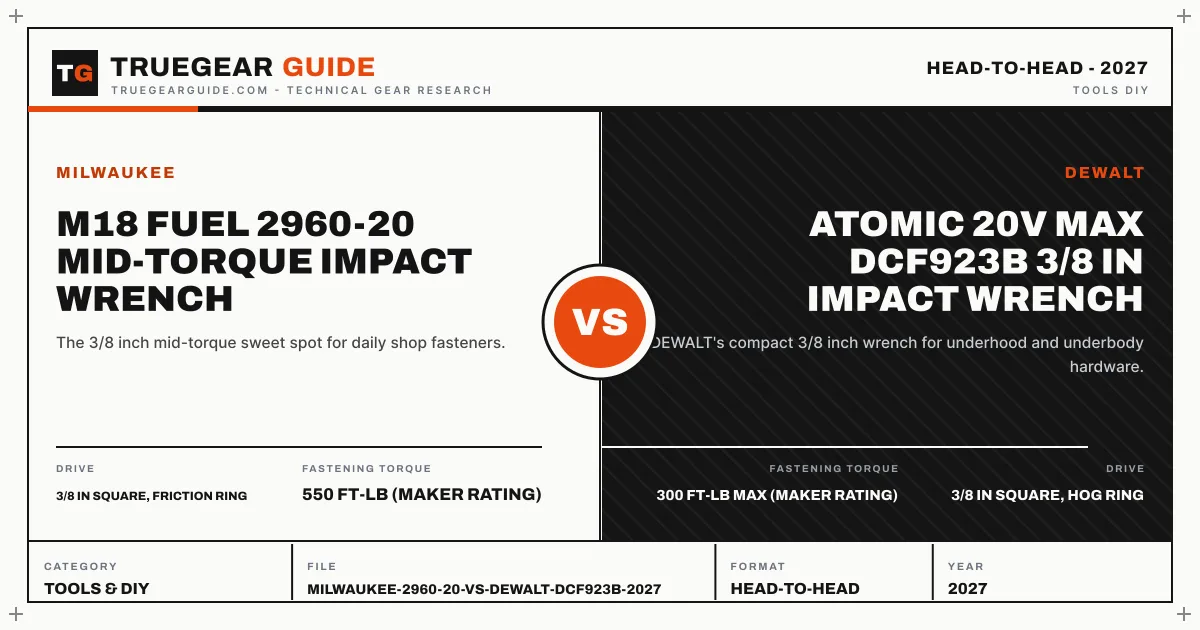

Milwaukee M18 FUEL 2960-20 Mid-Torque Impact Wrench
The 3/8 inch mid-torque sweet spot for daily shop fasteners.
- Drive: 3/8 in square, friction ring
- Fastening torque: 550 ft-lb (maker rating)

DEWALT ATOMIC 20V MAX DCF923B 3/8 in Impact Wrench
DEWALT's compact 3/8 inch wrench for underhood and underbody hardware.
- Drive: 3/8 in square, hog ring
- Fastening torque: 300 ft-lb max (maker rating)
What owners report
Most praised
- It quietly replaced the big high torque gun for most jobs in the bay
- Light enough to carry all day without the forearm fatigue of a flagship
- The LED ring makes brake and suspension bolts visible without a second light
Common complaints
- Owners still reach for a 1/2 inch gun on rusted truck lugs
- Battery choice changes its punch more than owners expect
- The mode indicator is easy to knock and hard to read with dirty gloves
What owners report
Most praised
- The size is right for caliper bracket, subframe and engine accessory bolts
- Precision Wrench mode stops small fasteners from snapping on run-down
- It is light enough for a full day of underbody work
Common complaints
- Owners confirm it is not a truck lug tool despite the strong numbers for its size
- The mode switch is small to work with gloves on
- Some owners end up buying the 1/2 inch sibling as well for wheel work
Our recommendation
These two share a drive size and nothing else. The Milwaukee 2960-20 is a true mid-torque wrench: 600 ft-lb of nut-busting torque that covers car lugs, suspension and the heavy end of bay work. The DEWALT DCF923B is a compact: 450 ft-lb of breakaway in a smaller, lighter ATOMIC body built for brakes, engine hardware and underbody fasteners. Buy the Milwaukee if one 3/8 wrench must do nearly everything including wheels. Buy the DEWALT if access and all-day lightness outrank peak torque, or if your shop is yellow. Many bays end up owning the class both tools point at: a mid-torque for work, a compact for reach.
Torque classes, not just numbers
The Milwaukee's 550 ft-lb fastening and 600 ft-lb nut-busting ratings are mid-torque class figures, enough for maintained car lugs and corroded suspension bolts. The DEWALT's 300 ft-lb fastening and 450 ft-lb breakaway are compact-class figures, aimed at hardware rather than wheels. The 150 ft-lb breakaway gap decides rusty lug jobs outright.
Size and all-day handling
The DEWALT is the smaller, lighter tool at roughly 2.76 lb per its listing, shaped for engine bays and overhead underbody work. The Milwaukee, at 6.0 inches and around 3.4 lb bare, is compact for its class but visibly the bigger wrench in hand. Over an eight-hour day of brake work, the DEWALT's size is a genuine ergonomic argument.
Control features
Milwaukee brings auto shut-off forward control and bolt removal slowdown, the flagship-derived pair. DEWALT brings Precision Wrench run-down protection plus a Timber Screw mode that gives the little wrench a second life driving lags in timber and site work. The Milwaukee's set serves the bay better; the DEWALT's serves a wider, scruffier job list.
Platform and batteries
M18 versus 20V MAX decides most real purchases before torque is discussed. Both tools reward bigger packs; the Milwaukee in particular is a different tool on high-output batteries. If your chargers already wear one of these colours, this section is the whole comparison.
Choose Milwaukee M18 FUEL 2960-20 Mid-Torque Impact Wrench if…
- One 3/8 wrench must cover wheels as well as bay work
- Suspension and corroded hardware are regular tickets
- You are on the Milwaukee M18 platform
- Auto shut-off and bolt removal modes matter to your workflow
Choose DEWALT ATOMIC 20V MAX DCF923B 3/8 in Impact Wrench if…
- Engine bay access and light weight beat peak torque
- Brakes, underbody and assembly hardware are the whole job list
- You are on the DEWALT 20V MAX platform
- A second life driving timber lags appeals to you
Questions, answered
Can either of these be my only impact wrench?
The Milwaukee can, for car-focused work: it spans small hardware control to lug removal. The DEWALT as a sole wrench leaves wheel and heavy work underpowered; it is designed as the compact half of a two-wrench kit.
Which is better for brake jobs?
Both excel, differently. The DEWALT's size wins in tight caliper and bracket spaces; the Milwaukee's extra torque wins on corroded slide-pin and bracket bolts in rust regions. Salt-belt techs pick the Milwaukee, everyone else splits by platform.
Is the DCF923B just a weaker 2960-20?
No, it is a different class of tool: compact rather than mid-torque, smaller and lighter by design, with a job list centred on hardware instead of wheels. Judging it by the Milwaukee's torque ceiling misses why it exists, in the same way the Milwaukee would be a clumsy engine bay tool.
Every guide on Impact Wrenches15 pages
- Topic hubImpact Wrenches
- Best ofThe Best Impact Wrenches (2027)
- This ranking is built on one measurement that matters for wheels: breakaway torque, the loosening figure. Correctly torqued car lugs yield to almost anything here. The ranking separates on the hard cases: lugs a shop over-torqued last year, rust-belt corrosion, and truck wheels tightened to the top of the passenger range. Compact-class tools are included only where their rating honestly covers correctly torqued car lugs, and the note says so.The Best Impact Wrenches for Lug Nuts (2027)
- Professional use inverts the usual ranking. The flagship high torque gun matters, but a mechanic's day is brakes, suspension, subframes and engine hardware, much of it on 3/8 inch sockets in spaces a flagship cannot enter. This ranking weights size, mode control and all-day weight ahead of headline torque, and reserves the big guns for the seized hardware they are actually for.The Best Impact Wrenches for Mechanics (2027)
- A home garage asks different questions than a shop. The jobs are seasonal tire swaps, trailer and mower maintenance, deck and fence hardware, and the occasional rusty bolt on a project car. Completeness matters more than refinement: a kit that works today beats a bare flagship waiting on a battery budget, and the platform you already own beats the platform a magazine prefers.The Best Impact Wrenches for a Home Garage (2027)
- ReviewMilwaukee M18 FUEL 2967-20 High Torque Impact Wrench Review (2027)
- ReviewDEWALT 20V MAX XR DCF961B High Torque Impact Wrench Review (2027)
- ReviewIngersoll Rand W7152-K12 20V High Torque Impact Wrench Kit Review (2027)
- ReviewMilwaukee M18 FUEL 2960-20 Mid-Torque Impact Wrench Review (2027)
- ReviewRyobi ONE+ HP 18V P262 Impact Wrench Review (2027)
- ReviewMilwaukee M12 FUEL 2562-20 Stubby Impact Wrench Review (2027)
- Head to headMilwaukee 2967-20 vs DEWALT DCF961B (2027)
- Buying guideImpact Wrench Buying Guide (2027)
- Fix itImpact Wrench Not Removing Lug Nuts? Fixes (2027)