Head to head
Milwaukee 2967-20 vs DEWALT DCF961B (2027)
The two flagship cordless wrenches compared: Milwaukee 2967-20 against DEWALT DCF961B on breakaway torque, size, control modes and platform, for 2027 buyers.
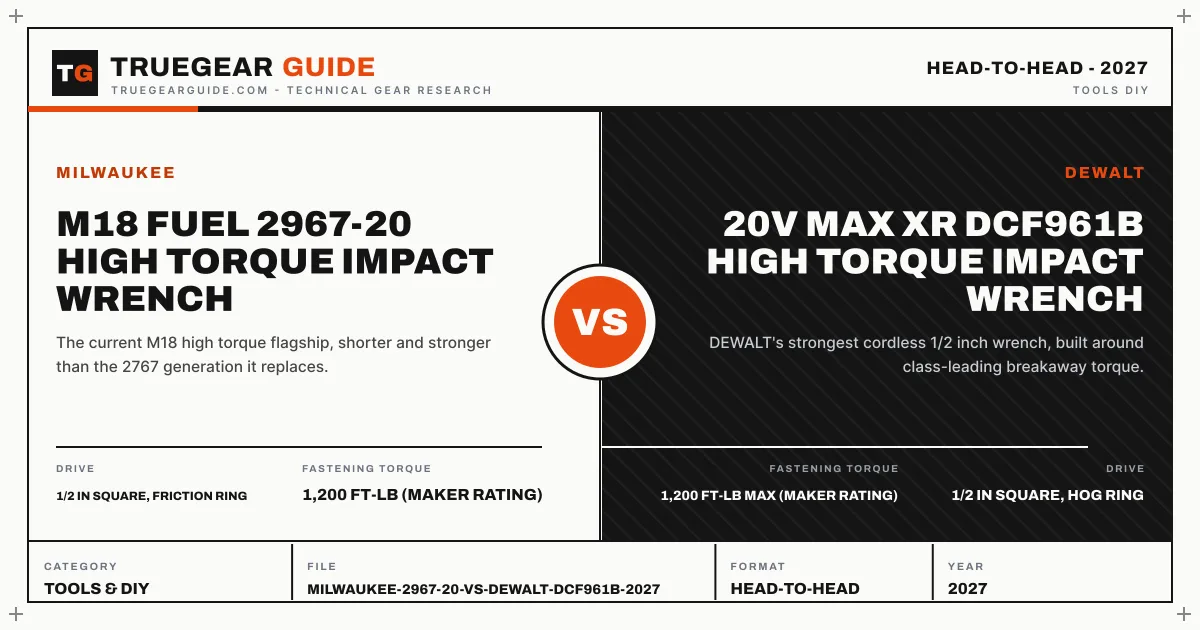

Milwaukee M18 FUEL 2967-20 High Torque Impact Wrench
The current M18 high torque flagship, shorter and stronger than the 2767 generation it replaces.
- Drive: 1/2 in square, friction ring
- Fastening torque: 1,200 ft-lb (maker rating)

DEWALT 20V MAX XR DCF961B High Torque Impact Wrench
DEWALT's strongest cordless 1/2 inch wrench, built around class-leading breakaway torque.
- Drive: 1/2 in square, hog ring
- Fastening torque: 1,200 ft-lb max (maker rating)
What owners report
Most praised
- It removes rusted, shop-installed lugs that stalled the owner's previous cordless gun
- The shorter head gets onto suspension and subframe bolts the old high torque body could not reach
- Bolt removal mode stops freed nuts from launching across the shop floor
Common complaints
- The weight adds up over a full day of wheel and suspension work
- Going bare-tool means the battery investment is a second purchase decision
- The forward and reverse button sits where the web of the thumb can nudge it mid-job
What owners report
Most praised
- It frees corroded lugs and crank bolts that other cordless wrenches in the shop gave up on
- The delayed power boost on stuck fasteners feels like a second gear engaging
- Precision Wrench mode makes it usable for run-down work, not just demolition
Common complaints
- The size and weight are the first thing owners mention, in bays and overhead
- It drains mid-size batteries quickly when run at full output
- For ordinary tire rotations it is simply more tool than the job asks for
Our recommendation
Choose the platform first; both of these wrenches deserve their flagship status. The DEWALT DCF961B posts the bigger breakaway number, 1,750 ft-lb against 1,600, and its sustained-impact power boost is a real weapon on corroded fasteners. The Milwaukee 2967-20 answers with a shorter body, a more granular four-mode Drive Control, and bolt removal behaviour that suits mixed shop work better. If your worst fasteners define the purchase, take the DEWALT. If the wrench must also behave all day on ordinary work, take the Milwaukee. If you own neither platform, the tiebreaker is the rest of the catalog you will buy into.
Breakaway torque and how it arrives
DEWALT rates the DCF961B at 1,750 ft-lb of max breakaway against the Milwaukee's 1,600 ft-lb nut-busting figure, with both tools fastening at 1,200 ft-lb. The DEWALT also adds output automatically after about four seconds of sustained impacting. On the single worst fastener of the year, that combination is the stronger hand. On the other ten thousand fasteners, the difference never appears.
Body size and handling
The Milwaukee is the smaller tool: 7.6 inches long where the DEWALT is a physically larger flagship, and that shows in subframes, suspension turrets and deep wheel wells. Both are heavy with the large packs they prefer. Techs who work in passenger car bays tend to prefer the Milwaukee's footprint; fleet and agricultural users rarely notice the DEWALT's size at all.
Control systems
Milwaukee's four-mode Drive Control with dedicated auto shut-off and bolt removal modes is the more detailed system, tuned for run-down finesse. DEWALT counters with a simpler four-mode switch and Precision Wrench control that pauses before full impact on tightening. Both work; the Milwaukee gives the operator more distinct behaviours to learn, the DEWALT fewer decisions to make.
Anvils, lights and details
The Milwaukee's friction ring and the DEWALT's hog ring both change sockets quickly; the Milwaukee's Tri-LED ring throws fewer shadows than the DEWALT's single work light. Small things, but on a tool used daily for years, lighting and socket feel are the differences owners actually describe.
Choose Milwaukee M18 FUEL 2967-20 High Torque Impact Wrench if…
- You already own M18 batteries and tools
- Your work mixes heavy removal with careful run-down in car bays
- The shorter body matters for suspension and subframe access
- You value granular modes, including auto shut-off and bolt removal control
Choose DEWALT 20V MAX XR DCF961B High Torque Impact Wrench if…
- You already own 20V MAX batteries and tools
- Seized, corroded and over-torqued fasteners are your defining jobs
- Maximum breakaway torque is the specification you are buying
- You prefer a simpler four-mode switch over a deeper mode menu
Questions, answered
Which one removes rusted lug nuts better?
On paper and in the worst cases, the DEWALT: 1,750 ft-lb of rated breakaway plus the power boost on sustained impacting. In ordinary rusted-wheel work both tools finish the job, and either can still be beaten by corrosion severe enough to need heat or a breaker bar first.
Which is better for a mixed-use shop?
The Milwaukee, on the strength of its shorter body and its control modes, which make a flagship usable on a wider range of tickets. Shops skewed toward heavy truck and fleet work lean DEWALT for the breakaway ceiling.
Do these wrenches need special batteries?
They run on standard packs from their platforms, but rated torque assumes the large high-output batteries each brand sells. Budget for at least one big pack with either tool; on compact batteries both are diminished versions of themselves.
Every guide on Impact Wrenches15 pages
- Topic hubImpact Wrenches
- Best ofThe Best Impact Wrenches (2027)
- This ranking is built on one measurement that matters for wheels: breakaway torque, the loosening figure. Correctly torqued car lugs yield to almost anything here. The ranking separates on the hard cases: lugs a shop over-torqued last year, rust-belt corrosion, and truck wheels tightened to the top of the passenger range. Compact-class tools are included only where their rating honestly covers correctly torqued car lugs, and the note says so.The Best Impact Wrenches for Lug Nuts (2027)
- Professional use inverts the usual ranking. The flagship high torque gun matters, but a mechanic's day is brakes, suspension, subframes and engine hardware, much of it on 3/8 inch sockets in spaces a flagship cannot enter. This ranking weights size, mode control and all-day weight ahead of headline torque, and reserves the big guns for the seized hardware they are actually for.The Best Impact Wrenches for Mechanics (2027)
- A home garage asks different questions than a shop. The jobs are seasonal tire swaps, trailer and mower maintenance, deck and fence hardware, and the occasional rusty bolt on a project car. Completeness matters more than refinement: a kit that works today beats a bare flagship waiting on a battery budget, and the platform you already own beats the platform a magazine prefers.The Best Impact Wrenches for a Home Garage (2027)
- ReviewMilwaukee M18 FUEL 2967-20 High Torque Impact Wrench Review (2027)
- ReviewDEWALT 20V MAX XR DCF961B High Torque Impact Wrench Review (2027)
- ReviewIngersoll Rand W7152-K12 20V High Torque Impact Wrench Kit Review (2027)
- ReviewMilwaukee M18 FUEL 2960-20 Mid-Torque Impact Wrench Review (2027)
- ReviewRyobi ONE+ HP 18V P262 Impact Wrench Review (2027)
- ReviewMilwaukee M12 FUEL 2562-20 Stubby Impact Wrench Review (2027)
- Head to headMilwaukee 2960-20 vs DEWALT DCF923B (2027)
- Buying guideImpact Wrench Buying Guide (2027)
- Fix itImpact Wrench Not Removing Lug Nuts? Fixes (2027)