Head to head
Milwaukee Fastback 48-22-1540 5-in-1 Knife vs Stanley Classic 99 Retractable Knife (2027)
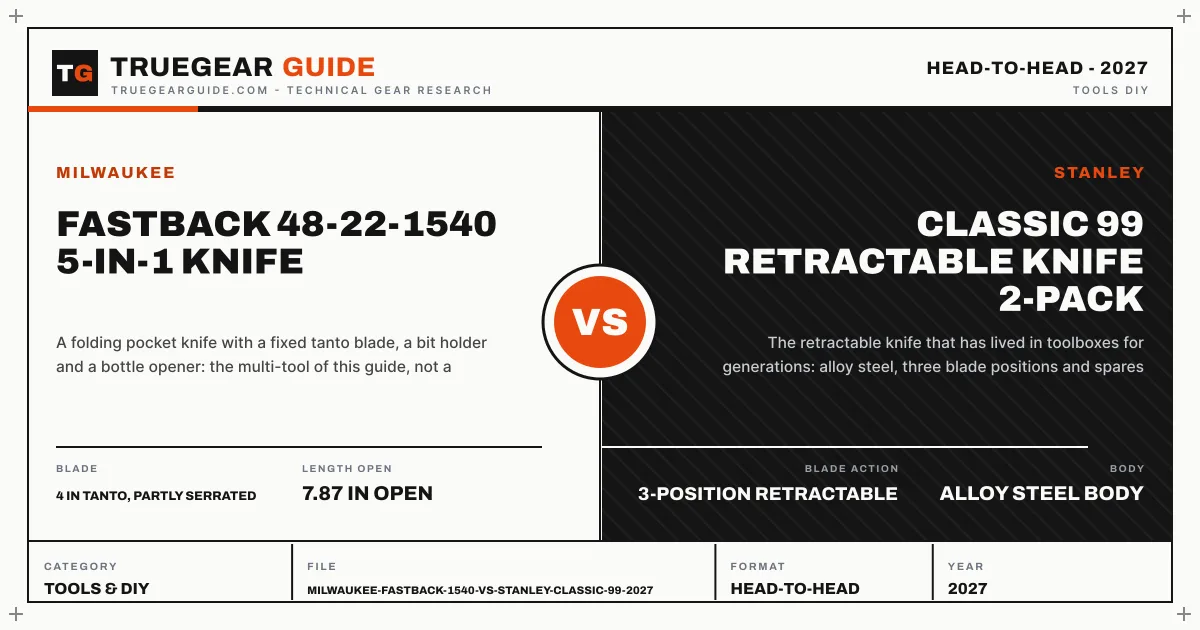
The Milwaukee Fastback 48-22-1540 folding knife against the Stanley Classic 99 retractable knife: a fixed blade multi-tool against the classic replaceable-blade slider.

Milwaukee Fastback 48-22-1540 5-in-1 Knife
A folding pocket knife with a fixed tanto blade, a bit holder and a bottle opener: the multi-tool of this guide, not a replaceable-blade cutter.
- Blade: 4 in tanto, partly serrated
- Length open: 7.87 in open

Stanley Classic 99 Retractable Knife 2-Pack
The retractable knife that has lived in toolboxes for generations: alloy steel, three blade positions and spares inside the handle.
- Body: Alloy steel body
- Blade action: 3-position retractable
What owners report
Most praised
- The fixed tanto blade stays sharp through box after box, and owners like not swapping a blade mid-job
- The press-and-flip opening works one-handed even with gloves on, which is the feature owners reach for first
- The fold-out bit holder turns a pocket knife into the tool that tightens the loose screw on the spot
Common complaints
- A fixed blade cannot be swapped when it dulls, so owners who cut abrasive material end up sharpening instead of replacing
- The partly serrated edge is awkward to sharpen evenly, and owners say the serrations stay dull longest
- At nearly eight inches open it rides long in a pocket, and owners with smaller pockets feel the length
What owners report
Most praised
- The alloy body has survived drops onto concrete that cracked the plastic knives owners carried before
- Three blade positions let owners match the exposed edge to the cut, from shallow scoring to full-depth slicing
- Spare blades ride inside the handle, so a dull edge is a thirty-second swap instead of a trip to the toolbox
Common complaints
- The retractable slider collects dust and grit, and owners say it starts to drag until it is blown out
- Two knives in the pack means the second one often sits unused while the first does all the work
- The slim handle feels thin in a large hand, and owners with gloves on want more to grip
Our recommendation
Buy the Milwaukee if you want a pocket knife that does more than cut: a fixed tanto blade, a bit holder, a bottle opener and one-handed opening in a tool you carry everywhere. Buy the Stanley if you want a utility knife in the classic sense: a replaceable blade, three positions and spares in the handle, at a budget tier, sold as a two-pack. The honest answer for a busy household is both: the Milwaukee in the pocket for daily carry and small jobs, the Stanley in the toolbox for boxes and cutting sessions. If you can buy only one, choose by the blade: fixed and sharpened, or replaceable and swapped.
Blade: fixed tanto against replaceable trapezoid
The Milwaukee's 4 inch stainless tanto blade is fixed to the handle and must be sharpened when it dulls. It holds its edge longer than a disposable blade and never needs a spare in the pocket. The Stanley's standard trapezoid blade swaps in seconds and spares ride inside the handle, so a dull edge is a thirty-second fix. The Milwaukee suits owners who sharpen; the Stanley suits owners who swap. Neither is better in the abstract: the right blade is the one whose maintenance you will actually do.
Opening: press-and-flip against a slider
The Milwaukee opens one-handed with a press-and-flip mechanism and locks open with a liner lock, which is the fastest opening in this guide and the one that works best with gloves on. The Stanley extends with a slider through three positions, which gives exact control over how much blade is exposed but needs two hands to set and a clean channel to run smooth. Pocket carry favours the Milwaukee's fold; bench work favours the Stanley's slider.
Extras: a multi-tool against a pure cutter
The Milwaukee is a 5-in-1: a bit holder with a reversible Phillips and slotted bit, a bottle opener, a belt clip and a lanyard hole alongside the blade. The Stanley is a pure cutter: an alloy body, three blade positions and spare storage, with nothing else attached. Buyers who tighten screws and open bottles as often as they cut boxes will use the Milwaukee's extras daily. Buyers who only cut will never miss them, and the Stanley's simplicity is its own virtue.
Price tier and pack: premium single against budget two-pack
The Milwaukee sits at the premium tier as a single knife, and the price buys the fixed blade, the bit holder and the one-handed opening. The Stanley sits at the budget tier as a two-pack, and the price buys two alloy knives with spares in the handle. The Milwaukee is the better single tool; the Stanley is the better value for a household that wants a knife in more than one place. Cost per knife favours the Stanley by a wide margin; capability per knife favours the Milwaukee.
Choose Milwaukee Fastback 48-22-1540 5-in-1 Knife if…
- You sharpen your knives and want a fixed blade that holds its edge
- One-handed opening and a pocket clip matter to you
- A bit holder and a bottle opener earn their keep in your day
- You carry one knife everywhere and want it to do the most
Choose Stanley Classic 99 Retractable Knife 2-Pack if…
- You want replaceable blades and a ten-second swap when the edge dulls
- Three blade positions and exact depth control matter to you
- You want two knives for a budget tier, one for the toolbox and one for the truck
- You cut at a bench and want the classic retractable shape
Questions, answered
Can I own both the Milwaukee Fastback and the Stanley 99?
Yes, and many owners do: the Milwaukee in the pocket for daily carry and small jobs, the Stanley in the toolbox for boxes and cutting sessions. Together they cost less than two premium folders and cover every cutting job a household is likely to meet.
Which one is better for opening boxes?
The Stanley, because its three blade positions let the edge sit shallow for tape and deep for cardboard, and a dull edge is a quick swap. The Milwaukee cuts boxes well too, but its fixed blade dulls on abrasive cardboard and must be sharpened, which is slower than swapping.
Which one is better for a beginner?
The Stanley, because its replaceable blade forgives the most common beginner mistake, which is cutting with a dull edge. The Milwaukee is the better knife, but it asks the beginner to learn sharpening, and a dull fixed blade is worse than a fresh replaceable one.
Every guide on Utility Knives15 pages
- Topic hubUtility Knives
- Best ofThe Best EDC Utility Knives (2027)
- Everyday carry inverts the usual ranking. A knife that cuts brilliantly but stays in a drawer is worth nothing, so this guide weights size, weight, clip and one-handed opening above cutting power. Thick cardboard performance barely matters, because daily carry is mostly tape, packaging, cord and the odd loose thread. The OLFA L-1 and the IRWIN safety knife drop out here: the first is too big for a pocket, the second is a warehouse tool that fights the thumb on long cuts. What remains are the knives owners actually have on them when something needs cutting.The Best EDC Utility Knives for Everyday Carry (2027)
- Budget buying is about what a cheap knife must not get wrong. A budget knife still has to lock open, hold its blade steady and take a standard blade, because a knife that wobbles or will not open is not a bargain at any price. This ranking weights the multi-packs heavily: a two-pack or a three-piece set puts a knife in every place one is needed for the price of one premium knife. The two premium knives drop out here, and the ranking is decided by how much honest cutting each tier buys.The Best Budget Utility Knives (2027)
- Opening boxes is the most common utility knife job, and it has its own rules. A deep blade nicks the goods inside the box, so shallow edges win: the Slice 10513's ceramic edge and the IRWIN's 2mm box-cut position are built for exactly this. A blade that retracts itself wins too, because packing work is fast and the knife gets set down between boxes. One-handed opening matters more than cutting power, because the other hand is holding the box. The heavy snap-off OLFA L-1 and the Husky set drop out here: both cut deeper and heavier than package work needs.The Best Utility Knives for Boxes and Packages (2027)
- ReviewMilwaukee Fastback 48-22-1540 5-in-1 Knife Review (2027)
- ReviewStanley Classic 99 Retractable Knife 2-Pack Review (2027)
- ReviewDEWALT DWHT10035L Folding Retractable Knife Review (2027)
- ReviewOLFA L-1 18mm Heavy-Duty Snap-Off Knife Review (2027)
- ReviewKlein FLICKBLADE 44306 2-in-1 Knife/Scraper Review (2027)
- ReviewHusky 3-Pc Compact Folding Knife Set Review (2027)
- Head to headDEWALT DWHT10035L Folding Retractable Knife vs Klein FLICKBLADE 44306 2-in-1 Knife/Scraper (2027)
- Buying guideUtility Knife Buying Guide (2027)
- Fix itUtility Knife Blade Stuck, Wobbly or Dull? Fixes (2027)