Buying guide
Utility Knife Buying Guide (2027)
How to buy a utility knife in 2027: blade types, opening and locking, safety mechanisms, handle and carry, and the ongoing cost of blades.
Blade type: replaceable, snap-off, fixed or ceramic
A standard trapezoid blade is the universal choice: cheap, sold everywhere and swapped in seconds, which is why most knives in this guide take it. A snap-off blade is the heavy cutter's choice: the OLFA L-1's 18mm blade powers through thick cardboard and carpet, and a fresh edge is one snap away. A fixed blade, like the Milwaukee Fastback 48-22-1540's tanto edge, holds its sharpness longer but must be sharpened when it dulls, which is a different ownership habit. A ceramic blade, like the Slice 10513's, cuts tape and film safely and stays sharp, but chips if it is twisted and cannot cut thick board. Buy the blade type that matches your material, not the knife that looks best in a photo, because the blade decides the work and the handle only decides the comfort.
Opening and locking: folding, retractable or slide
A folding knife lives or dies on its open and its lock. Press-and-flip opening, like the Milwaukee's, and a side button, like the Klein's, let the knife open with one hand while the other holds the box. A lock-back, a liner lock or a dual-position lock must hold the blade open under pressure, because a blade that folds back on a finger is the worst failure a utility knife can have. Retractable knives are judged differently: the slider must run smooth, hold its position and not drag when dust gets inside, which is why the Stanley Classic 99's three positions and the FatMax's blade clamp matter. Snap-off sliders like the OLFA A-1 and L-1 are judged on the lock that holds the blade in the channel: the L-1's ratchet wheel is the standard here. Check the lock before you buy, and check it again before every hard cut.
Safety: self-retracting, auto-retract and blade storage
The safest knives in this guide retract the blade by themselves: the IRWIN 2088600 pulls its edge back the moment pressure lifts, and the Slice 10513's manual positions hold the blade where it is set. Folding knives are safe when closed, but only if the lock holds and the blade cannot open in a pocket, which is why a stiff lock on a new folder is a safety feature before it is an annoyance. Snap-off knives are safe when the blade is retracted into the channel, and the OLFA ratchet-wheel lock is what keeps it there. Blade storage matters too: a knife that stores spares inside the handle, like the DEWALT and the Klein, keeps loose blades out of pockets and bags. A knife that relies on the owner remembering to close it is less safe than one that does the work itself, and that gap matters most in shared toolboxes, warehouses and homes with kids around.
Handle, size and carry: grip, clip and weight
After blade type and safety, the handle decides. A rubber grip, like the DEWALT's, stays put with sweaty or dusty hands. A soft-touch grip, like the FatMax's, is kindest through long cutting sessions. A textured grip, like the Husky's, holds with dusty hands at a budget tier. A slim handle, like the Stanley 99's, suits a pocket but cramps a large hand, and a short handle, like the IRWIN's, leaves little room for gloves. Carry decides whether the knife gets used: a belt clip, a holster or a small body puts the knife on you, while a heavy folder gets left behind. Weight matters more than buyers expect: a 2.5 oz OLFA L-1 and a 2.08 oz IRWIN disappear in a pocket, while a nearly six-ounce Klein is felt all day. Buy the knife that fits the pocket and the hand it will live in.
Blades and ongoing cost: standard blades, segments and ceramic
The knife is the cheap part of the decision and the blades are the running cost. Standard trapezoid blades cost pennies, are sold everywhere and fit most knives in this guide, which is why the Stanley 99, the FatMax, the DEWALT, the WORKPRO, the Husky set and the Amazon Basics folder are the cheapest to run. Snap-off blades cost more per blade but carry many fresh edges in one length: an OLFA L-1 blade holds eight segments, so one blade lasts through many fresh edges before it needs replacing. Ceramic blades, like the Slice 10513's, cost the most per blade but stay sharp far longer than steel on tape and film, so the cost per cut can still be low. Count the cost per edge, not the cost per blade, and buy the system whose spares are easy to find: a knife whose blades are hard to buy is a knife that ends up cutting dull.
Start with our top 3
The three highest-ranked products in our full utility knives ranking. Read the in-depth review where one exists, or jump to the product in the ranked list.

Milwaukee Fastback 48-22-1540 5-in-1 Knife
A folding pocket knife with a fixed tanto blade, a bit holder and a bottle opener: the multi-tool of this guide, not a replaceable-blade cutter.
- Blade: 4 in tanto, partly serrated
- Length open: 7.87 in open

Stanley Classic 99 Retractable Knife 2-Pack
The retractable knife that has lived in toolboxes for generations: alloy steel, three blade positions and spares inside the handle.
- Body: Alloy steel body
- Blade action: 3-position retractable
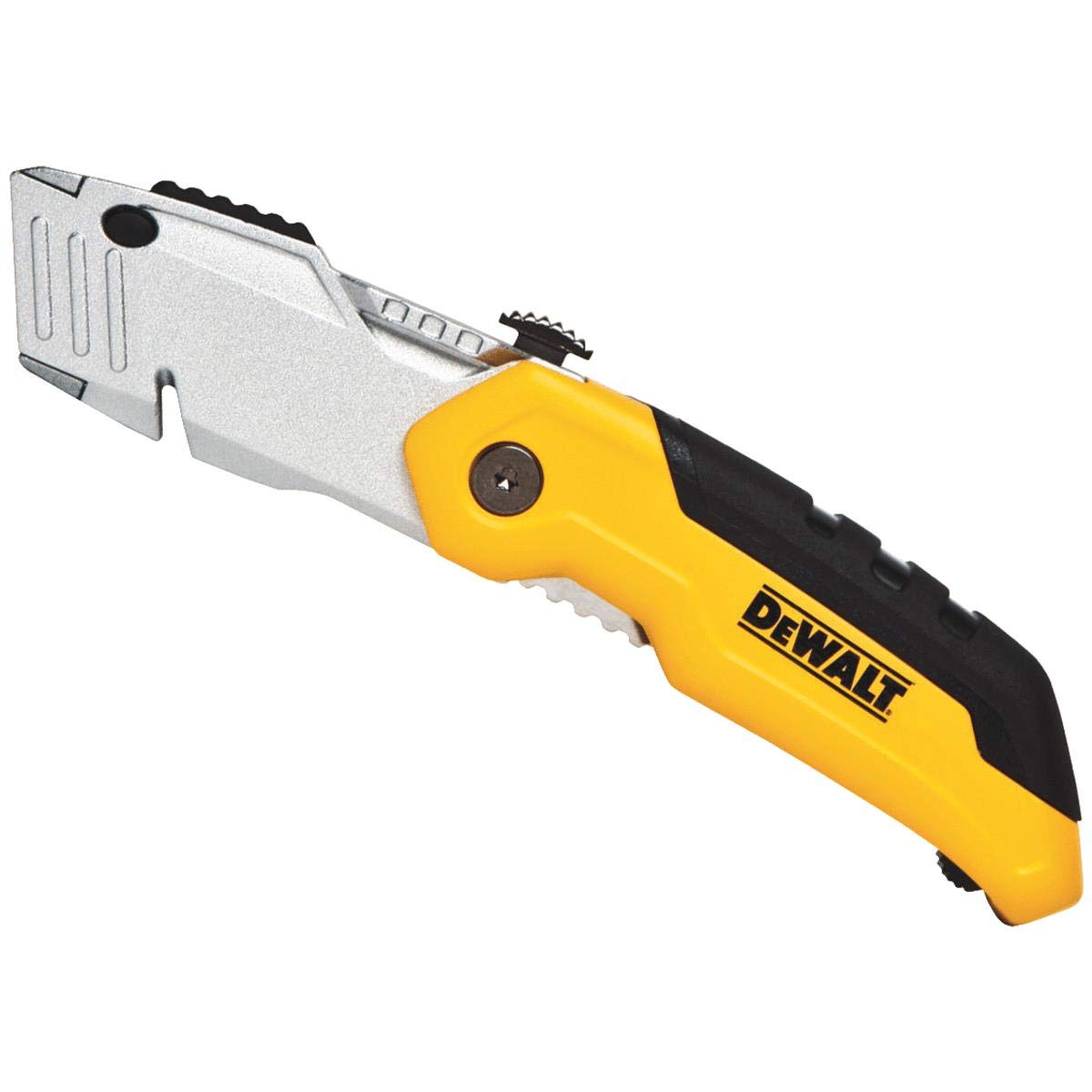
DEWALT DWHT10035L Folding Retractable Knife
The yellow and black folding retractable: a metal body, a rubber grip and blade storage inside the handle.
- Blade action: Retractable, variable depth
- Design: Folding, one-handed open
Questions, answered
How much should I spend on a utility knife?
For a few boxes a month, a budget knife like the Stanley Classic 99 2-pack or the OLFA A-1 does the job honestly. For daily carry, step up to a folding knife like the DEWALT DWHT10035L, which adds a lock, a clip and blade storage. For trade work with scraping, the Klein FLICKBLADE 44306 earns its premium tier. Spend on the mechanism and the grip, not on the brand name.
What blade should my utility knife take?
A standard trapezoid blade for most work, because it is cheap, available everywhere and swapped in seconds. A snap-off blade for heavy cutting, because a fresh edge is one snap away. A ceramic blade for tape and packaging where safety matters. A fixed blade only if you sharpen your knives and want an edge that holds longer than a disposable blade.
How do I know if a folding utility knife is safe?
Check three things: the blade opens fully and locks with a solid click, the lock holds when you push the blade against a surface, and the blade cannot open in your pocket when the knife is closed. A stiff lock on a new folder is normal and loosens with use. A blade that wobbles side to side or folds back under pressure is not safe, and the knife should be tightened or replaced.
How do I store a utility knife safely?
Close the blade or retract it fully, and store the knife with the edge covered: folded shut, retracted into the handle, or in its holster. Keep spare blades in the knife's own storage or in a blade dispenser, never loose in a drawer or a pocket. Hang the knife by its clip or hook, or lay it flat in a dry place, and keep it out of reach of children.
Every guide on Utility Knives15 pages
- Topic hubUtility Knives
- Best ofThe Best EDC Utility Knives (2027)
- Everyday carry inverts the usual ranking. A knife that cuts brilliantly but stays in a drawer is worth nothing, so this guide weights size, weight, clip and one-handed opening above cutting power. Thick cardboard performance barely matters, because daily carry is mostly tape, packaging, cord and the odd loose thread. The OLFA L-1 and the IRWIN safety knife drop out here: the first is too big for a pocket, the second is a warehouse tool that fights the thumb on long cuts. What remains are the knives owners actually have on them when something needs cutting.The Best EDC Utility Knives for Everyday Carry (2027)
- Budget buying is about what a cheap knife must not get wrong. A budget knife still has to lock open, hold its blade steady and take a standard blade, because a knife that wobbles or will not open is not a bargain at any price. This ranking weights the multi-packs heavily: a two-pack or a three-piece set puts a knife in every place one is needed for the price of one premium knife. The two premium knives drop out here, and the ranking is decided by how much honest cutting each tier buys.The Best Budget Utility Knives (2027)
- Opening boxes is the most common utility knife job, and it has its own rules. A deep blade nicks the goods inside the box, so shallow edges win: the Slice 10513's ceramic edge and the IRWIN's 2mm box-cut position are built for exactly this. A blade that retracts itself wins too, because packing work is fast and the knife gets set down between boxes. One-handed opening matters more than cutting power, because the other hand is holding the box. The heavy snap-off OLFA L-1 and the Husky set drop out here: both cut deeper and heavier than package work needs.The Best Utility Knives for Boxes and Packages (2027)
- ReviewMilwaukee Fastback 48-22-1540 5-in-1 Knife Review (2027)
- ReviewStanley Classic 99 Retractable Knife 2-Pack Review (2027)
- ReviewDEWALT DWHT10035L Folding Retractable Knife Review (2027)
- ReviewOLFA L-1 18mm Heavy-Duty Snap-Off Knife Review (2027)
- ReviewKlein FLICKBLADE 44306 2-in-1 Knife/Scraper Review (2027)
- ReviewHusky 3-Pc Compact Folding Knife Set Review (2027)
- Head to headMilwaukee Fastback 48-22-1540 5-in-1 Knife vs Stanley Classic 99 Retractable Knife (2027)
- Head to headDEWALT DWHT10035L Folding Retractable Knife vs Klein FLICKBLADE 44306 2-in-1 Knife/Scraper (2027)
- Fix itUtility Knife Blade Stuck, Wobbly or Dull? Fixes (2027)