Head to head
BioLite AlpenGlow 500 vs Coleman Classic Rechargeable 800L (2027)
Two big rechargeable camp lanterns compared: the BioLite AlpenGlow 500 against the Coleman Classic Rechargeable 800L, on brightness, battery, light quality and charging.
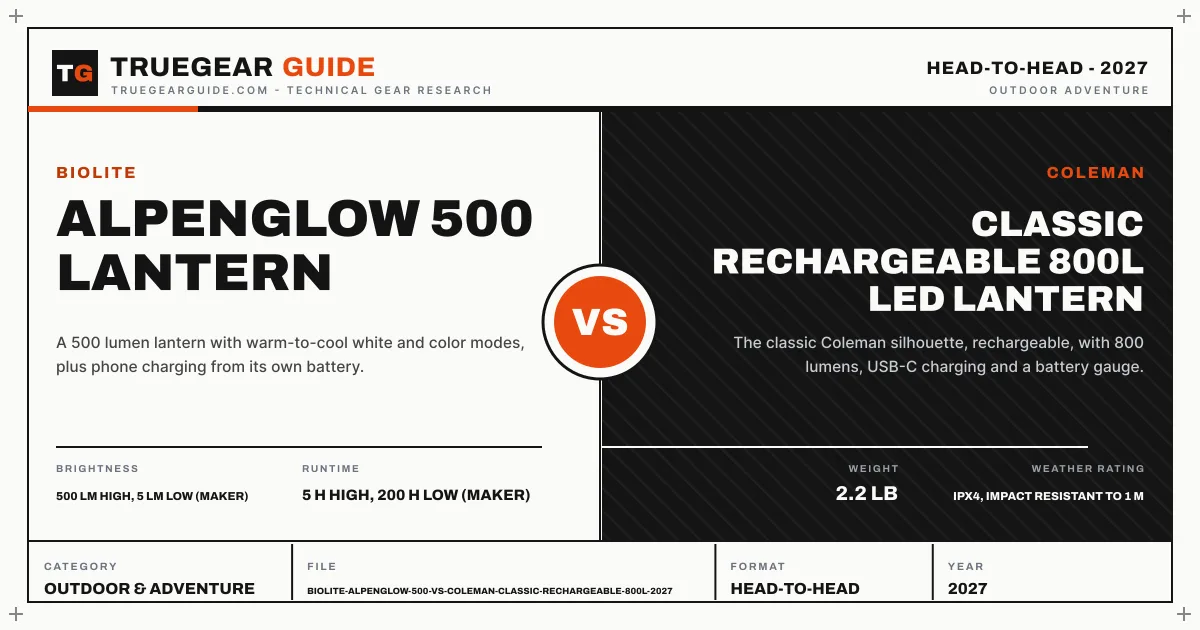

A 500 lumen lantern with warm-to-cool white and color modes, plus phone charging from its own battery.
- Brightness: 500 lm high, 5 lm low (maker)
- Runtime: 5 h high, 200 h low (maker)

Coleman Classic Rechargeable 800L LED Lantern
The classic Coleman silhouette, rechargeable, with 800 lumens, USB-C charging and a battery gauge.
- Weather rating: IPX4, impact resistant to 1 m
- Weight: 2.2 lb
What owners report
Most praised
- Warm-to-cool white plus color modes let one lantern cover reading light and relaxed evening glow without a second lamp
- The shaded, lantern-style glow spreads softly instead of throwing a harsh spot across the tent
- USB-A output that tops up a phone from the lantern earns its place as the shared camp power source
Common complaints
- The micro-USB input feels dated next to newer USB-C gear and forces a separate cable in the kit
- Brightest output drains the pack fast, so the headline brightness is not an all-night setting
- The lantern is heavier and bulkier than ultralight options, which matters when every gram is packed by hand
What owners report
Most praised
- The carabiner handle plus bail handle make it easy to clip to a pack or hang from a branch
- USB output that charges a phone turns the lantern into a backup power source at camp
- The battery level indicator removes guesswork about how much runtime is left
Common complaints
- At over two pounds it is one of the heavier lanterns here, better suited to car camping than backpacking
- Highest brightness drains the pack in a few hours, so all-night light means dropping to a lower mode
- The larger body takes up real space in a packed bin compared with collapsible lanterns
Our recommendation
Both of these lanterns anchor a car-camp table, and the choice comes down to what the evening is for. The Coleman wins on raw output and simplicity: 800 lumens, USB-C charging, a battery gauge and a familiar classic shape, with no mode list to learn. The BioLite wins on versatility: 500 lumens is plenty for most tables, and warm, cool and color modes plus single-side light turn one lantern into a reading light, a dinner light and a social light across one night. If the lantern's job is to light a group cooking area brightly and simply, take the Coleman. If one lantern must cover the whole evening, from cooking to cards to bedtime, take the BioLite.
Brightness and battery capacity
The Coleman posts the bigger headline: 800 lumens on high against the BioLite's 500, with a 4,800 mAh battery against the BioLite's 6,400 mAh. In practice the BioLite's larger battery at a lower maximum gives it the longer low-mode runtime, up to 200 hours at 5 lumens against the Coleman's 45 hours at 100 lumens, though the two low modes are not directly comparable. For a single evening at table brightness, both last comfortably; across a multi-night trip on low modes, the BioLite stretches further.
Light quality and modes
This is the real gap. The Coleman offers three white levels, high, medium and low, which is all a cooking table needs. The BioLite offers warm white, cool white, single color, multicolor, single-side light, candle flicker and party modes, which is what an evening needs after cooking ends. Campers who eat and sleep early will never use the BioLite's extra modes; campers whose campsite turns social after dinner will use them every night. Neither lantern is wrong, but they are built for different evenings.
Charging, size and handling
The Coleman charges by USB-C, the current standard, and shows its remaining battery on a gauge, which removes the two most common rechargeable frustrations. The BioLite charges by micro-USB, which needs a deliberate cable in the kit, and has no battery gauge, though its USB-A output charges a phone like the Coleman's does. On size the Coleman is the bigger lantern at 2.2 lb and 11 inches tall against the BioLite's 13.8 oz, so the BioLite packs easier while the Coleman feels more planted on a table. Both carry IPX4 weather resistance.
Choose BioLite AlpenGlow 500 Lantern if…
- One lantern must cover cooking, reading and social evenings
- Warm, cool and color modes matter more than maximum brightness
- The longest low-mode runtime across a multi-night trip matters
- A lighter, more packable lantern is worth a micro-USB cable
Choose Coleman Classic Rechargeable 800L LED Lantern if…
- Maximum brightness for a group cooking area is the priority
- USB-C charging and a battery gauge matter more than extra modes
- A simple three-level lantern with no mode list to learn is preferred
- The classic Coleman shape and stable table presence appeal
Questions, answered
Which is brighter, the AlpenGlow 500 or the Coleman 800L?
The Coleman, on maximum: 800 lumens against 500. For table use the difference is noticeable but not decisive, since both lanterns spend most evenings on mid modes well below their maximums. Brightness alone should not decide this pair; the mode list and the charging input matter more in daily use.
Which lasts longer on a camping trip?
On low modes, the BioLite: up to 200 hours at 5 lumens against the Coleman's 45 hours at 100 lumens, though the low modes differ in brightness. On high modes both last about 5 hours. For a weekend of evenings on mid modes, either lantern covers the trip on one charge, and the BioLite's larger battery gives it the edge across a longer trip.
Which charges a phone?
Both. The BioLite and the Coleman each offer a USB-A output that charges a phone from the lantern battery. Expect roughly one phone charge from either battery, and remember that charging a device shortens the night's light, so charge early in the evening and drop to a low mode after.
Every guide on Camping Lanterns15 pages
- Topic hubCamping Lanterns
- Best ofThe Best Camping Lanterns (2027)
- Rechargeable lanterns split into two families that should not be ranked against each other directly. The first is the big car-camp lantern: a 4,000 to 6,400 mAh battery, 500 to 1,000 lumens, and a phone-charging output, built to anchor a table for an evening. The second is the pocket lantern: a tiny battery, solar or USB charging, and a weight measured in ounces, built to hang in a tent for days on low. This guide ranks both families on the same honest test: how long the light you actually use lasts, and how it gets its charge back.The Best Rechargeable Camping Lanterns (2027)
- A collapsible lantern is judged on two sizes, not one: how big it is when lit, and how small it is when packed. The best designs here shrink to a flat disc, a thin puck or a bulb, then open into a full lantern at camp. That matters most for backpackers, who trade volume as carefully as weight, and for families, who need four lanterns to fit in one bin without a dedicated case. Brightness takes second place in this guide on purpose: a collapsible lantern that stays home because it does not pack is worse than a dimmer one that comes along.The Best Collapsible Camping Lanterns (2027)
- Tent light and table light are different jobs, and a lantern that does one well often does the other badly. A tent wants soft, even, dimmable light with no glare, hung above head height, in a body that cannot be knocked onto bedding. A table wants brighter, wider light that reaches every plate without blinding the person opposite. This guide separates the two jobs, then names the lanterns that genuinely cover both, because most campsites need a tent light and a table light on the same night.The Best Camping Lanterns for Tents and Tables (2027)
- ReviewBioLite AlpenGlow 500 Lantern Review (2027)
- ReviewVont 2 Pack LED Camping Lantern Review (2027)
- ReviewGoal Zero Lighthouse Micro Flash Review (2027)
- ReviewLE 1000LM Battery Powered LED Camping Lantern Review (2027)
- ReviewBlack Diamond Moji Lantern Review (2027)
- ReviewEtekcity Camping Lanterns for Power Outages, 4 Pack Review (2027)
- Head to headGoal Zero Lighthouse Micro Flash vs Goal Zero Crush Light Chroma (2027)
- Buying guideCamping Lantern Buying Guide (2027)
- Fix itCamping Lantern Not Working? Fixes (2027)