Buying guide
Camping Lantern Buying Guide (2027)
How to buy a camping lantern in 2027: lumens and runtime, rechargeable versus battery power, weight, weather ratings and hanging versus standing, explained without the marketing.
Lumens and runtime, read as a pair
A lantern's lumen figure and its runtime figure describe different modes, and reading them as if they described the same mode is the most common buying mistake. The headline lumens are the maximum, lasting a few hours; the headline runtime is the low mode, lasting days or weeks. The useful comparison is the range: a lantern that runs 5 to 500 lumens with 5 to 200 hours of runtime tells you what an evening actually looks like, while a lantern that quotes only one number of each hides the trade. For tent use, weight the low and mid modes; for a cooking table, weight the mid and high modes; and never buy on maximum lumens alone.
Rechargeable versus battery power
Rechargeable lanterns suit regular car camping: no battery buying, and several models charge a phone as well. Their limits are charging time, cable compatibility and a battery that ages over years. Battery lanterns suit emergency kits and long trips: AA, AAA and D cells store for years, are sold everywhere, and need no outlet. Solar charging sits between the two: a slow top-up that stretches a trip, not a replacement for a charger. The practical answer for many campers is one of each, a rechargeable main lantern and a battery backup, so a flat battery never ends the evening.
Weight, packed size and how the lantern travels
A lantern's travel method decides its weight budget. In a car, weight barely matters, and a 2.2 lb lantern is fine. On a back, every ounce is argued over, and the choice narrows to lights under 4 oz. Collapsible designs change the maths: a lantern that crushes to half an inch or folds flat can travel in a pocket where a rigid lantern of the same brightness cannot. Measure the pocket or bin the lantern will actually live in, not the tent it will light, and remember that multi-packs multiply both weight and battery needs by the number of lanterns.
Weather ratings and real rain
IPX4, the most common rating here, means resistance to splashing water from any direction, which covers rain at camp. IPX5 covers low-pressure jets and IPX6 covers powerful jets, both a step up, and both still stop short of submersion. No lantern in this guide is rated to be dropped in a stream or left in a puddle. Practical rain care matters as much as the rating: close charging port covers before rain, hang lanterns under a tarp in a storm, and dry a wet lantern before charging it, since water in a charging port is a bigger risk than water on a sealed body.
Hanging, standing and light quality
A tent light should hang above head height, so a hook or loop is essential and a stable base is irrelevant. A table light should stand stable in the middle of the table, so a wide base matters and a hook is a bonus. Light quality decides whether either job feels good: frosted globes and shaded designs spread soft, even light without glare, while bare LEDs throw hard light and shadows. Color temperature is the final piece: cool white for tasks, warm white for eating and talking, and lanterns offering both cover a whole evening from one unit. Choose the hanging or standing shape for the space, then judge the light itself by softness, not by lumens.
Start with our top 3
The three highest-ranked products in our full camping lanterns ranking. Read the in-depth review where one exists, or jump to the product in the ranked list.

A 500 lumen lantern with warm-to-cool white and color modes, plus phone charging from its own battery.
- Brightness: 500 lm high, 5 lm low (maker)
- Runtime: 5 h high, 200 h low (maker)
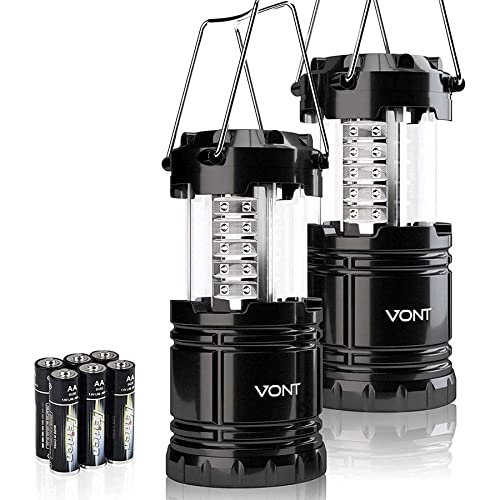
Vont 2 Pack LED Camping Lantern
Two collapsible lanterns that pack flat, dim by sliding, and run on ordinary AA batteries.
- Brightness: 140 lumens maximum (listing)
- Runtime: Up to 90 hours (listing)

Goal Zero Lighthouse Micro Flash
A 2.4 oz lantern and flashlight in one, with USB and solar charging for trips far from an outlet.
- Weight: 2.4 oz
- Weather rating: IPX6
Questions, answered
How much should I spend on a camping lantern?
For a first lantern, a budget multi-pack or a single battery lantern covers most needs well, and the money saved can go to batteries or a second light. Step up to the premium tier when a specific feature earns it: a large rechargeable battery with phone charging, color modes for long evenings, or a strong weather rating for exposed trips. The most expensive lantern is not the brightest in this guide, and the cheapest multi-pack lights more spaces than any single flagship, so spend on the feature you will use every night, not on the headline number.
How many lanterns do I need for a family camping trip?
Plan one per space, not one per site: one for each tent and one for the table is the usual minimum for a family, which is why 2-packs and 4-packs exist. A single big lantern can anchor a cooking area, with small lanterns distributed to tents. For a couple in one tent, two lanterns, one hanging and one for the table, cover the trip comfortably. Add one spare battery set or one rechargeable backup, and a flat battery never ends an evening.
What is the difference between IPX4, IPX5 and IPX6?
They describe increasing water resistance: IPX4 covers splashing water from any direction, such as rain; IPX5 covers low-pressure water jets; IPX6 covers powerful water jets. All three are about water hitting the lantern, and none of them covers submersion, which needs an IPX7 or IPX8 rating that no lantern in this guide claims. For camping, IPX4 is enough for rain, and the higher ratings add margin for storms and splashes rather than a new capability.
Can I leave a camping lantern on all night?
Yes, on a low mode, and that is what low modes are designed for: the lanterns in this guide run from overnight to weeks on their lowest settings, depending on the model. Do not leave a lantern on high overnight, since high modes drain the battery in a few hours and can be uncomfortably bright in a tent. For children, a dim warm mode or a dedicated night-light setting is the comfortable choice, and a lantern with a timer or auto-off, where offered, removes the worry entirely.
Every guide on Camping Lanterns15 pages
- Topic hubCamping Lanterns
- Best ofThe Best Camping Lanterns (2027)
- Rechargeable lanterns split into two families that should not be ranked against each other directly. The first is the big car-camp lantern: a 4,000 to 6,400 mAh battery, 500 to 1,000 lumens, and a phone-charging output, built to anchor a table for an evening. The second is the pocket lantern: a tiny battery, solar or USB charging, and a weight measured in ounces, built to hang in a tent for days on low. This guide ranks both families on the same honest test: how long the light you actually use lasts, and how it gets its charge back.The Best Rechargeable Camping Lanterns (2027)
- A collapsible lantern is judged on two sizes, not one: how big it is when lit, and how small it is when packed. The best designs here shrink to a flat disc, a thin puck or a bulb, then open into a full lantern at camp. That matters most for backpackers, who trade volume as carefully as weight, and for families, who need four lanterns to fit in one bin without a dedicated case. Brightness takes second place in this guide on purpose: a collapsible lantern that stays home because it does not pack is worse than a dimmer one that comes along.The Best Collapsible Camping Lanterns (2027)
- Tent light and table light are different jobs, and a lantern that does one well often does the other badly. A tent wants soft, even, dimmable light with no glare, hung above head height, in a body that cannot be knocked onto bedding. A table wants brighter, wider light that reaches every plate without blinding the person opposite. This guide separates the two jobs, then names the lanterns that genuinely cover both, because most campsites need a tent light and a table light on the same night.The Best Camping Lanterns for Tents and Tables (2027)
- ReviewBioLite AlpenGlow 500 Lantern Review (2027)
- ReviewVont 2 Pack LED Camping Lantern Review (2027)
- ReviewGoal Zero Lighthouse Micro Flash Review (2027)
- ReviewLE 1000LM Battery Powered LED Camping Lantern Review (2027)
- ReviewBlack Diamond Moji Lantern Review (2027)
- ReviewEtekcity Camping Lanterns for Power Outages, 4 Pack Review (2027)
- Head to headBioLite AlpenGlow 500 vs Coleman Classic Rechargeable 800L (2027)
- Head to headGoal Zero Lighthouse Micro Flash vs Goal Zero Crush Light Chroma (2027)
- Fix itCamping Lantern Not Working? Fixes (2027)