Head to head
Goal Zero Lighthouse Micro Flash vs Goal Zero Crush Light Chroma (2027)
Two tiny Goal Zero lanterns compared: the Lighthouse Micro Flash against the Crush Light Chroma, on weight, brightness, charging and camp role.
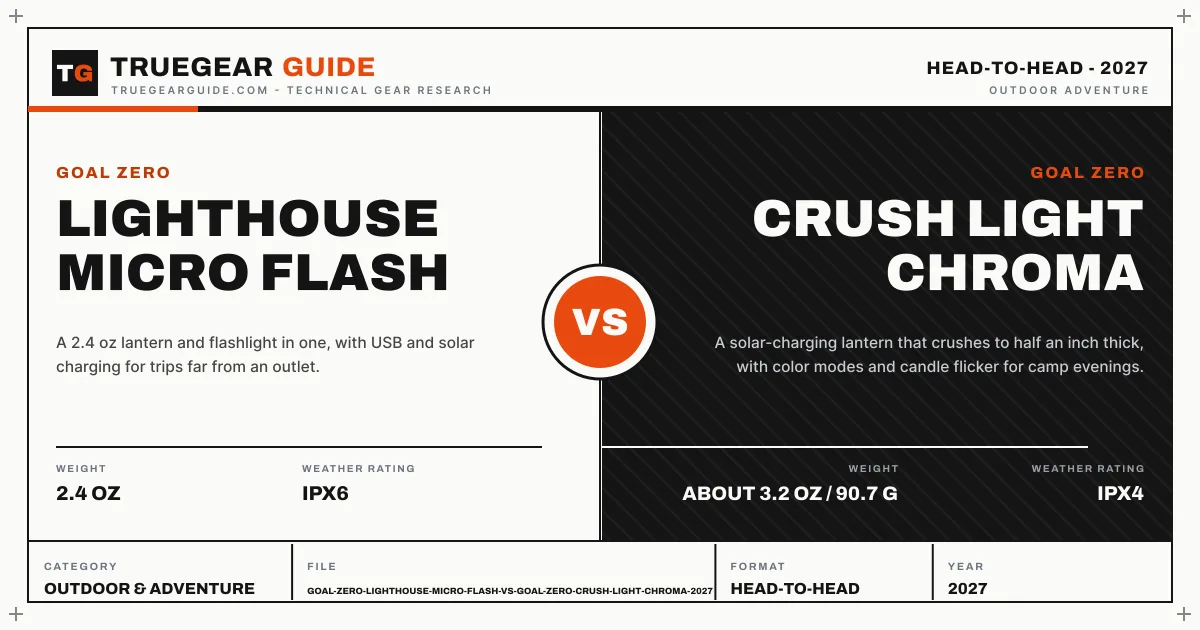

Goal Zero Lighthouse Micro Flash
A 2.4 oz lantern and flashlight in one, with USB and solar charging for trips far from an outlet.
- Weight: 2.4 oz
- Weather rating: IPX6

A solar-charging lantern that crushes to half an inch thick, with color modes and candle flicker for camp evenings.
- Weather rating: IPX4
- Weight: About 3.2 oz / 90.7 g
What owners report
Most praised
- Keychain size with a hanging loop means it clips to a pack or tent line and is always within reach
- The lantern-plus-flashlight combination covers both area light and a directed beam from one tiny unit
- USB and solar charging options suit trips where wall power is days away
Common complaints
- The small body is easy to misplace in a packed bag or a dark tent
- Output is modest, so it works as a personal light rather than a group lantern
- The hanging loop and compact switch take some getting used to with cold or gloved hands
What owners report
Most praised
- Collapsing to a thin disc makes it disappear into a pocket or pack lid
- Solar charging plus USB charging mean it can recover on a sunny rest day without an outlet
- Color modes and candle flicker turn it from a work light into camp ambience after dark
Common complaints
- The lightweight collapsible body can feel fragile next to hard-shell lanterns
- Solar charging is slow, so it is a top-up method rather than a same-day refill
- The small battery means bright white output runs out well before dawn on high
Our recommendation
These two lanterns share a brand and a philosophy, tiny, light, solar-friendly, but they do different jobs, so this comparison has a cleaner answer than most. The Micro Flash is the practical light: a lantern plus a flashlight, up to 150 lumens, IPX6 sealing, and a beam for walking at night. The Crush Light Chroma is the social light: 60 lumens of white at most, but color modes, candle flicker and a body that crushes to half an inch. Backpackers who need one light for everything should take the Micro Flash. Campers who already carry a headlamp and want a pocket light for the evening should take the Crush Light.
Brightness and beam
The Micro Flash is the brighter and more versatile light: up to 150 lumens of lantern light plus a 120 lumen flashlight beam, against the Crush Light's 60 lumen white high with no directed beam at all. That gap decides task use outright: cooking, searching a bag and walking a trail at night all belong to the Micro Flash. The Crush Light answers with color, offering six color modes, multicolor fade and candle flicker, which the Micro Flash does not attempt. One is a tool, the other is an atmosphere.
Packed size and weight
Both are ultralight, but they pack differently. The Micro Flash weighs 2.4 oz in a small rigid body with a hanging loop, while the Crush Light weighs about 3.2 oz and collapses to about 0.5 inch thick, so it disappears into a pocket or pack lid where the Micro Flash keeps its shape. The weight difference is trivial; the packed shape is not. If the lantern rides loose in a pocket, the Crush Light wins. If it clips to a pack or a tent line, the Micro Flash's loop is the better carry.
Charging and weather sealing
Both charge by USB and by sun, but the details differ. The Micro Flash charges by USB in about 3.5 hours or from a compatible solar panel, and carries an IPX6 rating, the strongest in this guide. The Crush Light charges by micro-USB in about 2.5 hours or by its own solar panel in about 20 hours of full sun, and carries IPX4. The Micro Flash is the tougher, more weatherproof unit; the Crush Light is the one that recharges itself on a sunny rest day without any panel accessory.
Choose Goal Zero Lighthouse Micro Flash if…
- One tiny light must do lantern and flashlight duty
- Walking at night and task brightness matter
- The strongest weather sealing in the guide matters
- A hanging loop and clip carry suit your pack
Choose Goal Zero Crush Light Chroma if…
- A headlamp already covers walking and tasks
- Color modes and candle flicker for camp evenings matter
- The thinnest possible packed shape matters
- Built-in solar charging without a separate panel appeals
Questions, answered
Which Goal Zero pocket lantern is brighter?
The Micro Flash, clearly: up to 150 lumens of lantern light plus a 120 lumen flashlight beam, against the Crush Light's 60 lumen white high. The Crush Light's strength is color and ambience, not brightness, so buyers who need task light should not choose it on lumens.
Do both charge from the sun?
Yes, in different ways. The Micro Flash charges from a compatible Goal Zero solar panel, while the Crush Light has its own built-in solar panel and needs about 20 hours of full sun for a full charge. In both cases solar is a slow top-up, not a quick refill, and USB charging is the reliable method.
Can I carry both?
Easily, and many ultralight campers do something close to it: the pair together weighs about 5.6 oz. The Micro Flash handles walking and tasks, the Crush Light handles the evening's ambience, and neither duplicates the other's job. If weight allows only one, the Micro Flash is the practical pick because it covers more jobs.
Every guide on Camping Lanterns15 pages
- Topic hubCamping Lanterns
- Best ofThe Best Camping Lanterns (2027)
- Rechargeable lanterns split into two families that should not be ranked against each other directly. The first is the big car-camp lantern: a 4,000 to 6,400 mAh battery, 500 to 1,000 lumens, and a phone-charging output, built to anchor a table for an evening. The second is the pocket lantern: a tiny battery, solar or USB charging, and a weight measured in ounces, built to hang in a tent for days on low. This guide ranks both families on the same honest test: how long the light you actually use lasts, and how it gets its charge back.The Best Rechargeable Camping Lanterns (2027)
- A collapsible lantern is judged on two sizes, not one: how big it is when lit, and how small it is when packed. The best designs here shrink to a flat disc, a thin puck or a bulb, then open into a full lantern at camp. That matters most for backpackers, who trade volume as carefully as weight, and for families, who need four lanterns to fit in one bin without a dedicated case. Brightness takes second place in this guide on purpose: a collapsible lantern that stays home because it does not pack is worse than a dimmer one that comes along.The Best Collapsible Camping Lanterns (2027)
- Tent light and table light are different jobs, and a lantern that does one well often does the other badly. A tent wants soft, even, dimmable light with no glare, hung above head height, in a body that cannot be knocked onto bedding. A table wants brighter, wider light that reaches every plate without blinding the person opposite. This guide separates the two jobs, then names the lanterns that genuinely cover both, because most campsites need a tent light and a table light on the same night.The Best Camping Lanterns for Tents and Tables (2027)
- ReviewBioLite AlpenGlow 500 Lantern Review (2027)
- ReviewVont 2 Pack LED Camping Lantern Review (2027)
- ReviewGoal Zero Lighthouse Micro Flash Review (2027)
- ReviewLE 1000LM Battery Powered LED Camping Lantern Review (2027)
- ReviewBlack Diamond Moji Lantern Review (2027)
- ReviewEtekcity Camping Lanterns for Power Outages, 4 Pack Review (2027)
- Head to headBioLite AlpenGlow 500 vs Coleman Classic Rechargeable 800L (2027)
- Buying guideCamping Lantern Buying Guide (2027)
- Fix itCamping Lantern Not Working? Fixes (2027)