Head to head
Comotomo vs Boon Nursh (2027)
Two soft silicone bottles compared: Comotomo against Boon Nursh on feel, venting, cleaning and price, for 2027 buyers.
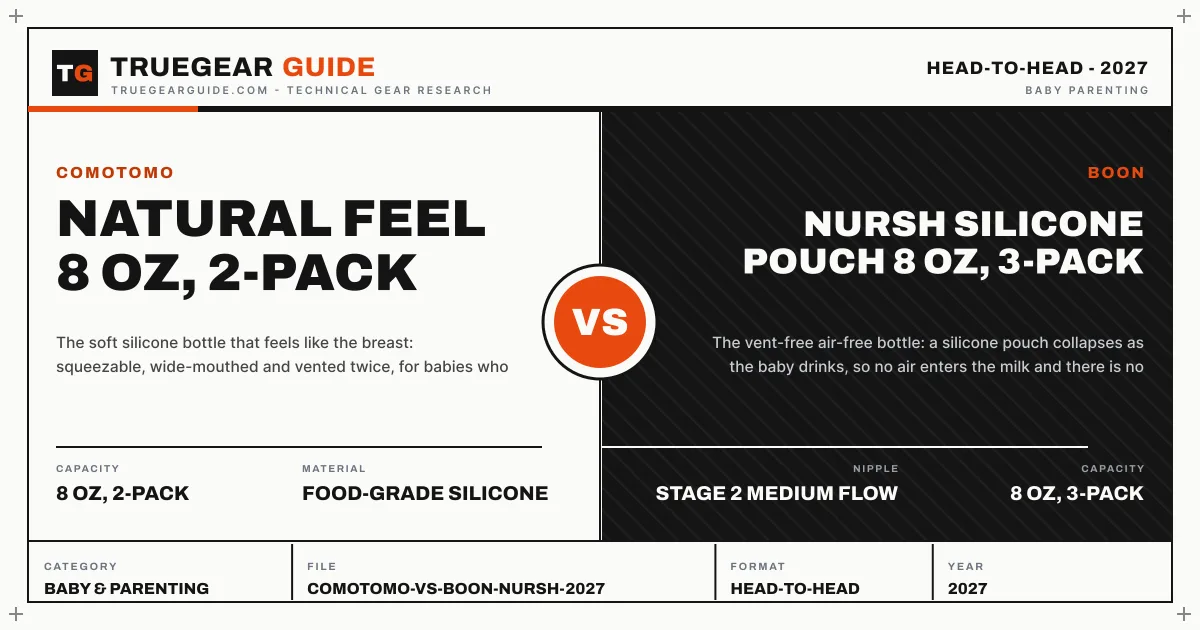

Comotomo Natural Feel 8 oz, 2-Pack
The soft silicone bottle that feels like the breast: squeezable, wide-mouthed and vented twice, for babies who refuse hard plastic.
- Capacity: 8 oz, 2-pack
- Material: Food-grade silicone

Boon Nursh Silicone Pouch 8 oz, 3-Pack
The vent-free air-free bottle: a silicone pouch collapses as the baby drinks, so no air enters the milk and there is no valve to wash.
- Capacity: 8 oz, 3-pack
- Nipple: Stage 2 medium flow
What owners report
Most praised
- Babies who rejected three hard bottles in a row take this soft one without a fight.
- Wide neck means a hand and a sponge reach every corner, so no bottle brush is needed.
- Squeezable body lets a parent nudge the flow gently when a baby stalls mid-feed.
Common complaints
- Bottles roll off changing tables because the round silicone body has no flat side.
- Milk film shows on the silicone after a few weeks and needs a proper wash to shift.
- Two bottles for the price feels steep next to the plastic multi-packs in this guide.
What owners report
Most praised
- No valve parts to wash turns the nightly clean-up into a quick rinse and dry.
- Collapsing pouch means no air bubbles in the milk, and gassy evenings calm down.
- Shell protects the pouch in a bag, so the bottle survives being tossed in with keys and toys.
Common complaints
- Pouches thin out after months of use and need replacing sooner than expected.
- Filling the soft pouch without spilling takes practice in the first week.
- Wide shell does not sit in narrow car cup holders, so it rides loose on car trips.
Our recommendation
Both bottles are soft silicone, both suit a breastfed baby, and the choice turns on how the bottle handles air. The Comotomo is the softer, more breast-like bottle: a squeezable body, a wide mound and dual vents, and it is the one most likely to be accepted by a baby who has refused rigid bottles. The Boon Nursh is the cleverer anti-colic design: a pouch that collapses as the baby drinks, so air never enters the milk and there is no vent to wash. If acceptance is the problem, take the Comotomo. If gas is the problem and the baby already takes a bottle, take the Nursh.
Feel and acceptance
The Comotomo is the softer bottle. Its whole body squeezes, its mound is wide, and a baby who refuses hard plastic often takes it on the first try. The Nursh is softer than a rigid bottle but firmer than the Comotomo: its pouch is soft, but the shell around it is rigid, so the baby meets a firm outer shape with a soft nipple. For a baby who has refused bottles, the Comotomo's softness is the stronger argument.
How they handle air
The Comotomo uses dual anti-colic vents in the nipple base, which work well but still let some air in when the bottle is tilted. The Nursh collapses its pouch as the baby drinks, so the milk volume shrinks and no air replaces it, which is a more complete answer to swallowed air. On gas, the Nursh has the better mechanism; on acceptance, the Comotomo has the better shape.
Cleaning and parts
Both are easy to clean, for different reasons. The Comotomo has a wide neck a hand can reach into and no separate vent parts. The Nursh has no vents or valves at all, only a pouch, a shell and a nipple. The Nursh asks one extra thing: its pouches wear and need replacing over time, which is a running cost the Comotomo does not have.
Fit, flow and price
Both are wide bottles that do not fit narrow warmers or cup holders. Both ship with medium flow nipples suited to babies from three to six months, so newborns need slower nipples bought separately. The Comotomo is a two-pack at a premium price; the Nursh is a three-pack at a mid price, so the Nursh costs less per bottle and covers more feeds out of the box.
Choose Comotomo Natural Feel 8 oz, 2-Pack if…
- Your breastfed baby has refused rigid bottles
- The softest, most breast-like feel matters most
- You want the easiest wide-neck bottle to wash
- You are willing to pay a premium for acceptance
Choose Boon Nursh Silicone Pouch 8 oz, 3-Pack if…
- Gas and colic are the main problem, not refusal
- You want anti-colic feeding with no vents or valves to wash
- You want three bottles for less per bottle
- You like the idea of milk only ever touching silicone
Questions, answered
Which one is better for a breastfed baby?
The Comotomo, for acceptance: its soft squeezable body and wide mound come closest to the breast. The Nursh is also soft and also suits a breastfed baby, but its rigid shell makes it feel less like the breast in the hand. If the baby already takes a bottle, either works.
Do Boon Nursh pouches need replacing?
Yes, over time. The silicone pouches wear with repeated use and sterilizing, and they should be replaced when they thin, tear or stop collapsing smoothly. That is a running cost to budget for, unlike a rigid bottle that lasts until the baby outgrows it.
Can either bottle convert to a sippy cup?
The Boon Nursh converts with a separately sold conversion top that turns the bottle into a straw sippy cup. The Comotomo does not convert, so its life ends when bottle feeding ends. The Nursh's longer life is a genuine point in its favour for families thinking past the first year.
Every guide on Baby Bottles16 pages
- Topic hubBaby Bottles
- Best ofThe Best Baby Bottles (2027)
- This ranking is built on one question: how does the bottle keep air out of the milk, and what does that mechanism cost in parts and washing? A vent tube, an AirFree vent, a vented base, a nipple valve and a collapsing pouch all solve the same problem differently, and the best mechanism is the one the household will use correctly at 3 a.m. Bottles are ranked on vent design first, then on whether the vent survives daily use without leaking.The Best Anti-Colic Baby Bottles (2027)
- This ranking is built on the switching problem, not on venting. A breastfed baby judges a bottle by its nipple: wide, soft, and shaped like the breast, with a flow slow enough that the baby still has to work for the milk. Bottles are ranked on nipple shape first, then on flow, then on whether the bottle lets a baby pace the feed instead of being flooded.The Best Baby Bottles for Breastfed Babies (2027)
- This ranking is built on the newborn's actual feeds: two to four ounces, slow flow, frequent and small. A newborn does not need a 9 oz bottle, a medium flow nipple or a gift set full of parts for later. Bottles are ranked on small capacity, slow flow and simplicity first, with larger sizes and extras treated as bonuses, not reasons to buy.The Best Baby Bottles for Newborns (2027)
- ReviewPhilips Avent AirFree Bottle Review (2027)
- ReviewDr. Brown's Options+ Bottle Review (2027)
- ReviewComotomo Baby Bottle Review (2027)
- ReviewTommee Tippee Natural Start Review (2027)
- ReviewMAM Easy Start Bottle Review (2027)
- ReviewPigeon PPSU Bottle Review (2027)
- Head to headAvent AirFree vs Dr. Brown's Options+ (2027)
- Buying guideBaby Bottles Buying Guide (2027)
- Fix itBaby Bottle Leaking? Fixes (2027)
- Fix itBaby Refusing the Bottle? Fixes (2027)