In-depth review
Pigeon PPSU Bottle Review (2027)
The Pigeon PPSU 8.1 oz 2-pack is the long-life premium bottle: stain-resistant PPSU with a latch-on nipple. Our research-based verdict for 2027 buyers.
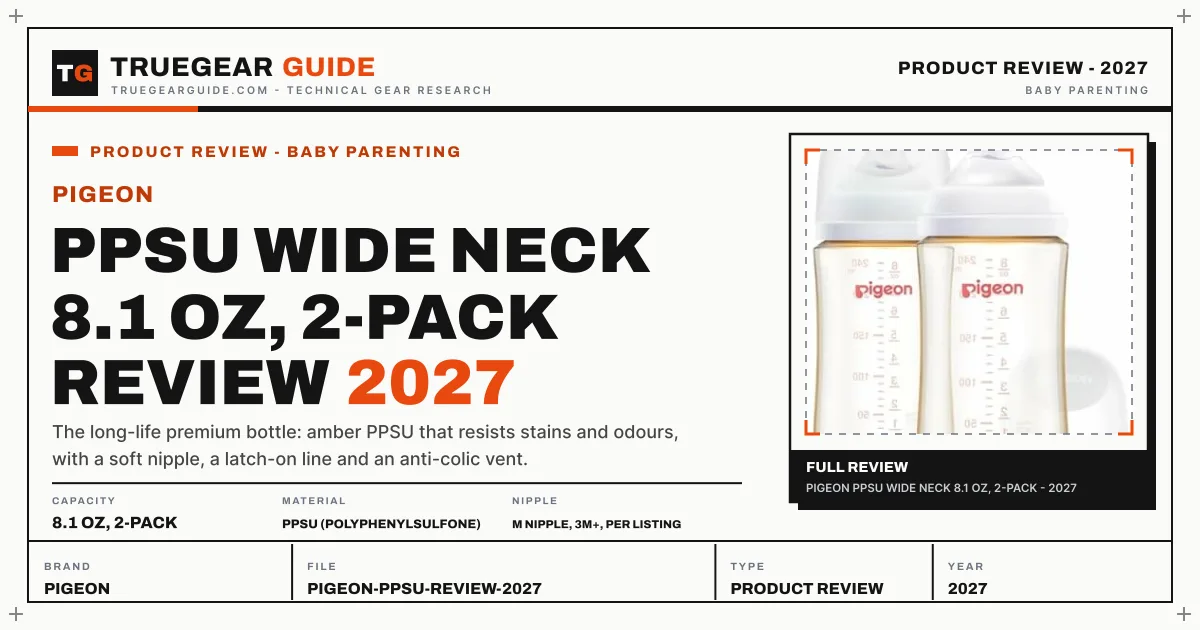

Pigeon PPSU Wide Neck 8.1 oz, 2-Pack
The long-life premium bottle: amber PPSU that resists stains and odours, with a soft nipple, a latch-on line and an anti-colic vent.
Our verdict
The Pigeon PPSU is the bottle to buy once and stop thinking about bottles. Its amber PPSU body resists stains and odours for months where standard plastic clouds, the nipple carries a latch-on line that helps a baby find the right depth, and the anti-colic vent keeps air out of the milk. It costs roughly double a standard plastic bottle, the amber tint makes the milk level harder to read in dim light, and the included M nipples suit babies from three months. For a household that wants durability over discounts, it earns its premium.
What we like
- PPSU material resists staining and odours far longer than standard plastic, per the maker description
- Soft silicone nipple carries a latch-on line to help a baby latch at the right depth
- Anti-colic vent in the nipple reduces swallowed air, per the maker description
- Streamlined wide-neck body is easy to hold and easy to wash
What to watch out for
- Amber tint makes the milk level slightly harder to read in dim light
- Premium price per bottle, so a full shelf of them costs noticeably more
- Wide neck needs a wide warmer or sterilizer chamber to fit comfortably
What owners report: Pigeon PPSU Wide Neck 8.1 oz, 2-Pack
Synthesized from recurring themes in long-term owner feedback.
Most praised
- Amber bottles still look new after months of daily sterilizing, unlike clouded plastic.
- Latch-on line helps a baby find the right depth instead of chewing the tip.
- Streamlined body sits comfortably in a tired hand during long night feeds.
Common complaints
- Reading the milk level against the amber plastic takes a tilt toward the light.
- Two bottles cost what a whole multi-pack costs elsewhere, which stings at checkout.
- M nipples suit babies from three months, so newborns need smaller nipples bought separately.
Who it is for
Parents who want one pair of bottles to last the whole feeding year, and a nipple designed to help a baby latch correctly.
PPSU, and why it outlasts plastic
PPSU is the material hospitals use for good reason: it resists heat, stains and odours far longer than standard polypropylene, and it keeps its clarity through months of sterilizing. A Pigeon bottle that has fed a baby for six months still looks new, where a standard plastic bottle of the same age is clouded and faintly smelling of old milk. That durability is the whole premium: the bottle is bought once, not replaced every few months.
The nipple and the latch-on line
The soft silicone nipple carries a latch-on line, a visible guide that helps a baby latch at the right depth instead of chewing the tip. It is a small detail that matters most for breastfed babies learning a bottle, and for parents tired of repositioning a teat mid-feed. The included M nipples suit babies from three months, per the listing, so newborns need SS or S nipples bought separately.
Weight, tint and the honest costs
The amber tint is the compromise: the milk level is slightly harder to read in dim light, so measure against a light background or under a lamp. The wide neck needs a wide warmer or sterilizer chamber. And the price stings at checkout, roughly double a standard bottle, with only two bottles in the box. Buy it for a year of use, not for a month, and the maths turns in its favour.
Key specifications
- Capacity
- 8.1 oz, 2-pack
- Material
- PPSU (polyphenylsulfone)
- Nipple
- M nipple, 3m+, per listing
- Vent
- Anti-colic vent, per maker description
- Neck
- Wide neck, streamlined
- Age
- 3m+ with included nipples
Also consider

Chicco Duo Hybrid 9 oz, 2-Pack
The hybrid: a micro-thin layer of glass bonded inside a plastic bottle, so milk touches glass while the bottle survives being dropped.
Why consider it: The other premium durability pick, with a glass layer inside instead of PPSU
- Capacity: 9 oz, 2-pack
- Construction: Invinci-Glass hybrid

Lansinoh Anti-Colic 8 oz, 3-Pack
The breastfeeding bottle on a budget: a NaturalWave nipple and an air ventilation system in a three-pack that costs less than most singles elsewhere.
Why consider it: The budget alternative, with a breastfeeding-shaped nipple at a third of the price
- Capacity: 8 oz, 3-pack
- Nipple: NaturalWave, medium flow
Research-based assessment. TrueGear has not hands-on tested this product; this evaluation synthesizes manufacturer specifications, retailer documentation, and published expert reviews.
Questions, answered
What is PPSU, and is it safe for baby bottles?
PPSU, polyphenylsulfone, is a high-performance plastic used in medical devices and baby bottles. It resists heat, stains and odours, and it is BPA free. It is the premium alternative to standard polypropylene, chosen for durability rather than for any feeding difference.
Which Pigeon nipple size does my baby need?
Pigeon nipples run SS for newborns, S for one month and up, M for three months and up, L for six months and up, LL and 3L for older babies. The 8.1 oz two-pack ships with M nipples, per the listing. Move up a size when the baby sucks hard, collapses the nipple, or finishes feeds too slowly.
Can Pigeon PPSU bottles go in the sterilizer?
Yes. PPSU handles boiling water, steam sterilizers and dishwashers without warping, which is one of its advantages over standard plastic. The nipples should be checked for wear as usual, and replaced when they thin or tear.
Every guide on Baby Bottles16 pages
- Topic hubBaby Bottles
- Best ofThe Best Baby Bottles (2027)
- This ranking is built on one question: how does the bottle keep air out of the milk, and what does that mechanism cost in parts and washing? A vent tube, an AirFree vent, a vented base, a nipple valve and a collapsing pouch all solve the same problem differently, and the best mechanism is the one the household will use correctly at 3 a.m. Bottles are ranked on vent design first, then on whether the vent survives daily use without leaking.The Best Anti-Colic Baby Bottles (2027)
- This ranking is built on the switching problem, not on venting. A breastfed baby judges a bottle by its nipple: wide, soft, and shaped like the breast, with a flow slow enough that the baby still has to work for the milk. Bottles are ranked on nipple shape first, then on flow, then on whether the bottle lets a baby pace the feed instead of being flooded.The Best Baby Bottles for Breastfed Babies (2027)
- This ranking is built on the newborn's actual feeds: two to four ounces, slow flow, frequent and small. A newborn does not need a 9 oz bottle, a medium flow nipple or a gift set full of parts for later. Bottles are ranked on small capacity, slow flow and simplicity first, with larger sizes and extras treated as bonuses, not reasons to buy.The Best Baby Bottles for Newborns (2027)
- ReviewPhilips Avent AirFree Bottle Review (2027)
- ReviewDr. Brown's Options+ Bottle Review (2027)
- ReviewComotomo Baby Bottle Review (2027)
- ReviewTommee Tippee Natural Start Review (2027)
- ReviewMAM Easy Start Bottle Review (2027)
- Head to headAvent AirFree vs Dr. Brown's Options+ (2027)
- Head to headComotomo vs Boon Nursh (2027)
- Buying guideBaby Bottles Buying Guide (2027)
- Fix itBaby Bottle Leaking? Fixes (2027)
- Fix itBaby Refusing the Bottle? Fixes (2027)