Head to head
Avent AirFree vs Dr. Brown's Options+ (2027)
The two leading anti-colic bottles compared: Philips Avent AirFree against Dr. Brown's Options+ on venting, parts, fit and price, for 2027 buyers.
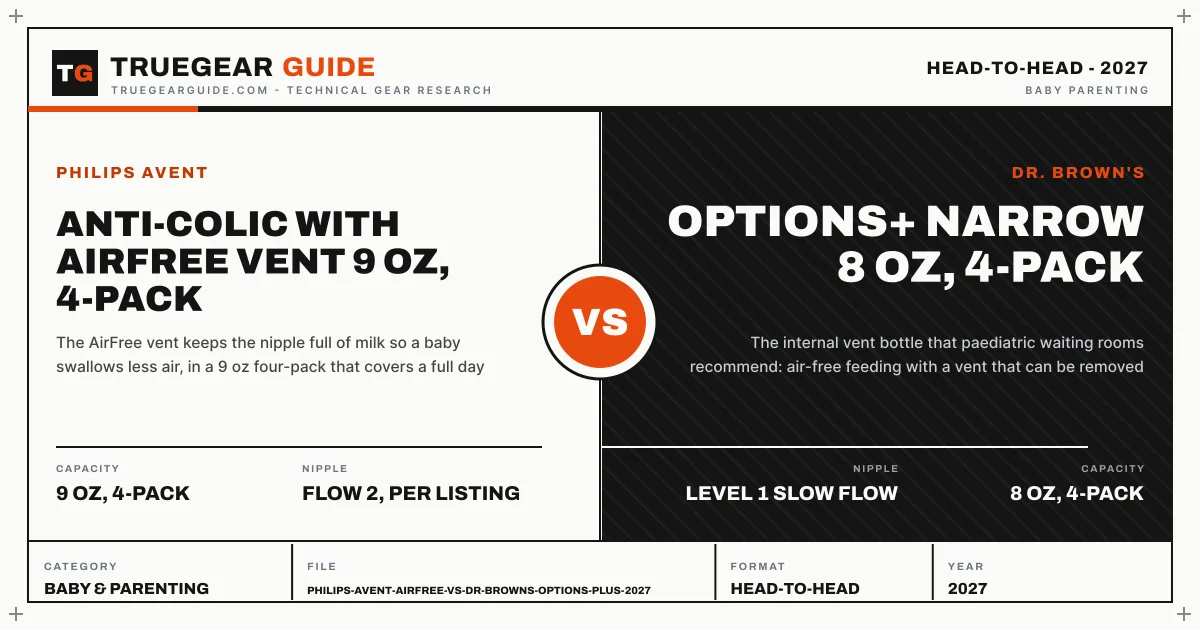

Philips Avent Anti-Colic with AirFree Vent 9 oz, 4-Pack
The AirFree vent keeps the nipple full of milk so a baby swallows less air, in a 9 oz four-pack that covers a full day of feeds.
- Capacity: 9 oz, 4-pack
- Nipple: Flow 2, per listing

Dr. Brown's Options+ Narrow 8 oz, 4-Pack
The internal vent bottle that paediatric waiting rooms recommend: air-free feeding with a vent that can be removed as the baby grows.
- Capacity: 8 oz, 4-pack
- Nipple: Level 1 slow flow
What owners report
Most praised
- Gassy babies settle faster after feeds once the household switches to the AirFree vent bottles.
- Four bottles in the box means a clean one is always ready while the rest are in the wash.
- Narrow shape sits securely in car seat cup holders and standard bottle warmers.
Common complaints
- Vent insert needs careful seating, and a rushed assembly leaves milk on the counter.
- Narrow neck makes scooping formula powder in without a funnel a fiddly job.
- Flow 2 nipples run fast for some newborns, who then need a slower flow bought separately.
What owners report
Most praised
- Parents of colicky babies describe noticeably calmer evenings after switching to the vented bottles.
- Removing the vent later turns the same bottles into simple everyday bottles with no new purchase.
- Narrow bottles slot into the sterilizer and warmer the family already owns.
Common complaints
- Washing the vent assembly after every feed feels like a second chore on top of the bottle itself.
- A missing vent piece leaves a bottle unusable until a spare arrives.
- Milk residue collects in the vent tube unless it is rinsed straight after the feed.
Our recommendation
Choose by the baby's gas and the parent's patience with washing. The Dr. Brown's Options+ has the deeper anti-colic system, with an internal vent tube that is the most established in the category, and it is the right choice when gas and fussiness are the main problem. The Philips Avent AirFree has the simpler vent, one insert instead of a tube, and a 9 oz capacity in a four-pack, and it is the right choice when the baby needs venting but the household needs the washing to stay short. If the baby is colicky, take the Dr. Brown's. If the baby is gassy but coping, take the Avent and keep the evenings simpler.
Vent design and how much air they remove
Dr. Brown's runs air through an internal vent tube and reservoir, keeping it out of the milk through the whole feed, which is why the maker describes it as clinically proven to reduce colic. Avent's AirFree vent keeps the nipple full of milk, which stops air entering at the nipple but does less about air already in the bottle. On the worst gas days the Dr. Brown's system does more; on ordinary days the difference is hard to notice.
Parts and washing
The Avent has one vent insert to wash. The Dr. Brown's has a vent tube, a reservoir, a nipple and a collar, roughly double the parts per feed. Over a week of eight feeds a day, that is dozens of extra small pieces to wash, dry and reassemble. Parents who rinse as they go cope with the Dr. Brown's; parents who batch-wash at night will feel the Avent's simplicity every single evening.
Capacity and pack value
The Avent is a 9 oz bottle in a four-pack; the Dr. Brown's is an 8 oz bottle in a four-pack. One ounce per bottle is a small difference, but across four bottles it is a feed's worth of capacity. Both sit in the same mid price tier, so the choice is not about money: it is about whether the household wants a slightly larger bottle or a slightly stronger vent.
Growing with the baby
Both bottles grow with the baby, differently. The Dr. Brown's vent removes, so the same bottle becomes a plain bottle once the baby's digestion matures. The Avent's AirFree insert can simply be left out, and the bottle works without it. Neither bottle is wasted after the colic phase, which is more than can be said for single-purpose anti-colic designs.
Choose Philips Avent Anti-Colic with AirFree Vent 9 oz, 4-Pack if…
- You want venting with the shortest possible washing routine
- Your baby is gassy but not severely colicky
- A 9 oz capacity in a four-pack suits your feeding pattern
- You prefer one vent insert over a tube and reservoir
Choose Dr. Brown's Options+ Narrow 8 oz, 4-Pack if…
- Your baby is colicky and gas is the main problem
- You want the most established vent system in the category
- You are willing to wash extra vent parts for calmer evenings
- You like the option of removing the vent as the baby grows
Questions, answered
Which one is better for a colicky baby?
The Dr. Brown's Options+, on the strength of its internal vent system, which is the most established in the category and is described by the maker as clinically proven to reduce colic. The Avent AirFree helps with gas too, but its vent is simpler and does less. For a truly colicky baby, the extra washing is worth it.
Can I use either bottle without the vent?
Yes, both. The Dr. Brown's vent removes and the bottle works as a plain bottle. The Avent works with the AirFree insert left out. Neither bottle is wasted once the baby no longer needs venting.
Do these bottles fit the same warmers and sterilizers?
Both are narrow bottles that fit standard warmers, sterilizers and cup holders. The Dr. Brown's vent tube adds height when assembled, so check the sterilizer lid closes over it, but in practice both fit the equipment most families already own.
Every guide on Baby Bottles16 pages
- Topic hubBaby Bottles
- Best ofThe Best Baby Bottles (2027)
- This ranking is built on one question: how does the bottle keep air out of the milk, and what does that mechanism cost in parts and washing? A vent tube, an AirFree vent, a vented base, a nipple valve and a collapsing pouch all solve the same problem differently, and the best mechanism is the one the household will use correctly at 3 a.m. Bottles are ranked on vent design first, then on whether the vent survives daily use without leaking.The Best Anti-Colic Baby Bottles (2027)
- This ranking is built on the switching problem, not on venting. A breastfed baby judges a bottle by its nipple: wide, soft, and shaped like the breast, with a flow slow enough that the baby still has to work for the milk. Bottles are ranked on nipple shape first, then on flow, then on whether the bottle lets a baby pace the feed instead of being flooded.The Best Baby Bottles for Breastfed Babies (2027)
- This ranking is built on the newborn's actual feeds: two to four ounces, slow flow, frequent and small. A newborn does not need a 9 oz bottle, a medium flow nipple or a gift set full of parts for later. Bottles are ranked on small capacity, slow flow and simplicity first, with larger sizes and extras treated as bonuses, not reasons to buy.The Best Baby Bottles for Newborns (2027)
- ReviewPhilips Avent AirFree Bottle Review (2027)
- ReviewDr. Brown's Options+ Bottle Review (2027)
- ReviewComotomo Baby Bottle Review (2027)
- ReviewTommee Tippee Natural Start Review (2027)
- ReviewMAM Easy Start Bottle Review (2027)
- ReviewPigeon PPSU Bottle Review (2027)
- Head to headComotomo vs Boon Nursh (2027)
- Buying guideBaby Bottles Buying Guide (2027)
- Fix itBaby Bottle Leaking? Fixes (2027)
- Fix itBaby Refusing the Bottle? Fixes (2027)