In-depth review
Philips Avent AirFree Bottle Review (2027)
The Philips Avent AirFree 9 oz 4-pack keeps the nipple full of milk to reduce colic, gas and reflux. Our research-based verdict for 2027 buyers.
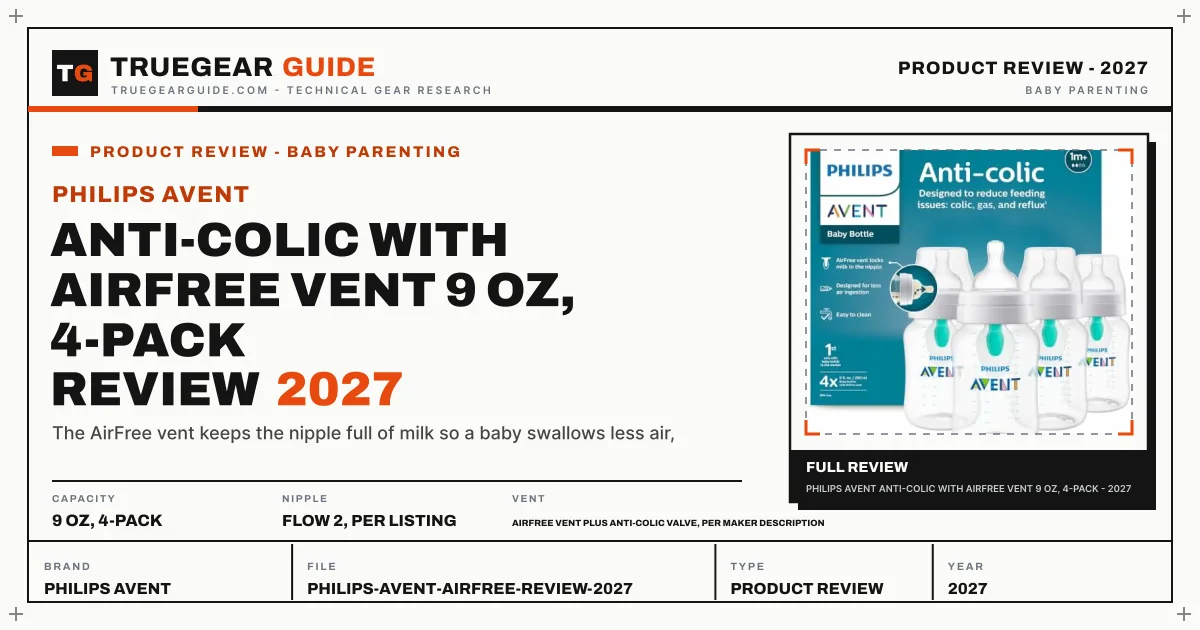

Philips Avent Anti-Colic with AirFree Vent 9 oz, 4-Pack
The AirFree vent keeps the nipple full of milk so a baby swallows less air, in a 9 oz four-pack that covers a full day of feeds.
Our verdict
The Avent AirFree is the vented bottle that asks the least of a tired parent. One vent insert, a narrow bottle that fits every warmer and cup holder, and a four-pack that covers a day of feeds at a mid-range price. It does not have the wide breast-like teat of the switching bottles or the drama-free pouch of the Boon Nursh, but for a baby who needs venting and a household that needs simplicity, it is the most complete answer in this guide.
What we like
- AirFree vent is designed to reduce feeding issues such as colic, gas and reflux, per the maker description
- Vent keeps the nipple full of milk, so air stays out of the feed even when the bottle is held at an angle
- 9 oz capacity suits babies who have outgrown newborn bottles and are taking fuller feeds
- Four-pack covers a day of feeds with spares in the sterilizer, at a lower cost per bottle than buying singles
What to watch out for
- Narrow neck is slower to fill and harder to reach into when washing than a wide-neck bottle
- AirFree vent is an extra part that must be seated correctly or the bottle can leak
- A four-pack commits the household to one nipple flow before the baby has confirmed it suits them
What owners report: Philips Avent Anti-Colic with AirFree Vent 9 oz, 4-Pack
Synthesized from recurring themes in long-term owner feedback.
Most praised
- Gassy babies settle faster after feeds once the household switches to the AirFree vent bottles.
- Four bottles in the box means a clean one is always ready while the rest are in the wash.
- Narrow shape sits securely in car seat cup holders and standard bottle warmers.
Common complaints
- Vent insert needs careful seating, and a rushed assembly leaves milk on the counter.
- Narrow neck makes scooping formula powder in without a funnel a fiddly job.
- Flow 2 nipples run fast for some newborns, who then need a slower flow bought separately.
Who it is for
Parents whose baby struggles with gas, colic or reflux, and who want a vented bottle in a practical multi-pack without learning a complicated system.
The AirFree vent, and what it actually does
The AirFree vent sits inside the bottle and keeps the nipple full of milk, so the baby swallows milk instead of air even when the bottle is tilted. That is a narrower claim than a cure for colic, and it is the honest one: less swallowed air means less gas and less fussiness after feeds, which is what parents report. The vent is a single insert, so there is no tube to thread and no base seal to check, and the four-pack means the routine survives a lost insert without a trip to the shops.
Size, flow and the four-pack question
Nine ounces is the right capacity for a baby who has outgrown newborn bottles, and the Flow 2 nipples in the box suit a baby past the first weeks. Newborns will likely need a slower flow bought separately, which is the one honest extra cost here. The four-pack is the right shape for a household feeding five to eight times a day: two bottles in use, two in the wash, and no nightly scramble. Buying four of a bottle the baby has not yet tried is a gamble, so test one bottle first if the baby is still on a first brand.
Where it falls short
The narrow neck is the compromise. Filling it with formula powder needs a funnel or a steady hand, and washing it needs a brush where a wide-neck bottle needs only a hand. The AirFree vent must be seated correctly or the bottle leaks, which is a small skill that takes a few feeds to learn. And the narrow nipple is not the shape a breastfed baby is most likely to accept, so switching households should look at the Tommee Tippee or Comotomo first.
Key specifications
- Capacity
- 9 oz, 4-pack
- Nipple
- Flow 2, per listing
- Vent
- AirFree vent plus anti-colic valve, per maker description
- Material
- Polypropylene, BPA free, per listing
- Age
- 1m+, per listing
- Model
- SCY703/04
Also consider

Dr. Brown's Options+ Narrow 8 oz, 4-Pack
The internal vent bottle that paediatric waiting rooms recommend: air-free feeding with a vent that can be removed as the baby grows.
Why consider it: The deeper anti-colic system, with a vent tube and a removable vent, for babies whose gas needs more than a single insert
- Capacity: 8 oz, 4-pack
- Nipple: Level 1 slow flow

Tommee Tippee Natural Start Anti-Colic 9 oz
The breast-like teat bottle for switching between breast and bottle, with a slow flow nipple and a bottle that sterilizes itself in the microwave.
Why consider it: The wide-teat alternative for breastfed babies who refuse a narrow nipple
- Capacity: 9 oz
- Nipple: Slow flow, breast-like teat
Research-based assessment. TrueGear has not hands-on tested this product; this evaluation synthesizes manufacturer specifications, retailer documentation, and published expert reviews.
Questions, answered
What is the AirFree vent, and does it work?
The AirFree vent is an insert that keeps the nipple full of milk so the baby swallows less air during the feed. Parents commonly report less gas and fussiness after switching, which matches what the vent is designed to do. It helps with the air-swallow part of colic, not with every cause of crying, and it must be seated correctly or the bottle can leak.
Which nipple flow comes with the AirFree 9 oz 4-pack?
Flow 2 nipples, per the listing. They suit a baby past the newborn stage. A newborn will usually need Flow 1 nipples bought separately, and an older baby will move to Flow 3 and Flow 4 as feeds get faster.
Is the AirFree bottle compatible with other Avent nipples?
AirFree bottles use Avent Anti-Colic nipples, which are a different fitting from the Natural Response range. Check the nipple range before buying spares, because the two Avent systems do not interchange.
Every guide on Baby Bottles16 pages
- Topic hubBaby Bottles
- Best ofThe Best Baby Bottles (2027)
- This ranking is built on one question: how does the bottle keep air out of the milk, and what does that mechanism cost in parts and washing? A vent tube, an AirFree vent, a vented base, a nipple valve and a collapsing pouch all solve the same problem differently, and the best mechanism is the one the household will use correctly at 3 a.m. Bottles are ranked on vent design first, then on whether the vent survives daily use without leaking.The Best Anti-Colic Baby Bottles (2027)
- This ranking is built on the switching problem, not on venting. A breastfed baby judges a bottle by its nipple: wide, soft, and shaped like the breast, with a flow slow enough that the baby still has to work for the milk. Bottles are ranked on nipple shape first, then on flow, then on whether the bottle lets a baby pace the feed instead of being flooded.The Best Baby Bottles for Breastfed Babies (2027)
- This ranking is built on the newborn's actual feeds: two to four ounces, slow flow, frequent and small. A newborn does not need a 9 oz bottle, a medium flow nipple or a gift set full of parts for later. Bottles are ranked on small capacity, slow flow and simplicity first, with larger sizes and extras treated as bonuses, not reasons to buy.The Best Baby Bottles for Newborns (2027)
- ReviewDr. Brown's Options+ Bottle Review (2027)
- ReviewComotomo Baby Bottle Review (2027)
- ReviewTommee Tippee Natural Start Review (2027)
- ReviewMAM Easy Start Bottle Review (2027)
- ReviewPigeon PPSU Bottle Review (2027)
- Head to headAvent AirFree vs Dr. Brown's Options+ (2027)
- Head to headComotomo vs Boon Nursh (2027)
- Buying guideBaby Bottles Buying Guide (2027)
- Fix itBaby Bottle Leaking? Fixes (2027)
- Fix itBaby Refusing the Bottle? Fixes (2027)