In-depth review
Celestron Nature DX ED 8x42 Review (2027)
The Celestron Nature DX ED 8x42 adds ED glass to the budget birding classic. Our research-based verdict on the ED value pick.
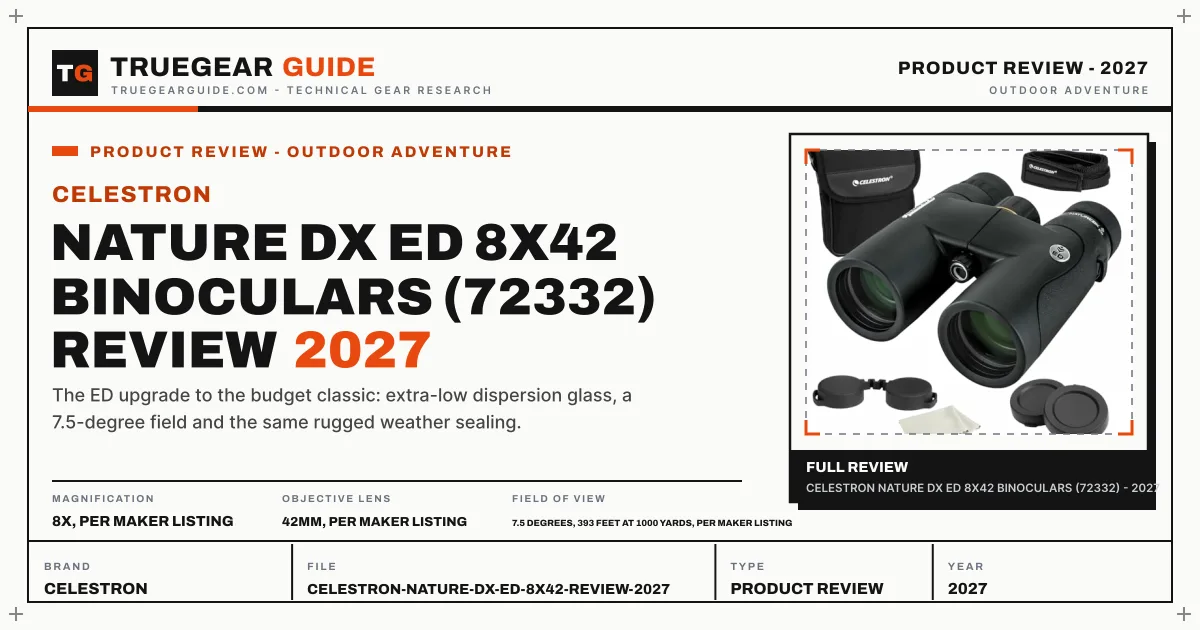

Celestron Nature DX ED 8x42 Binoculars (72332)
The ED upgrade to the budget classic: extra-low dispersion glass, a 7.5-degree field and the same rugged weather sealing.
Our verdict
The Nature DX ED 8x42 is the smart upgrade for birders who liked the standard Nature DX but noticed fringing: extra-low dispersion glass cleans up high-contrast edges, the field widens to 7.5 degrees, and 17.8mm eye relief keeps glasses wearers comfortable, all with full weather sealing. It is heavier than its price suggests and the focus travel takes learning, but for birders who want ED clarity without premium money, this is the value pick of the guide.
What we like
- Extra-low dispersion objective lenses cut colour fringing on white birds and bright skies
- 7.5-degree field with 393 feet at 1000 yards is wider than the standard Nature DX, easing tracking
- 17.8mm eye relief keeps the full field available to glasses wearers on long reserve walks
- Rubber-armoured, nitrogen-filled body is fully waterproof and fogproof for wet-weather birding
What to watch out for
- Heavier than the standard Nature DX feel suggests, so neck carry tires on the longest walks
- Focus wheel needs a full turn habit to learn, and fast near-to-far jumps feel slow at first
- Kit case is bulky for the binocular alone, so pack space goes to accessories as well as optics
What owners report: Celestron Nature DX ED 8x42 Binoculars (72332)
Synthesized from recurring themes in long-term owner feedback.
Most praised
- Owners praise the cleaner edges most, saying white egrets against blue sky no longer carry a purple fringe.
- Dawn birders praise the colour retention, reporting warblers staying identifiable in the first grey light.
- The wide field earns praise for following swallows and swifts, which cross the frame too fast for narrow pairs.
Common complaints
- Weight on a neck strap is the main complaint, with owners switching to a harness for full-day use.
- Focus direction and travel confuse owners switching from another brand, taking a week to feel natural.
- The objective covers feel stiff in cold weather, making quick deployment slower on frosty mornings.
Who it is for
Birders upgrading from a budget pair who want ED glass and a wide field without paying a premium price.
ED glass where it shows
ED glass earns its keep on the subjects birders actually watch: white egrets against blue sky, backlit branches, and bright water edges. Owners report the purple fringe of the standard Nature DX largely gone, with plumage colours staying natural in harsh light. The 7.5-degree field helps too, giving swallows and swifts a longer framed path than the standard model's 7.4 degrees suggests on paper.
Handling and weight honesty
The Nature DX ED is not a lightweight, and owners notice it on a neck strap over a full day. A harness or a wide strap solves the problem, but buyers should plan for it rather than discover it on a long reserve walk. Focus travel also needs a week to learn: the wheel's throw feels long at first, then becomes precise once the hand calibrates to it.
Against the standard Nature DX
The standard Nature DX remains the better buy for beginners and tight budgets, giving most of the handling and sealing for less. The ED version is for birders who already notice fringing and want it gone, or who bird often in harsh light. Buy the standard pair first if unsure; buy the ED pair if you know exactly which flaw you are fixing.
Key specifications
- Magnification
- 8x, per maker listing
- Objective lens
- 42mm, per maker listing
- Field of view
- 7.5 degrees, 393 feet at 1000 yards, per maker listing
- Eye relief
- 17.8mm, per maker listing
- Glass
- Extra-low dispersion objectives, BaK-4 prisms, per maker listing
- Sealing
- Waterproof and fogproof, nitrogen filled, per maker listing
Also consider

Celestron Nature DX 8x42 Binoculars (71332)
The budget birding classic: a 7.4-degree field, 6.5-foot close focus and full weather sealing at the lowest price in the 8x42 class here.
Why consider it: The budget original with close focus, for buyers who do not yet notice fringing
- Magnification: 8x, per maker listing
- Objective lens: 42mm, per maker listing

Vortex Diamondback HD 8x42 Binoculars (DB-214)
The birding default done right: HD glass, a wide 393-foot field, twist-up eyecups and a harness-style carry case in the box.
Why consider it: The mid-range rival with a harness case, for buyers who value carry over ED glass
- Magnification: 8x, per maker listing
- Objective lens: 42mm, per maker listing
Research-based assessment. TrueGear has not hands-on tested this product; this evaluation synthesizes manufacturer specifications, retailer documentation, and published expert reviews.
Questions, answered
How much better is the ED version than the standard Nature DX?
Mainly on high-contrast edges and in harsh light, where fringing visibly drops. In soft woodland light the difference is small. Buyers who bird at dawn, on water or against bright sky gain most.
Is the Nature DX ED heavy for all-day birding?
It is heavier than the price suggests, and a neck strap tires over a full day. A harness or wide strap fixes the problem and is worth buying with the binocular for reserve days.
Does the ED version keep the close focus?
Close focus is a Nature DX family strength, and the ED model keeps the near-viewing ability that makes garden birds and butterflies rewarding subjects alongside distant birds.
Every guide on Binoculars15 pages
- Topic hubBinoculars
- Best ofThe Best Binoculars (2027)
- Birding punishes the wrong binocular faster than any other use. A narrow field loses a warbler mid-hop, short eye relief clips the view for glasses wearers, and an unsealed body fogs on the damp morning when birds are most active. This ranking weighs field, close focus and sealing first, and treats magnification as a secondary choice between steady 8x and reaching 10x.The Best Binoculars for Birding (2027)
- Kids quit binoculars for three reasons: the pair is too heavy, the field is too narrow to find anything, or the view blacks out every time eye placement shifts. This ranking favours light bodies, wide fields and steady 8x magnification, and it treats a real optic with a warranty as better than a toy that teaches nothing.The Best Binoculars for Kids (2027)
- Stargazing rewrites the binocular rules. Aperture matters more than magnification, because faint light is the limit, and a tripod matters more than both, because 10x and above shake stars into streaks. This ranking favours big objectives, generous exit pupils and tripod adaptability, and it is honest about the handheld ceiling.The Best Binoculars for Stargazing (2027)
- ReviewVortex Diamondback HD 8x42 Review (2027)
- ReviewNikon Monarch M7 8x42 Review (2027)
- ReviewCelestron SkyMaster 15x70 Review (2027)
- ReviewVortex Crossfire HD 10x42 Review (2027)
- ReviewNikon Trailblazer ATB 8x25 Review (2027)
- Head to headVortex Diamondback HD 8x42 vs Crossfire HD 10x42 (2027)
- Head to headNikon Monarch M7 8x42 vs M5 8x42 (2027)
- Buying guideBinocular Buying Guide (2027)
- Fix itBinoculars Blurry or Foggy? Fixes (2027)