Head to head
Nikon Monarch M7 8x42 vs M5 8x42 (2027)
Two Nikon Monarch 8x42s compared: M7 against M5 on field of view, glass, handling and price, for 2027 buyers.
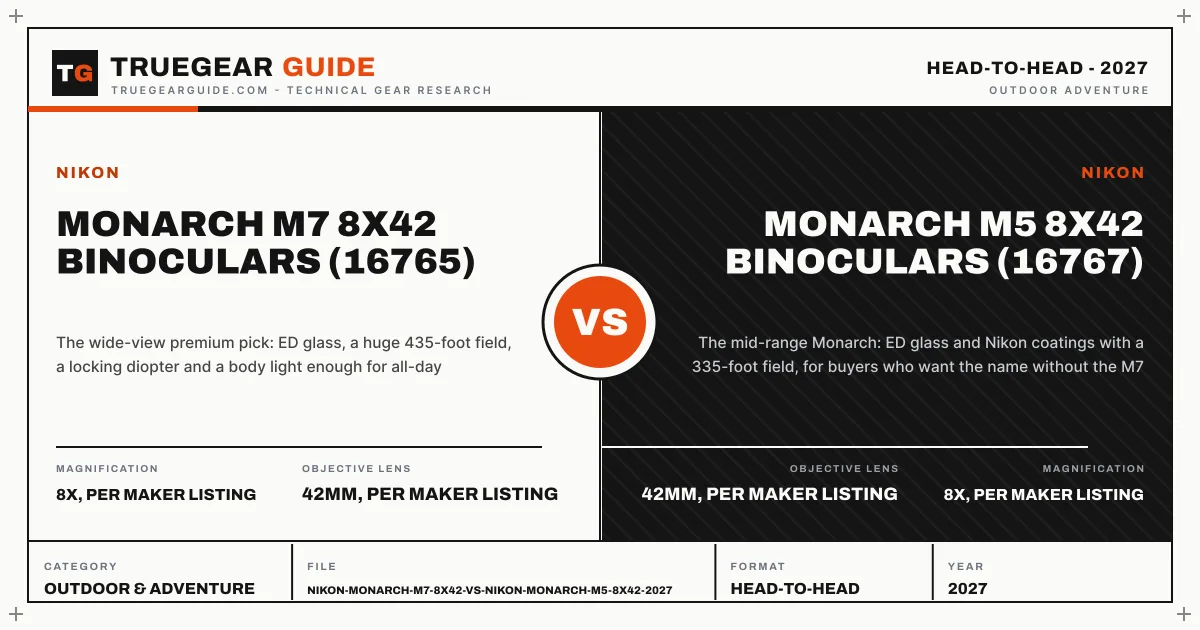

Nikon MONARCH M7 8x42 Binoculars (16765)
The wide-view premium pick: ED glass, a huge 435-foot field, a locking diopter and a body light enough for all-day birding.
- Magnification: 8x, per maker listing
- Objective lens: 42mm, per maker listing

Nikon MONARCH M5 8x42 Binoculars (16767)
The mid-range Monarch: ED glass and Nikon coatings with a 335-foot field, for buyers who want the name without the M7 price.
- Magnification: 8x, per maker listing
- Objective lens: 42mm, per maker listing
What owners report
Most praised
- Owners praise the field of view above all, describing flocks and flying raptors staying framed where narrower binoculars lose them.
- Low-light birders report colours staying true at dawn, when cheaper glass turns birds grey and flat.
- The locking diopter is praised by owners with differing eyesight, who no longer re-check focus after every carry.
Common complaints
- Eye placement takes practice, and new owners report blackouts at the field edge until they learn the eyecup position.
- The supplied neck strap feels basic next to the premium optics, and many owners replace it quickly.
- Lens caps come off in a pack more easily than owners expect, so caps get lost on rough trails.
What owners report
Most praised
- Owners praise the glass for the price, saying bright birds hold colour where their old budget pair fringed badly.
- Build quality earns praise, with the rubber armour and sealing feeling like a premium body at a mid-range price.
- Glasses wearers praise the comfortable eye relief on long viewing sessions at reserves and wetlands.
Common complaints
- The narrower field disappoints owners upgrading from a wide-field pair, who notice birds leaving the frame sooner.
- Focus speed frustrates owners tracking birds that move from far to near quickly.
- The case supplied feels thin for the price, and owners often buy a sturdier case for travel.
Our recommendation
This is a field-of-view decision with a price attached. The M7 gives a 435-foot field, a locking diopter and the fuller premium glass treatment, and it is the pick for birders who track flying birds all day. The M5 gives Nikon ED glass, sealing and build at a mid-range price, with a 335-foot field that serves garden, hide and general birding well. If flying birds are your main subject, pay for the M7. If most watching is perched birds, feeders and reserves, the M5 keeps most of the Monarch experience for less.
Field of view
435 feet against 335 feet is a 100-foot gap at 1000 yards, and it shows on every flying bird: the M7 holds the subject longer, the M5 loses it sooner. For perched birds and feeder watching the gap barely matters, which is why the M5 remains a strong general pick.
Glass and coatings
Both use ED glass, but the M7 adds dielectric multilayer prism coatings and the wider eyepiece design that produces its immersive view, plus an oil and water repellent coating for easy cleaning. The M5 keeps the core ED benefit, cleaner edges than budget glass, without the full premium treatment.
Handling and price
The M7 adds a locking diopter, a feature usually found on costlier optics, and a lighter, more compact feel for its field. The M5 counters with a mid-range price and simpler handling, and its longer focus travel is the main handling complaint. The price gap buys field and finesse, not basic capability.
Choose Nikon MONARCH M7 8x42 Binoculars (16765) if…
- You track flying birds, flocks and raptors regularly
- The widest field in this guide is worth a premium to you
- You want a locking diopter that holds your correction
- You bird dawn to dusk and value low-light colour
Choose Nikon MONARCH M5 8x42 Binoculars (16767) if…
- Most of your birding is perched birds, feeders and hides
- Mid-range money is the budget and ED glass is the priority
- You want Nikon build and sealing without the premium price
- A narrower field does not bother your subjects or style
Questions, answered
Is the M7 really 100 feet wider?
Yes: 435 feet against 335 feet at 1000 yards, per maker and retailer figures. That is roughly a third wider, and it is the single biggest difference between the two Monarchs.
Do both have ED glass?
Yes, both use ED glass, so both control fringing better than budget pairs. The M7 adds wider eyepieces, dielectric coatings and a locking diopter on top of the shared ED benefit.
Which should a beginner buy?
The M5, unless the beginner already tracks flying birds. The M5's price and simpler handling suit learning, and the M7's field advantage matters most once finding birds feels automatic.
Every guide on Binoculars15 pages
- Topic hubBinoculars
- Best ofThe Best Binoculars (2027)
- Birding punishes the wrong binocular faster than any other use. A narrow field loses a warbler mid-hop, short eye relief clips the view for glasses wearers, and an unsealed body fogs on the damp morning when birds are most active. This ranking weighs field, close focus and sealing first, and treats magnification as a secondary choice between steady 8x and reaching 10x.The Best Binoculars for Birding (2027)
- Kids quit binoculars for three reasons: the pair is too heavy, the field is too narrow to find anything, or the view blacks out every time eye placement shifts. This ranking favours light bodies, wide fields and steady 8x magnification, and it treats a real optic with a warranty as better than a toy that teaches nothing.The Best Binoculars for Kids (2027)
- Stargazing rewrites the binocular rules. Aperture matters more than magnification, because faint light is the limit, and a tripod matters more than both, because 10x and above shake stars into streaks. This ranking favours big objectives, generous exit pupils and tripod adaptability, and it is honest about the handheld ceiling.The Best Binoculars for Stargazing (2027)
- ReviewVortex Diamondback HD 8x42 Review (2027)
- ReviewNikon Monarch M7 8x42 Review (2027)
- ReviewCelestron Nature DX ED 8x42 Review (2027)
- ReviewCelestron SkyMaster 15x70 Review (2027)
- ReviewVortex Crossfire HD 10x42 Review (2027)
- ReviewNikon Trailblazer ATB 8x25 Review (2027)
- Head to headVortex Diamondback HD 8x42 vs Crossfire HD 10x42 (2027)
- Buying guideBinocular Buying Guide (2027)
- Fix itBinoculars Blurry or Foggy? Fixes (2027)