In-depth review
Nikon Monarch M7 8x42 Review (2027)
The Nikon Monarch M7 8x42 pairs a 435-foot field with ED glass and a locking diopter. Our research-based verdict on the premium birding pick.
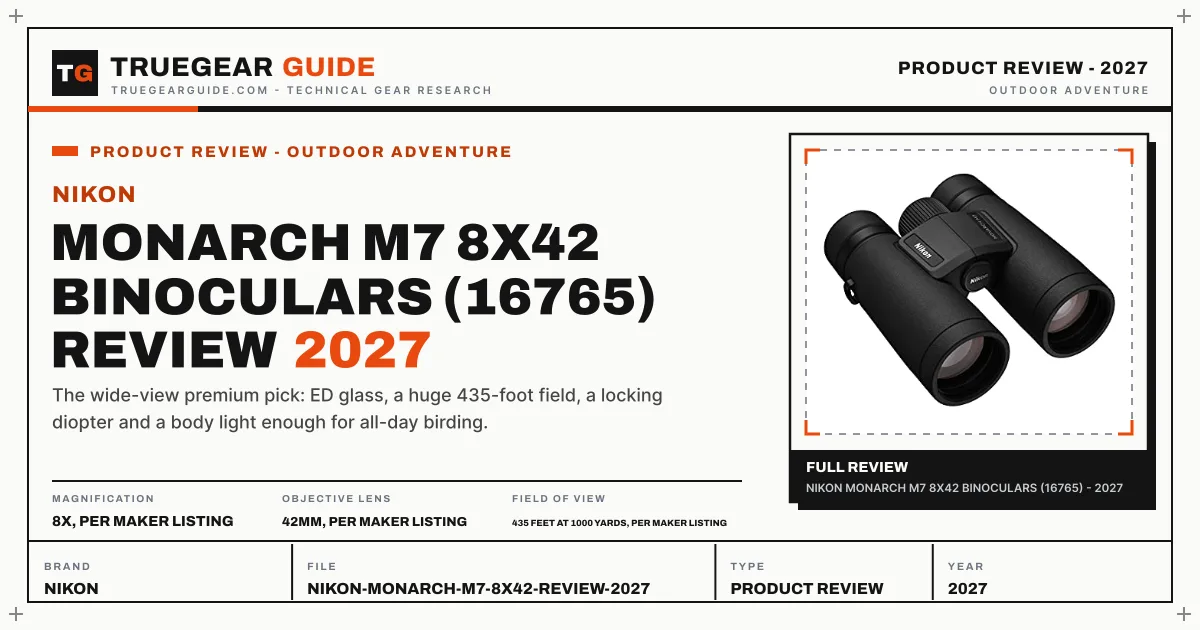

Nikon MONARCH M7 8x42 Binoculars (16765)
The wide-view premium pick: ED glass, a huge 435-foot field, a locking diopter and a body light enough for all-day birding.
Our verdict
The Monarch M7 8x42 is the best birding binocular in this guide for watchers who track moving birds: a 435-foot field that no rival matches, ED glass that holds colour at dawn, a locking diopter that ends focus drift, and a 23.6-ounce body light enough for all-day walks. The price is premium, eye placement needs a little practice, and the supplied strap feels basic. For serious birders, the field alone justifies the step up; for casual watchers, the Diamondback HD gives most of the experience for less.
What we like
- 435-foot field of view at 1000 yards is the widest 8x42 field in this guide, a real advantage on flying birds
- ED glass with dielectric multilayer prism coatings delivers vivid colour and sharp resolution in low light
- Locking diopter holds the right-eye correction once set, so it cannot drift in a pack or a coat pocket
- 23.6-ounce body is light for a premium 42mm binocular, easing neck strain on long birding walks
What to watch out for
- Premium price puts it well above the capable mid-range 8x42s, and casual users may not see the difference
- Wide-field eyepieces demand careful eye placement, so beginners can lose the field edge until positioning becomes habit
- No harness-style case in the box, so chest carry needs a separate purchase for hikers who want it
What owners report: Nikon MONARCH M7 8x42 Binoculars (16765)
Synthesized from recurring themes in long-term owner feedback.
Most praised
- Owners praise the field of view above all, describing flocks and flying raptors staying framed where narrower binoculars lose them.
- Low-light birders report colours staying true at dawn, when cheaper glass turns birds grey and flat.
- The locking diopter is praised by owners with differing eyesight, who no longer re-check focus after every carry.
Common complaints
- Eye placement takes practice, and new owners report blackouts at the field edge until they learn the eyecup position.
- The supplied neck strap feels basic next to the premium optics, and many owners replace it quickly.
- Lens caps come off in a pack more easily than owners expect, so caps get lost on rough trails.
Who it is for
Serious birders who track fast-moving birds and want the widest field and premium glass in this guide.
A field that changes how you bird
435 feet at 1000 yards is not a marginal gain: it is roughly a tenth wider than the Diamondback HD and nearly a third wider than the Monarch M5. In practice that means flocks stay framed, flying raptors stay tracked, and the viewer spends less time searching and more time watching. Wide-field eyepieces demand careful eye placement at first, but once the habit forms, the extra scene becomes the normal view and narrower pairs feel blinkered.
Glass and diopter for low light and differing eyes
ED glass with dielectric multilayer coatings keeps colours true in the grey light when birds are most active, and the locking diopter solves a small, constant annoyance: a right-eye correction that drifts in a pack. Owners with differing eyesight praise the lock most, because it removes a re-check from every outing. Combined with the light body, the M7 is built for dawn-to-dusk reserve days rather than short garden sessions.
Price and the practice curve
The M7 costs enough that casual buyers should pause: the Diamondback HD and Nature DX ED cover most birding days for less. New owners also report a short learning curve on eye placement, with field-edge blackouts until eyecup position becomes habit. Neither point dims the verdict for serious birders, but both explain why this is a specialist upgrade rather than a default recommendation.
Key specifications
- Magnification
- 8x, per maker listing
- Objective lens
- 42mm, per maker listing
- Field of view
- 435 feet at 1000 yards, per maker listing
- Glass
- ED glass with dielectric multilayer prism coatings, per maker listing
- Weight
- 23.6 ounces, per maker listing
- Sealing
- Waterproof and fogproof, nitrogen filled and O-ring sealed, per maker listing
Also consider

Vortex Diamondback HD 8x42 Binoculars (DB-214)
The birding default done right: HD glass, a wide 393-foot field, twist-up eyecups and a harness-style carry case in the box.
Why consider it: The mid-range birding default with a wide field and harness carry, for buyers who do not need the M7 premium
- Magnification: 8x, per maker listing
- Objective lens: 42mm, per maker listing

Nikon MONARCH M5 8x42 Binoculars (16767)
The mid-range Monarch: ED glass and Nikon coatings with a 335-foot field, for buyers who want the name without the M7 price.
Why consider it: The mid-range Monarch with ED glass, for Nikon buyers who accept a narrower field
- Magnification: 8x, per maker listing
- Objective lens: 42mm, per maker listing
Research-based assessment. TrueGear has not hands-on tested this product; this evaluation synthesizes manufacturer specifications, retailer documentation, and published expert reviews.
Questions, answered
Is the M7 field really that much wider?
Yes, measurably: 435 feet against 393 feet for the Diamondback HD and 335 feet for the Monarch M5. On flying birds the difference shows immediately, with subjects staying framed longer and requiring fewer re-aims.
Why does the locking diopter matter?
Because a diopter that drifts in a pack means refocusing for one eye on every outing. The lock holds the correction once set, so the binocular is ready the moment it comes out of the case.
Is the M7 worth it over the M5?
For tracking fast birds, yes: the field advantage is large and the glass is a step up. For general birding at a fixed hide or in a garden, the M5 gives most of the Monarch experience for less money.
Every guide on Binoculars15 pages
- Topic hubBinoculars
- Best ofThe Best Binoculars (2027)
- Birding punishes the wrong binocular faster than any other use. A narrow field loses a warbler mid-hop, short eye relief clips the view for glasses wearers, and an unsealed body fogs on the damp morning when birds are most active. This ranking weighs field, close focus and sealing first, and treats magnification as a secondary choice between steady 8x and reaching 10x.The Best Binoculars for Birding (2027)
- Kids quit binoculars for three reasons: the pair is too heavy, the field is too narrow to find anything, or the view blacks out every time eye placement shifts. This ranking favours light bodies, wide fields and steady 8x magnification, and it treats a real optic with a warranty as better than a toy that teaches nothing.The Best Binoculars for Kids (2027)
- Stargazing rewrites the binocular rules. Aperture matters more than magnification, because faint light is the limit, and a tripod matters more than both, because 10x and above shake stars into streaks. This ranking favours big objectives, generous exit pupils and tripod adaptability, and it is honest about the handheld ceiling.The Best Binoculars for Stargazing (2027)
- ReviewVortex Diamondback HD 8x42 Review (2027)
- ReviewCelestron Nature DX ED 8x42 Review (2027)
- ReviewCelestron SkyMaster 15x70 Review (2027)
- ReviewVortex Crossfire HD 10x42 Review (2027)
- ReviewNikon Trailblazer ATB 8x25 Review (2027)
- Head to headVortex Diamondback HD 8x42 vs Crossfire HD 10x42 (2027)
- Head to headNikon Monarch M7 8x42 vs M5 8x42 (2027)
- Buying guideBinocular Buying Guide (2027)
- Fix itBinoculars Blurry or Foggy? Fixes (2027)