In-depth review
Vortex Diamondback HD 8x42 Review (2027)
The Vortex Diamondback HD 8x42 pairs a wide 393-foot field with HD glass and a harness case. Our research-based verdict on the birding default.
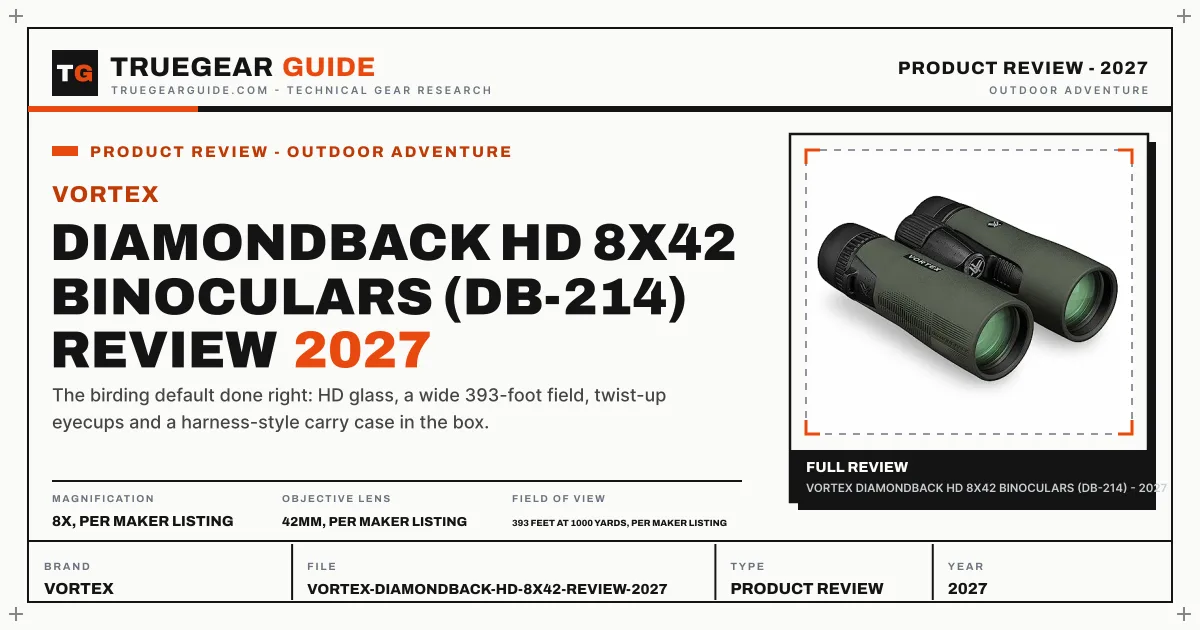

Vortex Diamondback HD 8x42 Binoculars (DB-214)
The birding default done right: HD glass, a wide 393-foot field, twist-up eyecups and a harness-style carry case in the box.
Our verdict
The Diamondback HD 8x42 is the binocular most buyers should buy first: a 393-foot field that finds birds fast, HD glass that keeps colour honest, 17mm eye relief that suits glasses wearers, and a GlassPak harness that solves the carry problem other pairs leave to the buyer. It lacks ED glass, so bright high-contrast edges fringe slightly, and it is a full-size pair that will not pocket. For trail, wetland and garden birding at a mid-range price, those are easy trades, and the Vortex warranty removes the remaining risk.
What we like
- HD optical system with fully multi-coated lenses keeps colour honest and edges sharp for a mid-priced roof prism
- 393-foot field of view at 1000 yards makes finding a moving bird faster than on narrower 8x42 rivals
- 17mm eye relief with twist-up eyecups gives glasses wearers a full field without pressing lenses to the eyecups
- GlassPak harness case in the box carries the weight on the chest and keeps the binocular ready instead of swinging on a strap
What to watch out for
- No ED glass designation at this price, so high-contrast edges can show a trace of colour fringe in harsh light
- Full-size 42mm body is too bulky for a jacket pocket, so it needs a pack or a harness for all-day carry
- Close focus is sized for birds and wildlife, not for butterflies at arm's length or other near subjects
What owners report: Vortex Diamondback HD 8x42 Binoculars (DB-214)
Synthesized from recurring themes in long-term owner feedback.
Most praised
- Birders praise the wide field most, saying warblers stay in view while they move through branches instead of vanishing at the frame edge.
- The harness case earns praise from walkers who used to fight a swinging neck strap on steep trails.
- Glasses wearers report a full, unclipped view with the eyecups twisted down, a detail cheaper 8x42s often get wrong.
Common complaints
- Colour fringing on bright white birds against a hard sky disappoints owners who expected ED-level correction.
- The harness straps need a few outings to adjust, and first-time users find the fit fiddly before it settles.
- Weight on a bare neck strap tires owners on long walks, which is why the harness matters more than it first appears.
Who it is for
Birders and general wildlife watchers who want one dependable 8x42 for daily use, with glasses-friendly handling and harness carry.
Field and glass that earn the reputation
The 393-foot field is the number that matters in use: warblers stay framed through branches, and a scanning sweep covers ground quickly without the constant re-aiming a narrow pair demands. HD glass with full multi-coating keeps the centre sharp and colour natural, and while ED rivals edge it on bright white birds, the gap is small in ordinary light and invisible to most buyers on most days.
Carry solved in the box
The GlassPak harness is the Diamondback's quiet advantage. It spreads weight across the chest, keeps the binocular from swinging on steep trails, and holds it ready instead of bouncing on a strap. Owners who arrive sceptical about a harness case tend to become its loudest advocates after a week of walks, and it is a real cost saving against rivals that charge separately for chest carry.
Limits worth knowing before buying
Two limits matter. First, colour fringing on high-contrast edges, where ED glass would clean up the last trace of purple on white feathers against sky. Second, size: this is a full-size 42mm pair, and it needs a pack or a harness, never a jacket pocket. Buyers who need pocket carry should look at the Trailblazer 8x25 instead, and buyers who chase fringe-free edges should step up to the Nature DX ED or the Monarch M7.
Key specifications
- Magnification
- 8x, per maker listing
- Objective lens
- 42mm, per maker listing
- Field of view
- 393 feet at 1000 yards, per maker listing
- Eye relief
- 17mm, per maker listing
- Exit pupil
- 5.25mm, per maker listing
- Sealing
- Waterproof and fogproof, nitrogen purged, per maker listing
Also consider

Nikon MONARCH M7 8x42 Binoculars (16765)
The wide-view premium pick: ED glass, a huge 435-foot field, a locking diopter and a body light enough for all-day birding.
Why consider it: The widest-field upgrade with ED glass, for birders who will pay for the best view here
- Magnification: 8x, per maker listing
- Objective lens: 42mm, per maker listing

Celestron Nature DX 8x42 Binoculars (71332)
The budget birding classic: a 7.4-degree field, 6.5-foot close focus and full weather sealing at the lowest price in the 8x42 class here.
Why consider it: The budget birding alternative with close focus, for buyers who want the lowest entry price
- Magnification: 8x, per maker listing
- Objective lens: 42mm, per maker listing
Research-based assessment. TrueGear has not hands-on tested this product; this evaluation synthesizes manufacturer specifications, retailer documentation, and published expert reviews.
Questions, answered
Is the Diamondback HD 8x42 good for glasses wearers?
Yes. 17mm eye relief with twist-up eyecups gives a full field with glasses on, provided the eyecups are twisted down. Owners with glasses consistently report an unclipped view, which is not true of every mid-range 8x42.
Does the GlassPak harness really help?
Yes, especially on walks longer than an hour. It spreads the weight, stops swinging on slopes, and keeps the binocular instantly available. Owners who try it usually keep it, even those who expected to prefer a neck strap.
Will I miss ED glass?
On bright white birds against a hard sky, slightly. In ordinary woodland and garden light, rarely. If fringe-free edges matter most to you, the Nature DX ED or Monarch M7 are the upgrades, but most Diamondback owners never feel the lack.
Every guide on Binoculars15 pages
- Topic hubBinoculars
- Best ofThe Best Binoculars (2027)
- Birding punishes the wrong binocular faster than any other use. A narrow field loses a warbler mid-hop, short eye relief clips the view for glasses wearers, and an unsealed body fogs on the damp morning when birds are most active. This ranking weighs field, close focus and sealing first, and treats magnification as a secondary choice between steady 8x and reaching 10x.The Best Binoculars for Birding (2027)
- Kids quit binoculars for three reasons: the pair is too heavy, the field is too narrow to find anything, or the view blacks out every time eye placement shifts. This ranking favours light bodies, wide fields and steady 8x magnification, and it treats a real optic with a warranty as better than a toy that teaches nothing.The Best Binoculars for Kids (2027)
- Stargazing rewrites the binocular rules. Aperture matters more than magnification, because faint light is the limit, and a tripod matters more than both, because 10x and above shake stars into streaks. This ranking favours big objectives, generous exit pupils and tripod adaptability, and it is honest about the handheld ceiling.The Best Binoculars for Stargazing (2027)
- ReviewNikon Monarch M7 8x42 Review (2027)
- ReviewCelestron Nature DX ED 8x42 Review (2027)
- ReviewCelestron SkyMaster 15x70 Review (2027)
- ReviewVortex Crossfire HD 10x42 Review (2027)
- ReviewNikon Trailblazer ATB 8x25 Review (2027)
- Head to headVortex Diamondback HD 8x42 vs Crossfire HD 10x42 (2027)
- Head to headNikon Monarch M7 8x42 vs M5 8x42 (2027)
- Buying guideBinocular Buying Guide (2027)
- Fix itBinoculars Blurry or Foggy? Fixes (2027)