In-depth review
Celestron SkyMaster 15x70 Review (2027)
The Celestron SkyMaster 15x70 pairs 70mm objectives with a tripod adapter for astronomy. Our research-based verdict on the stargazing pick.
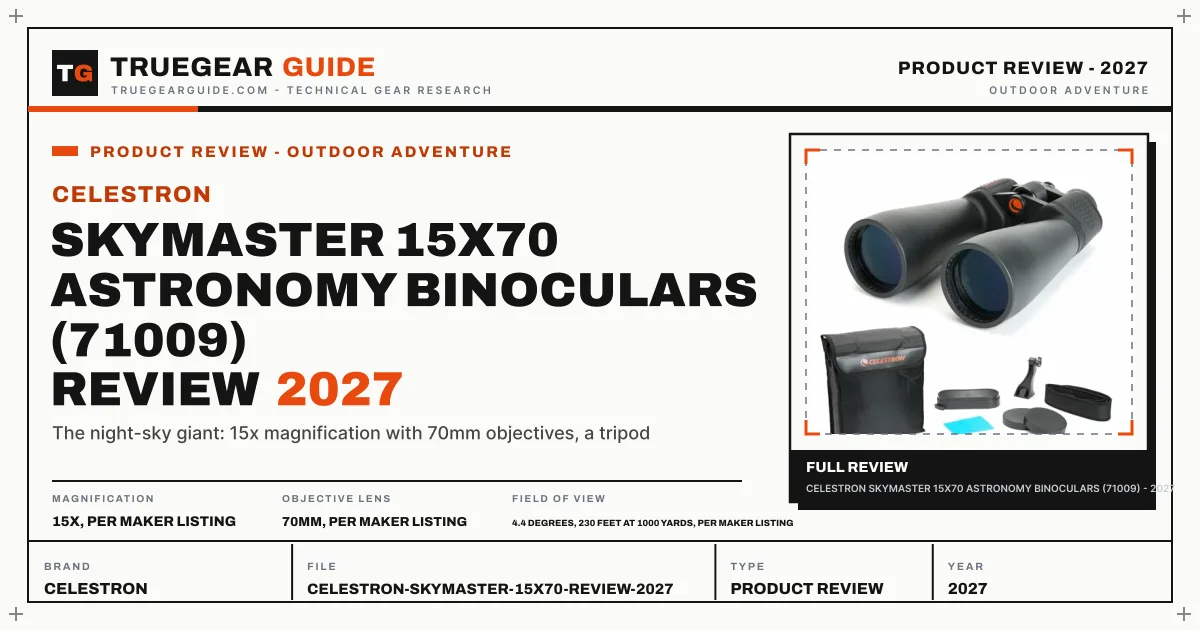

Celestron SkyMaster 15x70 Astronomy Binoculars (71009)
The night-sky giant: 15x magnification with 70mm objectives, a tripod adapter in the box, and the cheapest route to Jupiter's moons.
Our verdict
The SkyMaster 15x70 is the cheapest serious astronomy binocular worth buying: 70mm objectives that gather real deep-sky light, 15x magnification that resolves lunar craters and cluster stars, and a tripod adapter in the box so the mount it needs costs nothing extra. Hand-held use is a non-starter, the porro body is large, and collimation needs care on rough trips. On a tripod under a dark sky, nothing else at this price frames the heavens as well.
What we like
- 15x magnification with 70mm objectives gathers far more light than any 42mm pair, revealing star clusters and lunar detail
- Tripod adapter included in the box, so the mount it needs does not become a second purchase
- BaK-4 prisms with multi-coated optics keep the bright centre of the field sharp for astronomy and distant land viewing
- Long eye relief suits glasses wearers even at high magnification, where short relief usually punishes them
What to watch out for
- Hand-held use is impractical, so a tripod or monopod is effectively mandatory, not optional
- Porro body is large and heavy for hiking, and it will not fit a day pack alongside other gear
- Narrow 4.4-degree field makes finding targets harder, so beginners need patience or a finder habit
What owners report: Celestron SkyMaster 15x70 Astronomy Binoculars (71009)
Synthesized from recurring themes in long-term owner feedback.
Most praised
- Stargazers praise the lunar detail most, reporting craters and the moons of Jupiter visible on a steady tripod on clear nights.
- Owners praise the tripod adapter being included, since many giant binoculars charge extra for the one accessory they require.
- Value earns praise, with owners saying no telescope at this price frames the Milky Way sweep as easily.
Common complaints
- Shake when hand-held is the top complaint, from buyers who underestimated how much 15x magnifies tremor.
- Collimation drift after knocks worries owners, who find the two barrels drifting out of alignment on rough trips.
- The supplied case feels thin for such a large porro body, and owners buy padded protection for transport.
Who it is for
Stargazers and long-range watchers who will use a tripod and want deep-sky reach for little money.
What 70mm actually shows
On a steady tripod, the SkyMaster resolves the Moon's craters, shows Jupiter's moons as points beside the planet, splits bright clusters into stars, and renders the Milky Way as structured bands rather than haze. No 42mm pair in this guide reaches that faint structure, because aperture, not magnification alone, decides what appears. The 4.4-degree field is narrow, so finding targets takes patience, but the payoff per target is large.
The tripod is the product
Every complaint about shake traces back to skipping the tripod: 15x magnifies tremor into streaks, and no hand, however steady, holds it still. The included adapter means any sturdy photo tripod completes the setup, and owners who mount it from the first night love the binocular, while owners who try handheld first often blame the optic. Mount it, and the SkyMaster behaves like an instrument; carry it loose, and it behaves like a disappointment.
Bulk, collimation and care
The porro body is big and heavy, so this is a car-to-tripod instrument, not a hiking companion. Collimation, the alignment of the two barrels, can drift after knocks, so owners should transport it padded and check the merged image after rough trips. The supplied case feels thin for the size, and a padded case is the sensible first accessory.
Key specifications
- Magnification
- 15x, per maker listing
- Objective lens
- 70mm, per maker listing
- Field of view
- 4.4 degrees, 230 feet at 1000 yards, per maker listing
- Prism
- Porro prism, BaK-4, per maker listing
- Tripod adapter
- Included, per maker listing
- Weight
- 1.49 kg, per retailer fields
Also consider

Nikon ACULON A211 10x50 Binoculars (8248)
The classic porch porro: 10x50 reach, a bright 5mm exit pupil and tripod adaptability for dusk, decks and stadiums.
Why consider it: The handheld-friendly astronomy alternative with 50mm brightness and tripod adaptability
- Magnification: 10x, per maker listing
- Objective lens: 50mm, per maker listing

Vortex Diamondback HD 8x42 Binoculars (DB-214)
The birding default done right: HD glass, a wide 393-foot field, twist-up eyecups and a harness-style carry case in the box.
Why consider it: The constellation-sweeping alternative for learning the sky before committing to a giant pair
- Magnification: 8x, per maker listing
- Objective lens: 42mm, per maker listing
Research-based assessment. TrueGear has not hands-on tested this product; this evaluation synthesizes manufacturer specifications, retailer documentation, and published expert reviews.
Questions, answered
Can I hand-hold the SkyMaster 15x70 at all?
Briefly, for a bright Moon or a distant landmark, but not for satisfying astronomy. Stars streak, clusters blur, and the view tires the arms within minutes. Treat a tripod as part of the purchase, not an optional extra.
What tripod do I need?
Any sturdy photo tripod that holds the weight without creeping, used with the included adapter. A fluid video head helps for sweeping the sky, but a basic pan head suffices for lunar and cluster viewing.
Will the SkyMaster show planets in detail?
It shows Jupiter's moons and the Moon in detail, but not planetary surface detail like a telescope. Its strength is wide deep-sky framing: clusters, nebulae and Milky Way structure that a telescope cannot fit in one view.
Every guide on Binoculars15 pages
- Topic hubBinoculars
- Best ofThe Best Binoculars (2027)
- Birding punishes the wrong binocular faster than any other use. A narrow field loses a warbler mid-hop, short eye relief clips the view for glasses wearers, and an unsealed body fogs on the damp morning when birds are most active. This ranking weighs field, close focus and sealing first, and treats magnification as a secondary choice between steady 8x and reaching 10x.The Best Binoculars for Birding (2027)
- Kids quit binoculars for three reasons: the pair is too heavy, the field is too narrow to find anything, or the view blacks out every time eye placement shifts. This ranking favours light bodies, wide fields and steady 8x magnification, and it treats a real optic with a warranty as better than a toy that teaches nothing.The Best Binoculars for Kids (2027)
- Stargazing rewrites the binocular rules. Aperture matters more than magnification, because faint light is the limit, and a tripod matters more than both, because 10x and above shake stars into streaks. This ranking favours big objectives, generous exit pupils and tripod adaptability, and it is honest about the handheld ceiling.The Best Binoculars for Stargazing (2027)
- ReviewVortex Diamondback HD 8x42 Review (2027)
- ReviewNikon Monarch M7 8x42 Review (2027)
- ReviewCelestron Nature DX ED 8x42 Review (2027)
- ReviewVortex Crossfire HD 10x42 Review (2027)
- ReviewNikon Trailblazer ATB 8x25 Review (2027)
- Head to headVortex Diamondback HD 8x42 vs Crossfire HD 10x42 (2027)
- Head to headNikon Monarch M7 8x42 vs M5 8x42 (2027)
- Buying guideBinocular Buying Guide (2027)
- Fix itBinoculars Blurry or Foggy? Fixes (2027)