In-depth review
Kidde C3010D Carbon Monoxide Alarm Review (2027)
The C3010D pairs a live ppm display with a ten-year sealed battery. Our research-based verdict on the best battery display alarm.
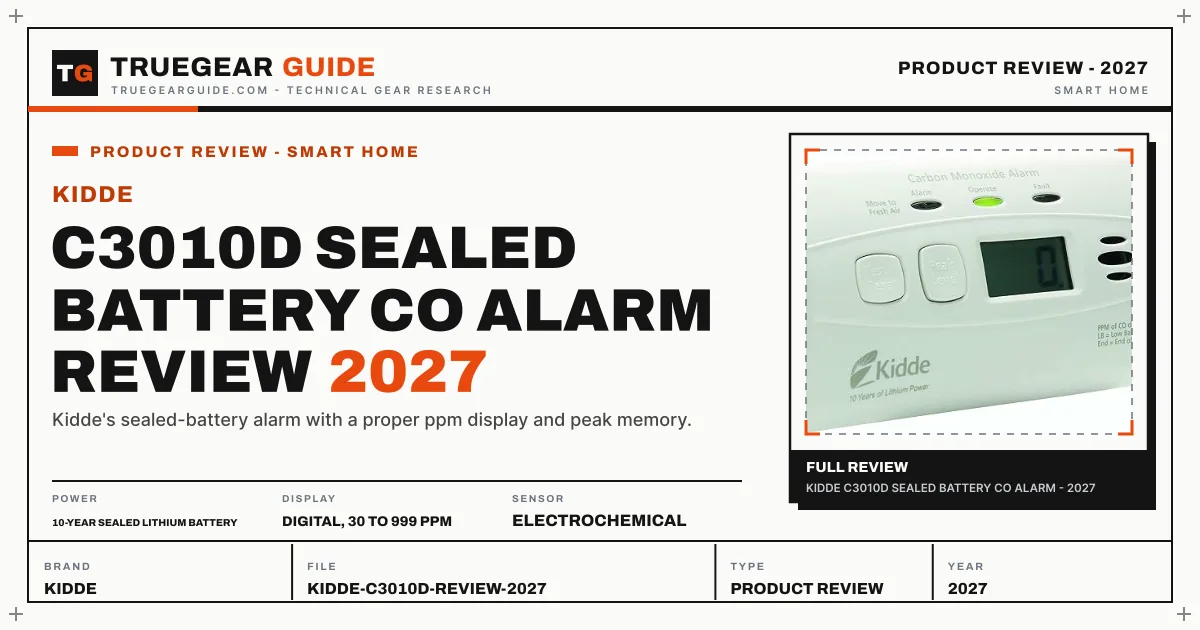

Kidde C3010D Sealed Battery CO Alarm
Kidde's sealed-battery alarm with a proper ppm display and peak memory.
Our verdict
The C3010D is the battery detector that refuses the usual compromise. It shows a live CO reading from 30 to 999 ppm, remembers the peak, signals its state with three LEDs, and runs for ten years on a sealed lithium battery that never needs changing. It costs more than the plain AA alarms and it has no mains option, but for a room with no socket it is the most complete CO detector in this guide, and the one that asks least of its owner.
What we like
- Ten-year sealed lithium battery never needs replacing over the unit's life
- Digital display shows CO from 30 to 999 ppm and updates every 15 seconds
- Peak-level memory records the highest CO level since the last reset
- Three LEDs separate normal operation, CO alarm and replace states clearly
What to watch out for
- Battery-only, so there is no mains option for homes that prefer wired power
- Some retailer tables list AA batteries for this model, which contradicts the manual and confuses buyers
- The sealed battery means the whole unit is replaced at end of life, not just a cell
What owners report: Kidde C3010D Sealed Battery CO Alarm
Synthesized from recurring themes in long-term owner feedback.
Most praised
- The ppm display plus peak memory is the combination owners say finally makes CO visible
- Ten years without touching a battery compartment is a genuine quality-of-life gain
- The three LEDs make the unit's state obvious from across the room
Common complaints
- Conflicting battery information in retailer tables makes buyers doubt the sealed claim
- It is heavier on the wall than the plain AA models, which shows on weak fixings
- The display blanks between readings in a way some owners read as the unit being off
Who it is for
Households with no socket where the detector must go, who want a display and a decade without battery changes.
A display and a sealed battery, together at last
Most battery alarms make the buyer choose: a display, or a sealed battery. The C3010D offers both, and that is its whole case. The display updates every 15 seconds and shows CO from 30 to 999 ppm, plus low-battery and end-of-life states. Peak-level memory keeps the highest reading. The sealed lithium battery removes the annual cell change entirely, which is the maintenance job that most often gets forgotten.
The three LEDs do real work
Green for normal operation, red for CO, amber for replace: the three-LED system means the unit's state is readable from across the room without touching it. That matters because the most common failure of a CO detector is not a dead sensor but a household that stopped looking at it. The display and the LEDs together make neglect harder.
The fine print worth knowing
Two caveats travel with this unit. Some retailer specification tables list AA batteries for it, which contradicts the manual's sealed lithium claim and confuses buyers; the manual is the authority. And the sealed battery means the whole unit is replaced at end of life, not just a cell, so the ten-year warranty is the real horizon. Neither caveat changes the verdict, but both are worth knowing before the purchase.
Key specifications
- Power
- 10-year sealed lithium battery
- Display
- Digital, 30 to 999 ppm
- Sensor
- Electrochemical
- Alarm
- 85 dB
- LEDs
- Green, red and amber LEDs
- Life
- 10-year limited warranty
Also consider

First Alert CO710 Sealed Battery CO Alarm
A ten-year sealed battery and a display that shows temperature as well as CO.
Why consider it: The First Alert sealed-battery rival, with a temperature display instead of a ppm-first screen
- Power: 10-year sealed lithium battery
- Display: Digital, temperature and CO

Kidde KN-COPP-3 Plug-In CO Detector
The long-running Nighthawk plug-in, with a live ppm display and a 9V battery behind it.
Why consider it: The plug-in equivalent, with the same display and peak memory, for rooms that have a socket
- Power: 120V AC, 9V battery backup
- Display: Digital, 30 to 999 ppm
Research-based assessment. TrueGear has not hands-on tested this product; this evaluation synthesizes manufacturer specifications, retailer documentation, and published expert reviews.
Questions, answered
Does the C3010D need batteries?
No, in the usual sense. It runs on a sealed lithium battery that lasts the ten-year life of the unit and is never replaced. Some retailer tables wrongly list AA batteries for this model; the manual states a sealed lithium battery.
What does the display show?
The live carbon monoxide level from 30 to 999 ppm, updating every 15 seconds, plus low-battery and end-of-life indications. The peak-level button recalls the highest level recorded since the last reset.
What do the three LEDs mean?
Green means normal operation, red means CO has been detected and the alarm is sounding, and amber means the unit needs replacing. The LEDs make the unit's state obvious without reading the display.
Every guide on Carbon Monoxide Detectors15 pages
- Topic hubCarbon Monoxide Detectors
- Best ofThe Best Carbon Monoxide Detectors (2027)
- A display is the dividing line in this category. Without one, an alarm is a binary event: silent, then shouting. With one, the household can watch a number climb, check a peak after an event, and give a technician a figure to work from. This ranking covers only the nine picks in the guide that show a reading, and it ranks them on how readable that reading is, whether peak memory is included, and what power source sits behind the screen.The Best Carbon Monoxide Detectors with a Display (2027)
- Battery power is what frees a CO detector from the socket, and it comes in three honest forms: ordinary replaceable cells, a replaceable lithium cell, and a sealed battery that lasts the life of the unit. This ranking covers the seven battery picks in the guide and weighs the real trade: a cheap alarm that needs cells every year or two, against a sealed unit that costs more once and is never opened again.The Best Battery Carbon Monoxide Detectors (2027)
- The bedroom is where a CO detector earns its keep, because carbon monoxide kills in sleep before anyone smells anything, and there is nothing to smell. This ranking weights the bedroom questions first: can the display be read in the dark, does the unit remember the peak overnight, will it survive a power cut, and will its low-battery chirp wake the household at 3 a.m. for the wrong reason. Plug-in models lead where a socket sits near the bed; battery models lead everywhere else.The Best Carbon Monoxide Detectors for Bedrooms (2027)
- ReviewKidde KN-COPP-3 Carbon Monoxide Detector Review (2027)
- ReviewFirst Alert CO615 Carbon Monoxide Detector Review (2027)
- ReviewFirst Alert CO710 Carbon Monoxide Alarm Review (2027)
- ReviewKidde KN-COP-IC Hardwired CO Alarm Review (2027)
- ReviewKidde KN-COP-DP-10YL Plug-In CO Detector Review (2027)
- Head to headKidde KN-COPP-3 vs First Alert CO615 (2027)
- Head to headKidde C3010D vs First Alert CO710 (2027)
- Buying guideCarbon Monoxide Detector Buying Guide (2027)
- Fix itCarbon Monoxide Detector Beeping? Fixes (2027)