Head to head
Kidde C3010D vs First Alert CO710 (2027)
Two sealed-battery CO alarms compared: Kidde C3010D against First Alert CO710 on display, battery and lifespan, for 2027 buyers.
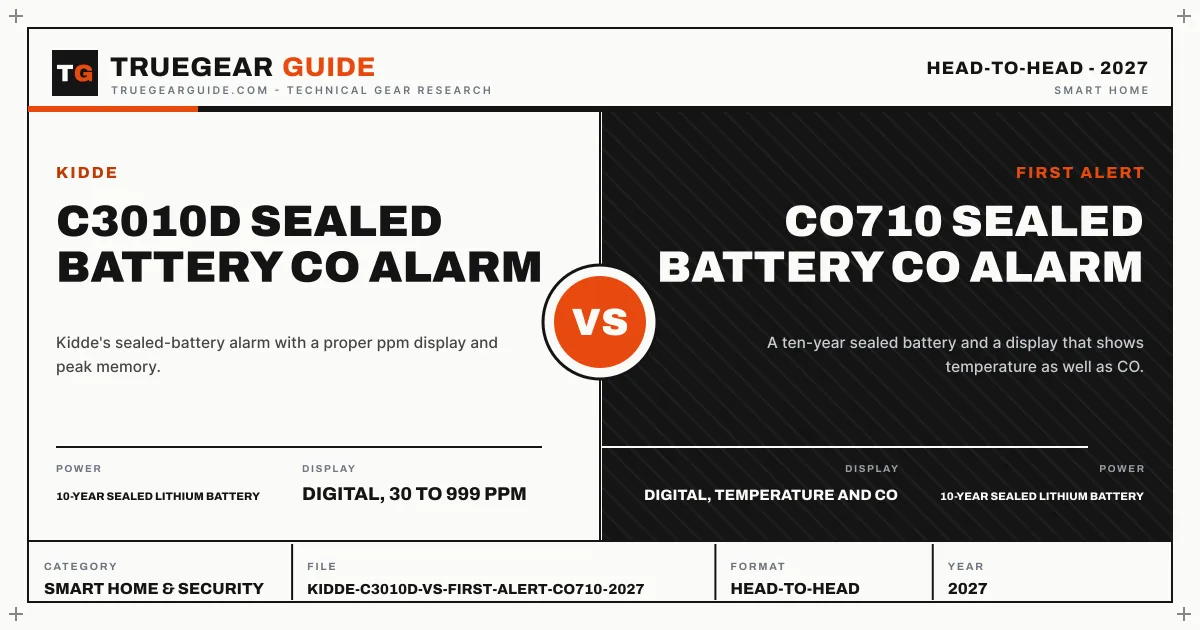

Kidde C3010D Sealed Battery CO Alarm
Kidde's sealed-battery alarm with a proper ppm display and peak memory.
- Power: 10-year sealed lithium battery
- Display: Digital, 30 to 999 ppm

First Alert CO710 Sealed Battery CO Alarm
A ten-year sealed battery and a display that shows temperature as well as CO.
- Power: 10-year sealed lithium battery
- Display: Digital, temperature and CO
What owners report
Most praised
- The ppm display plus peak memory is the combination owners say finally makes CO visible
- Ten years without touching a battery compartment is a genuine quality-of-life gain
- The three LEDs make the unit's state obvious from across the room
Common complaints
- Conflicting battery information in retailer tables makes buyers doubt the sealed claim
- It is heavier on the wall than the plain AA models, which shows on weak fixings
- The display blanks between readings in a way some owners read as the unit being off
What owners report
Most praised
- Never buying or changing a battery for ten years is the reason owners pick this one
- The temperature display means the unit gets looked at daily instead of forgotten
- It keeps guarding through power cuts, which plug-in-only alarms cannot do
Common complaints
- Owners who wanted a ppm-first display find the temperature-led screen a mild letdown
- The sealed battery is a strength until the day it is not, and then the whole unit goes
- It costs more than the plain battery alarms that do the same core job
Our recommendation
These are the two sealed-battery display alarms in this guide, and they answer the same question two ways. The Kidde C3010D is the instrument: a ppm-first display, peak memory and three LEDs that state its condition plainly. The First Alert CO710 is the household appliance: a temperature display that gets looked at daily, with the CO reading behind it. If the household wants a CO number to act on, take the Kidde. If the household wants a detector that earns attention every day and never needs a battery, take the First Alert. Both run ten years on a sealed cell and both work through power cuts.
What the display shows first
The Kidde's display leads with the CO level, 30 to 999 ppm, updating every 15 seconds, with peak memory a button press away. The First Alert's display leads with the room temperature, and the CO level is available behind it. One is built for a household that wants a number; the other is built for a household that wants a reason to look.
Status signals
The Kidde uses three LEDs, green for normal, red for CO and amber for replace, so its state is visible from across the room. The First Alert relies on its display and its alarm, with low-battery and end-of-life indicators on the screen. The Kidde's system is the clearer of the two at a distance.
Battery and life
Both units run on a ten-year sealed lithium battery with a ten-year limited warranty, and both are battery powered, so both work through power cuts. There is no meaningful difference in lifespan or upkeep between them; the choice is the display, not the battery.
Listing confusion
The Kidde suffers from conflicting battery information in some retailer tables, which wrongly list AA batteries for a sealed unit. The First Alert suffers the opposite confusion, with some listings implying it is a plug-in when it is battery powered. Both problems are solved by reading the manual, not the retailer's table.
Choose Kidde C3010D Sealed Battery CO Alarm if…
- You want a ppm-first display with peak memory
- Three status LEDs matter to you
- The household wants a number to quote to a technician
- You prefer Kidde's display-first design
Choose First Alert CO710 Sealed Battery CO Alarm if…
- You want a display that shows temperature daily
- The detector should earn a glance every day, not just in an emergency
- You prefer First Alert's design and warranty
- A temperature readout in the bedroom appeals to you
Questions, answered
Which one shows the CO level more clearly?
The Kidde C3010D. Its display leads with the ppm reading and updates every 15 seconds, with peak memory. The First Alert CO710 leads with temperature and shows the CO level behind it.
Do either of them need batteries?
No, in the usual sense. Both run on a sealed lithium battery that lasts the ten-year life of the unit and is never replaced. If the battery fails, the whole unit is replaced.
Which one is better in a power cut?
Both, equally. Both are battery powered, so both keep sensing through outages. Neither needs mains power at all, which is their shared advantage over plug-in detectors.
Every guide on Carbon Monoxide Detectors15 pages
- Topic hubCarbon Monoxide Detectors
- Best ofThe Best Carbon Monoxide Detectors (2027)
- A display is the dividing line in this category. Without one, an alarm is a binary event: silent, then shouting. With one, the household can watch a number climb, check a peak after an event, and give a technician a figure to work from. This ranking covers only the nine picks in the guide that show a reading, and it ranks them on how readable that reading is, whether peak memory is included, and what power source sits behind the screen.The Best Carbon Monoxide Detectors with a Display (2027)
- Battery power is what frees a CO detector from the socket, and it comes in three honest forms: ordinary replaceable cells, a replaceable lithium cell, and a sealed battery that lasts the life of the unit. This ranking covers the seven battery picks in the guide and weighs the real trade: a cheap alarm that needs cells every year or two, against a sealed unit that costs more once and is never opened again.The Best Battery Carbon Monoxide Detectors (2027)
- The bedroom is where a CO detector earns its keep, because carbon monoxide kills in sleep before anyone smells anything, and there is nothing to smell. This ranking weights the bedroom questions first: can the display be read in the dark, does the unit remember the peak overnight, will it survive a power cut, and will its low-battery chirp wake the household at 3 a.m. for the wrong reason. Plug-in models lead where a socket sits near the bed; battery models lead everywhere else.The Best Carbon Monoxide Detectors for Bedrooms (2027)
- ReviewKidde KN-COPP-3 Carbon Monoxide Detector Review (2027)
- ReviewFirst Alert CO615 Carbon Monoxide Detector Review (2027)
- ReviewKidde C3010D Carbon Monoxide Alarm Review (2027)
- ReviewFirst Alert CO710 Carbon Monoxide Alarm Review (2027)
- ReviewKidde KN-COP-IC Hardwired CO Alarm Review (2027)
- ReviewKidde KN-COP-DP-10YL Plug-In CO Detector Review (2027)
- Head to headKidde KN-COPP-3 vs First Alert CO615 (2027)
- Buying guideCarbon Monoxide Detector Buying Guide (2027)
- Fix itCarbon Monoxide Detector Beeping? Fixes (2027)