In-depth review
Kidde KN-COPP-3 Carbon Monoxide Detector Review (2027)
The KN-COPP-3 is Kidde's long-running plug-in CO detector with a live ppm display. Our research-based verdict on the bedroom standard.
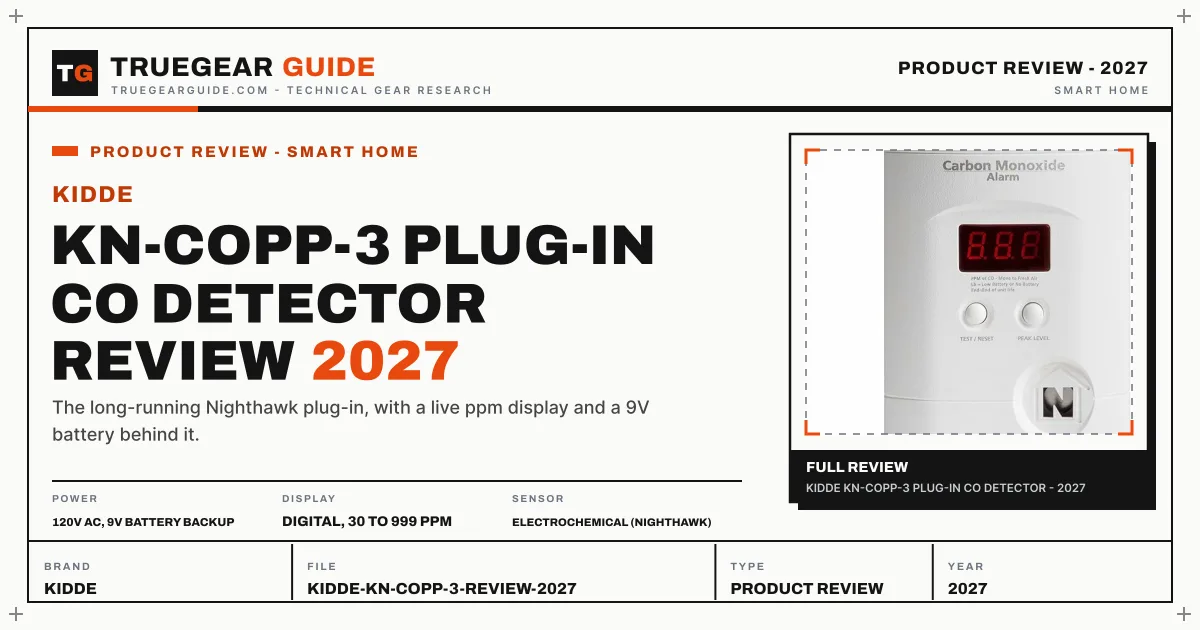

Kidde KN-COPP-3 Plug-In CO Detector
The long-running Nighthawk plug-in, with a live ppm display and a 9V battery behind it.
Our verdict
The KN-COPP-3 is the default plug-in CO detector for a reason: a live display that reads 30 to 999 ppm and updates every 15 seconds, peak-level memory, plug-in power with a 9V backup, and a ten-year life on a model that has been sold for years. It is not the newest detector in this guide and its display is not backlit, but it is the one other plug-in detectors are measured against, and for a bedroom with a socket nearby it remains the most complete answer in 2027.
What we like
- Digital display shows live CO from 30 to 999 ppm and updates every 15 seconds, per the manual
- Peak-level memory recalls the highest CO level recorded since the last reset
- Plug-in power with a 9V battery backup keeps the sensor running through a power cut
- Six-foot power cord gives real choice about where the unit sits relative to the bed
What to watch out for
- Needs a wall socket, so placement follows the outlet rather than the ideal sensing spot
- The 9V backup battery is a consumable that needs periodic replacement
- The display reads in ppm only, with no temperature or humidity readout
What owners report: Kidde KN-COPP-3 Plug-In CO Detector
Synthesized from recurring themes in long-term owner feedback.
Most praised
- The live ppm display turns a silent alarm into something the household can actually read and understand
- Peak-level memory settles the argument about whether the alarm sounded for a real reason
- It keeps working through power cuts, which is when heating appliances are most likely to misbehave
Common complaints
- Finding a free socket at the right height near the bed is harder than buyers expect
- The 9V backup battery needs remembering, and a dead backup shows up at the worst time
- The display is small enough that older eyes need to stand close to read it
Who it is for
Homeowners and renters with a socket near the sleeping area who want a live CO reading and peak memory.
The display is the product
The KN-COPP-3's case rests on its screen. A live ppm reading, refreshed every 15 seconds, turns carbon monoxide from an abstract danger into a number the household can watch, and peak-level memory keeps the highest reading after the event for a technician to see. Display-free alarms in this guide do the same sensing, but they leave the household with nothing to report and nothing to learn from. For a bedroom, where the alarm may sound while everyone sleeps, that record is worth more than the price difference.
Plug-in power, with the usual socket problem
Plug-in power is both the strength and the constraint. The unit never needs a battery routine for its main supply, and the 9V backup covers outages, but placement follows the socket rather than the ideal sensing height, and the 6 ft cord only partly solves that. Households with a socket near the bed will never notice the constraint; households whose sockets sit behind furniture will. The display is also not backlit, so reading it at night needs a lamp or a phone light.
Longevity and the honest costs
The manual states a ten-year life and a ten-year limited warranty, which puts this unit in the long-life class despite its age, though older reviews quote shorter figures from earlier manuals, so the current manual is the authority here. The running cost is a 9V battery every year or two, and the purchase price sits in the mid tier. Owners consistently praise the display and the peak memory, and just as consistently note the socket hunt and the small, unlit screen.
Key specifications
- Power
- 120V AC, 9V battery backup
- Display
- Digital, 30 to 999 ppm
- Sensor
- Electrochemical (Nighthawk)
- Alarm
- 85 dB
- Cord
- 6 ft power cord
- Life
- 10-year life, per manual
Also consider

First Alert CO615 Plug-In CO Detector
First Alert's plug-in with a backlit display, peak memory and a 6 ft cord.
Why consider it: The First Alert plug-in rival, with a backlit display and a 6 ft cord, at a seven-year life
- Power: 120V AC, 2x AA backup
- Display: Backlit digital, peak memory

Kidde C3010D Sealed Battery CO Alarm
Kidde's sealed-battery alarm with a proper ppm display and peak memory.
Why consider it: The same display and peak memory on a ten-year sealed battery, for rooms with no socket
- Power: 10-year sealed lithium battery
- Display: Digital, 30 to 999 ppm
Research-based assessment. TrueGear has not hands-on tested this product; this evaluation synthesizes manufacturer specifications, retailer documentation, and published expert reviews.
Questions, answered
Does the KN-COPP-3 need batteries?
It runs on mains power, with a 9V battery as backup for power cuts. The battery should be replaced when the unit signals low battery, typically every year or two, and the detector will not protect the household during an outage if the backup is dead.
What does the display show?
The live carbon monoxide concentration in parts per million, from 30 to 999 ppm, updating every 15 seconds. The peak-level button recalls the highest concentration recorded since the last reset, which is the number a gas engineer will ask for.
How long does the KN-COPP-3 last?
The current manual states a ten-year life with a ten-year limited warranty. Older reviews quote seven-year and five-year figures from earlier manuals, so the manual supplied with the unit is the one to trust.
Every guide on Carbon Monoxide Detectors15 pages
- Topic hubCarbon Monoxide Detectors
- Best ofThe Best Carbon Monoxide Detectors (2027)
- A display is the dividing line in this category. Without one, an alarm is a binary event: silent, then shouting. With one, the household can watch a number climb, check a peak after an event, and give a technician a figure to work from. This ranking covers only the nine picks in the guide that show a reading, and it ranks them on how readable that reading is, whether peak memory is included, and what power source sits behind the screen.The Best Carbon Monoxide Detectors with a Display (2027)
- Battery power is what frees a CO detector from the socket, and it comes in three honest forms: ordinary replaceable cells, a replaceable lithium cell, and a sealed battery that lasts the life of the unit. This ranking covers the seven battery picks in the guide and weighs the real trade: a cheap alarm that needs cells every year or two, against a sealed unit that costs more once and is never opened again.The Best Battery Carbon Monoxide Detectors (2027)
- The bedroom is where a CO detector earns its keep, because carbon monoxide kills in sleep before anyone smells anything, and there is nothing to smell. This ranking weights the bedroom questions first: can the display be read in the dark, does the unit remember the peak overnight, will it survive a power cut, and will its low-battery chirp wake the household at 3 a.m. for the wrong reason. Plug-in models lead where a socket sits near the bed; battery models lead everywhere else.The Best Carbon Monoxide Detectors for Bedrooms (2027)
- ReviewFirst Alert CO615 Carbon Monoxide Detector Review (2027)
- ReviewKidde C3010D Carbon Monoxide Alarm Review (2027)
- ReviewFirst Alert CO710 Carbon Monoxide Alarm Review (2027)
- ReviewKidde KN-COP-IC Hardwired CO Alarm Review (2027)
- ReviewKidde KN-COP-DP-10YL Plug-In CO Detector Review (2027)
- Head to headKidde KN-COPP-3 vs First Alert CO615 (2027)
- Head to headKidde C3010D vs First Alert CO710 (2027)
- Buying guideCarbon Monoxide Detector Buying Guide (2027)
- Fix itCarbon Monoxide Detector Beeping? Fixes (2027)