Head to head
Kidde KN-COPP-3 vs First Alert CO615 (2027)
The two leading plug-in CO detectors compared: Kidde KN-COPP-3 against First Alert CO615 on display, life, backup and price, for 2027 buyers.
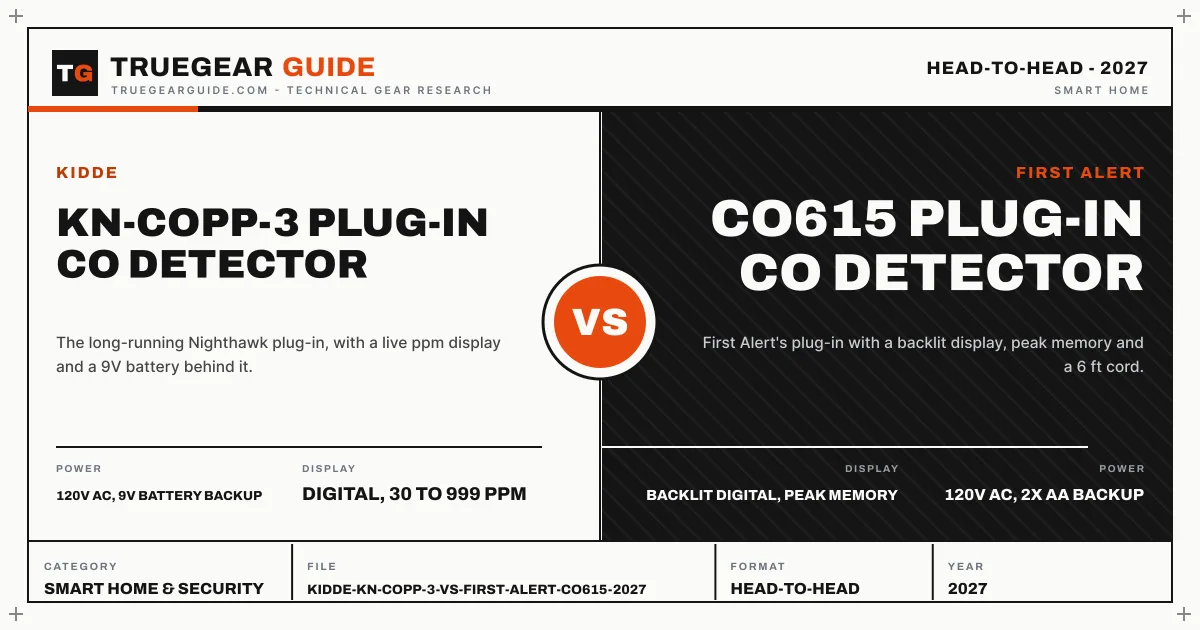

Kidde KN-COPP-3 Plug-In CO Detector
The long-running Nighthawk plug-in, with a live ppm display and a 9V battery behind it.
- Power: 120V AC, 9V battery backup
- Display: Digital, 30 to 999 ppm

First Alert CO615 Plug-In CO Detector
First Alert's plug-in with a backlit display, peak memory and a 6 ft cord.
- Power: 120V AC, 2x AA backup
- Display: Backlit digital, peak memory
What owners report
Most praised
- The live ppm display turns a silent alarm into something the household can actually read and understand
- Peak-level memory settles the argument about whether the alarm sounded for a real reason
- It keeps working through power cuts, which is when heating appliances are most likely to misbehave
Common complaints
- Finding a free socket at the right height near the bed is harder than buyers expect
- The 9V backup battery needs remembering, and a dead backup shows up at the worst time
- The display is small enough that older eyes need to stand close to read it
What owners report
Most praised
- The backlit display is the feature owners mention first, because it works at 3 a.m. without a lamp
- Peak memory gives a number to show a landlord or technician after an alarm event
- The plug-in form means no mounting screws and no battery routine to remember
Common complaints
- Owners who bought it expecting a ten-year life are surprised by the seven-year rating
- It looks so like the battery version that households buy the wrong power type by mistake
- A socket low on the wall puts the display at ankle height in some rooms
Our recommendation
These are the two plug-in detectors most homes will choose between, and the choice is a fair one. The Kidde KN-COPP-3 wins on life, ten years against seven, and on its longer track record as the bedroom standard. The First Alert CO615 wins on night readability, because its display is backlit and the Kidde's is not. If the detector lives in a bedroom and will be read in the dark, take the First Alert. If it lives anywhere else, or if a ten-year life matters more than a backlight, take the Kidde. Both show a live ppm reading, both remember the peak, and both cover a power cut on battery backup.
Display: live number versus backlit number
Both units show the CO level in ppm with peak memory. The Kidde's display reads 30 to 999 ppm and updates every 15 seconds, but it is not backlit, so it needs ambient light. The First Alert's display is backlit, so it reads in a dark hallway. In daylight the Kidde's larger reading range is the better screen; at night the First Alert's is.
Life and warranty
The Kidde is rated for ten years with a ten-year limited warranty, per the current manual. The First Alert is rated for seven years with a seven-year limited warranty. Three years of extra service is a real difference over the life of a home, and it is the Kidde's strongest argument.
Backup batteries
The Kidde backs up its mains power with a 9V battery; the First Alert uses two AA batteries. Neither is better in principle, but AA cells are cheaper and easier to find in most homes, while a 9V is a single cell to remember. Both backups need periodic replacement, and both units are unprotected in an outage if the backup is dead.
Cord, size and shelf confusion
Both units ship with a 6 ft power cord and an 85 dB alarm. The First Alert's oval housing is near-identical to its own battery models, which causes more confusion at the shelf than the Kidde's distinct plug-in shape. Buyers should check the power source in the specifications, not the photo, before choosing.
Choose Kidde KN-COPP-3 Plug-In CO Detector if…
- You want the longest life, ten years against seven
- The detector sits in a room with good light, so a backlight is not needed
- You trust the longest-established model in the category
- A 9V backup battery is acceptable to you
Choose First Alert CO615 Plug-In CO Detector if…
- The detector will be read at night, in a dark hallway or bedroom
- A backlit display matters more to you than three extra years of life
- You prefer AA backup batteries to a 9V cell
- You already own First Alert alarms and want one brand on the wall
Questions, answered
Which one is better for a bedroom?
The First Alert CO615, on the strength of its backlit display, which is readable without switching on a light. The Kidde is the better bedroom choice only if the room has a bedside lamp within reach of the detector or the household reads the display in daylight.
Which one lasts longer?
The Kidde KN-COPP-3, rated for ten years against the First Alert's seven. Both signal end of life when their time is up, and neither should be kept past it.
Can I tell them apart by looking at them?
Not reliably from the front. The First Alert CO615 shares its housing with First Alert battery models, while the Kidde has a more distinct plug-in shape. Check the model number on the box and the power source in the specifications.
Every guide on Carbon Monoxide Detectors15 pages
- Topic hubCarbon Monoxide Detectors
- Best ofThe Best Carbon Monoxide Detectors (2027)
- A display is the dividing line in this category. Without one, an alarm is a binary event: silent, then shouting. With one, the household can watch a number climb, check a peak after an event, and give a technician a figure to work from. This ranking covers only the nine picks in the guide that show a reading, and it ranks them on how readable that reading is, whether peak memory is included, and what power source sits behind the screen.The Best Carbon Monoxide Detectors with a Display (2027)
- Battery power is what frees a CO detector from the socket, and it comes in three honest forms: ordinary replaceable cells, a replaceable lithium cell, and a sealed battery that lasts the life of the unit. This ranking covers the seven battery picks in the guide and weighs the real trade: a cheap alarm that needs cells every year or two, against a sealed unit that costs more once and is never opened again.The Best Battery Carbon Monoxide Detectors (2027)
- The bedroom is where a CO detector earns its keep, because carbon monoxide kills in sleep before anyone smells anything, and there is nothing to smell. This ranking weights the bedroom questions first: can the display be read in the dark, does the unit remember the peak overnight, will it survive a power cut, and will its low-battery chirp wake the household at 3 a.m. for the wrong reason. Plug-in models lead where a socket sits near the bed; battery models lead everywhere else.The Best Carbon Monoxide Detectors for Bedrooms (2027)
- ReviewKidde KN-COPP-3 Carbon Monoxide Detector Review (2027)
- ReviewFirst Alert CO615 Carbon Monoxide Detector Review (2027)
- ReviewKidde C3010D Carbon Monoxide Alarm Review (2027)
- ReviewFirst Alert CO710 Carbon Monoxide Alarm Review (2027)
- ReviewKidde KN-COP-IC Hardwired CO Alarm Review (2027)
- ReviewKidde KN-COP-DP-10YL Plug-In CO Detector Review (2027)
- Head to headKidde C3010D vs First Alert CO710 (2027)
- Buying guideCarbon Monoxide Detector Buying Guide (2027)
- Fix itCarbon Monoxide Detector Beeping? Fixes (2027)