Best of
The Best Telescopes (2027)
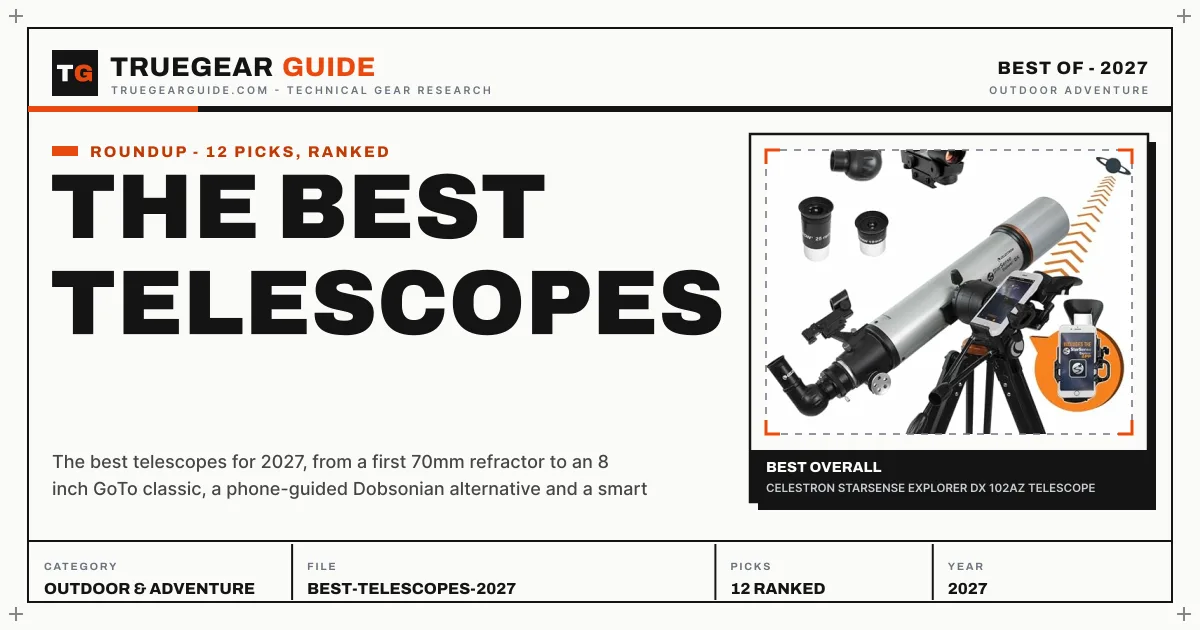
The best telescopes for 2027, from a first 70mm refractor to an 8 inch GoTo classic, a phone-guided Dobsonian alternative and a smart imaging scope, ranked on aperture, mount and finding help.
The short answer
For most first-time buyers, the Celestron StarSense Explorer DX 102AZ is the safest all-round pick: 102mm refractor optics, phone guidance and slow-motion controls, with no motors or alignment ritual. If the budget is tight, the AstroMaster 70AZ teaches the sky honestly. If deep-sky reach matters most for the money, the Sky-Watcher Heritage 130 Dobsonian wins. If finding targets is the barrier, GoTo scopes like the NexStar 130SLT do the work, and the NexStar 8SE is the long-term visual scope in this guide.
Our top picks at a glance
- Celestron StarSense Explorer DX 102AZ TelescopeThe DX step up: 102mm refractor optics with StarSense guidance and slow-motion controls for steadier tracking.Best overall
- Celestron AstroMaster 70AZ Refractor TelescopeThe long-running first refractor: a 70mm tube on a simple alt-azimuth mount with a full-height tripod.Best first telescope
- Sky-Watcher Heritage 130 Tabletop Dobsonian TelescopeMaximum aperture for the money: a collapsible 130mm Dobsonian that sits on a sturdy table and just works.Best value for deep sky
- Celestron NexStar 130SLT Computerized TelescopeA compact GoTo Newtonian: 130mm of aperture with a hand control that finds and tracks thousands of objects.Best GoTo for beginners
- Celestron NexStar 8SE Computerized TelescopeThe orange-tube classic: an 8 inch Schmidt-Cassegrain with GoTo, in a tube shorter than most 8 inch reflectors.Best long-term visual scope
The picks, ranked
| # | Product | Award | Optical design | Aperture | Focal length | Eyepieces | Mount |
|---|---|---|---|---|---|---|---|
| 1 | Celestron StarSense Explorer DX 102AZ Telescope | Best overall | Achromatic refractor | 102mm | 660mm, f/6.5 | 25mm (26x) and 10mm (66x) | Manual alt-azimuth, dual-axis slow-motion controls |
| 2 | Celestron AstroMaster 70AZ Refractor Telescope | Best first telescope | Achromatic refractor | 70mm | 900mm, f/12.9 | 20mm (45x) and 10mm (90x) | Manual alt-azimuth, adjustable-height tripod |
| 3 | Sky-Watcher Heritage 130 Tabletop Dobsonian Telescope | Best value for deep sky | Newtonian reflector, Dobsonian | 130mm | 650mm, f/5 | 25mm and 10mm, 1.25 in | Tabletop Dobsonian rocker box |
| 4 | Celestron NexStar 130SLT Computerized Telescope | Best GoTo for beginners | Newtonian reflector | 130mm | 650mm, f/5 | 20mm and 9mm | Computerized alt-azimuth, single fork arm |
| 5 | Celestron NexStar 8SE Computerized Telescope | Best long-term visual scope | Schmidt-Cassegrain | 203mm (8 in) | 2032mm, f/10 | - | Computerized alt-azimuth, single fork arm |
| 6 | Celestron Travel Scope 70 Portable Refractor Telescope | Best for travel | Achromatic refractor | 70mm | 400mm, f/5.71 | 20mm (20x) and 10mm (40x) | Manual alt-azimuth, pan handle, full-height tripod |
| 7 | Celestron PowerSeeker 127EQ Reflector Telescope | Best equatorial starter | Newtonian reflector, spherical primary mirror | 127mm | 1000mm, f/7.87 | 20mm (50x) and 4mm (250x), plus 3x Barlow | Manual German equatorial, slow-motion controls |
| 8 | Celestron StarSense Explorer DX 130AZ Telescope | Best app-guided reflector | Newtonian reflector | 130mm | 650mm, f/5 | 25mm (26x) and 10mm (65x) | Manual alt-azimuth, dual-axis slow-motion controls |
| 9 | Celestron StarSense Explorer LT 80AZ Telescope | Best budget app-guided scope | Achromatic refractor | 80mm | 900mm, f/11 | 25mm (36x) and 10mm (90x), plus 2x Barlow | Manual alt-azimuth, preassembled tripod |
| 10 | Celestron AstroMaster 102AZ Refractor Telescope | Best manual refractor | Achromatic refractor | 102mm | 660mm, f/6.5 | 20mm (33x) and 10mm (66x) | Manual alt-azimuth, adjustable-height tripod |
| 11 | Gskyer 80mm AZ Space Astronomical Refractor Telescope (AZ80400) | Best budget complete kit | Achromatic refractor | 80mm | 400mm, f/5 | 25mm (16x), 10mm (40x), 5mm (80x), plus 3x Barlow | Manual alt-azimuth, stainless steel tripod |
| 12 | ZWO Seestar S50 Smart Telescope | Best smart telescope | Triplet apochromatic refractor, smart telescope | 50mm | 250mm, f/5 | - | - |
Best overall
Celestron StarSense Explorer DX 102AZ Telescope
The DX step up: 102mm refractor optics with StarSense guidance and slow-motion controls for steadier tracking.

Strengths
- StarSense guidance on a manual mount gives GoTo-like finding without motors or mount batteries
- Dual-axis slow-motion controls let observers track smoothly, a clear upgrade over the LT mount
- 102mm aperture at 660mm focal length gives 26x from the 25mm eyepiece and 66x from the 10mm eyepiece
- Erect image diagonal keeps daytime viewing correctly oriented, so the scope earns its keep by day
Limitations
- The DX price buys guidance and mount refinement, not a jump in aperture over cheaper 102mm scopes
- Phone dock alignment must be done carefully, or the app arrows point slightly off target
- Refractor colour fringing remains on the brightest lunar and planetary edges
What owners report
Most praised
- The slow-motion knobs are the upgrade owners mention most, after guidance itself
- Planetary viewers like the steady, contrasty refractor image at moderate power
- The app list of tonight best targets stops clear nights being wasted deciding what to look at
Common complaints
- Owners comparing prices note a manual 102mm scope without StarSense costs less for the same optics
- Dock calibration takes a few tries on the first night, especially in light-polluted skies
- The mount still needs a firm tripod setup, or slow-motion tracking feels uneven
| Optical design | Achromatic refractor |
|---|---|
| Aperture | 102mm |
| Focal length | 660mm, f/6.5 |
| Eyepieces | 25mm (26x) and 10mm (66x) |
| Mount | Manual alt-azimuth, dual-axis slow-motion controls |
| Guidance | StarSense Explorer app, smartphone dock |
Best for: Beginners who want phone guidance plus a sturdier mount, and observers who like refractors for planets.
Skip if: Deep-sky aperture is the priority; a 102mm refractor costs more per millimetre than a Dobsonian reflector.
Best first telescope
Celestron AstroMaster 70AZ Refractor Telescope
The long-running first refractor: a 70mm tube on a simple alt-azimuth mount with a full-height tripod.

Strengths
- 70mm fully coated achromatic objective with a long 900mm focal length, a forgiving combination for lunar and planetary detail
- Alt-azimuth mount moves the way a camera tripod does, so first-night aiming needs no polar alignment lesson
- Two eyepieces, 20mm for 45x and 10mm for 90x, plus an erect image diagonal for correct-orientation daytime views
- StarPointer red dot finder and an adjustable-height tripod keep the whole kit usable standing up
Limitations
- At f/12.9 the tube is long for its aperture, so storage and transport need more room than a short-tube scope
- An achromatic refractor at this price shows some colour fringing on the brightest Moon and planet edges
- The mount is a starter mount: it steadies low-power views well and shudders more as magnification climbs
What owners report
Most praised
- First-time buyers get the Moon in the eyepiece on the first clear night without a long setup ritual
- Parents value a scope children can aim by pushing the tube rather than learning mount controls first
- The erect image diagonal turns the same kit into a usable daytime spotting scope for distant scenery
Common complaints
- Owners expecting galaxy detail from a 70mm tube are disappointed by how faint deep-sky targets look
- The tripod legs and mount head feel light for the long tube in a breeze
- High-power views demand patience, because small mount vibrations take a moment to settle
| Optical design | Achromatic refractor |
|---|---|
| Aperture | 70mm |
| Focal length | 900mm, f/12.9 |
| Eyepieces | 20mm (45x) and 10mm (90x) |
| Mount | Manual alt-azimuth, adjustable-height tripod |
| Finder | StarPointer red dot finder |
Best for: Absolute beginners and families who want a first scope for the Moon, bright planets and daytime viewing.
Skip if: Faint galaxies and nebulae are the main goal; 70mm shows them only as dim smudges under most skies.
Best value for deep sky
Sky-Watcher Heritage 130 Tabletop Dobsonian Telescope
Maximum aperture for the money: a collapsible 130mm Dobsonian that sits on a sturdy table and just works.

Strengths
- 130mm parabolic mirror on a simple Dobsonian base gives bright deep-sky views at a beginner price
- FlexTube collapsible design shortens the tube for storage and transport between sessions
- Push-to-point Dobsonian motion is intuitive: push the tube, release, and it stays where aimed
- Two eyepieces, 25mm and 10mm, plus a StarPointer finder cover low-power finding and closer views
Limitations
- A tabletop scope is only as good as its table: a wobbly surface ruins the stability advantage
- No tracking, no slow-motion controls and no guidance, so planets drift and finding is manual
- The open truss-style tube needs care against dust and stray light compared with a closed tube
What owners report
Most praised
- Value hunters call it the cheapest honest route to 130mm deep-sky views
- The collapsible tube makes the scope easy to carry to a dark site in a small car
- Push-to aiming feels natural to complete beginners, with no mount controls to learn
Common complaints
- Owners without a suitable table end up buying or building a stand before the scope feels right
- Manual tracking at high power means frequent nudges, which tires planetary observers
- The truss shroud question comes up often, since stray light reaches the mirror more easily
| Optical design | Newtonian reflector, Dobsonian |
|---|---|
| Aperture | 130mm |
| Focal length | 650mm, f/5 |
| Eyepieces | 25mm and 10mm, 1.25 in |
| Mount | Tabletop Dobsonian rocker box |
| Coatings | Radiant Aluminum Quartz |
Best for: Beginners who want the most deep-sky reach per pound spent, and observers with a solid garden table.
Skip if: You have no suitable table or need a standing-height tripod scope; this one needs a stable surface.
Best GoTo for beginners
Celestron NexStar 130SLT Computerized Telescope
A compact GoTo Newtonian: 130mm of aperture with a hand control that finds and tracks thousands of objects.

Strengths
- Computerized alt-azimuth mount slews to objects from a database of more than 4,000 stars, galaxies and nebulae
- SkyAlign alignment needs any three bright objects centred in the eyepiece, not named stars from a chart
- 130mm Newtonian tube at 650mm focal length stays compact for transport and sets up in minutes
- NexStar+ hand control tracks targets once found, so planets stay in view while observers swap eyepieces
Limitations
- It runs on 8 AA batteries or 12V DC, neither included, so a first night needs a power plan
- A single fork arm alt-azimuth mount is convenient, not a long-exposure astrophotography platform
- GoTo accuracy depends on careful alignment and a level tripod, and sloppy setup shows up as missed targets
What owners report
Most praised
- The hand control turns a first dark-site night into a tour, with one target after another landing in view
- The short tube packs into a car far more easily than the long refractors beginners often start with
- SkyAlign feels forgiving, because it accepts bright objects the observer can already recognise
Common complaints
- Battery appetite surprises buyers who assumed a mains or rechargeable pack came in the box
- Alignment fails frustrate first users until they learn to level the tripod and centre stars carefully
- The mount can sound and feel busy while slewing, which puts off observers used to silent manual scopes
| Optical design | Newtonian reflector |
|---|---|
| Aperture | 130mm |
| Focal length | 650mm, f/5 |
| Eyepieces | 20mm and 9mm |
| Mount | Computerized alt-azimuth, single fork arm |
| Database | More than 4,000 objects, SkyAlign |
Best for: Beginners who want the computer to do the finding, and observers who travel to dark sites with a short tube.
Skip if: You dislike batteries and menus; this scope needs power and a three-star alignment before it earns its keep.
Best long-term visual scope
Celestron NexStar 8SE Computerized Telescope
The orange-tube classic: an 8 inch Schmidt-Cassegrain with GoTo, in a tube shorter than most 8 inch reflectors.

Strengths
- 203mm Schmidt-Cassegrain aperture with StarBright XLT coatings gathers enough light for globular clusters and galaxies
- Long 2032mm focal length at f/10 suits lunar and planetary detail, with a 25mm eyepiece giving 81x
- Fully automated GoTo mount with a database of more than 40,000 objects locates and tracks targets
- The folded optical path keeps the tube to 432mm, so an 8 inch scope travels like a much smaller one
Limitations
- The single fork arm mount and alt-azimuth tracking suit visual use, not long deep-sky exposures
- Power comes from 8 AA batteries or an external source, none included, and GoTo eats batteries on long nights
- At this aperture and price, a dew shield and a sturdier power supply become near-essential extras
What owners report
Most praised
- Long-term owners keep coming back to how much sky an 8 inch tube shows from a suburban garden
- The orange tube and fork mount set up as one familiar unit, with no separate mount assembly puzzle
- Planetary observers single out Saturn and Jupiter detail that smaller starters only hint at
Common complaints
- The fork arm and tripod show their limits when the tube is loaded with heavy eyepieces or cameras
- Dew on the corrector plate ends autumn nights early unless a shield or heater is added
- Buyers who skip the power-supply question end up feeding the mount a stream of AA batteries
| Optical design | Schmidt-Cassegrain |
|---|---|
| Aperture | 203mm (8 in) |
| Focal length | 2032mm, f/10 |
| Eyepiece | 25mm Plossl (81x) |
| Mount | Computerized alt-azimuth, single fork arm |
| Database | More than 40,000 objects, SkyAlign |
Best for: Serious visual observers who want 8 inches of aperture, GoTo finding and a scope that still fits a car boot.
Skip if: The budget is beginner level, or deep-sky photography is the goal; this is a visual scope first.
Best for travel
Celestron Travel Scope 70 Portable Refractor Telescope
A backpack refractor: 70mm optics, a full-height tripod and a carry bag for camping and travel nights.

Strengths
- The whole kit, tube, tripod and eyepieces, packs into the included custom backpack
- Tool-free assembly gets the scope from bag to observing in seconds, which matters on short trips
- Fully coated 70mm optics with 20mm and 10mm eyepieces give 20x and 40x views for Moon and scenery
- A 45 degree erect image diagonal keeps daytime views the right way up for wildlife and landscapes
Limitations
- Short focal length and modest aperture cap planetary detail well below longer 70mm refractors
- The travel tripod prioritises pack size over rigidity, so high-power views shake more
- A 400mm tube needs low-power patience: it is a wide-field scope, not a high-magnification planet scope
What owners report
Most praised
- Campers report the backpack is the reason the scope actually leaves the house, unlike heavier kits
- Children manage the pan-handle mount on their own after one guided evening
- Daytime users keep it by a window for birds and distant hills between night sessions
Common complaints
- Owners chasing crisp planet detail find the short tube runs out of useful magnification early
- The included tripod flexes in wind, and buyers often plan a sturdier tripod as the first upgrade
- The finderscope needs careful alignment, or beginners sweep past the Moon more than once
| Optical design | Achromatic refractor |
|---|---|
| Aperture | 70mm |
| Focal length | 400mm, f/5.71 |
| Eyepieces | 20mm (20x) and 10mm (40x) |
| Mount | Manual alt-azimuth, pan handle, full-height tripod |
| Kit | Backpack, erect image diagonal, 5x24 finderscope |
Best for: Travellers, campers and families who need a scope that packs away and sets up in seconds.
Skip if: Deep-sky observing is the priority; a short 400mm tube trades reach for packability.
Best equatorial starter
Celestron PowerSeeker 127EQ Reflector Telescope
A 127mm Newtonian on a manual German equatorial mount, the classic budget route into larger aperture.

Strengths
- 127mm aperture gathers far more light than 70mm and 80mm starters, which shows in clusters and bright nebulae
- 1000mm focal length at f/7.87 gives useful planetary magnification from the included eyepieces
- German equatorial mount with slow-motion controls lets one axis track a target once roughly polar aligned
- The kit includes a 20mm eyepiece, a 4mm eyepiece and a 3x Barlow, so several magnifications arrive in the box
Limitations
- The spherical primary mirror is a cost-saving design, not the parabolic mirror found on dearer reflectors
- Equatorial setup is the learning curve: balance, latitude setting and polar alignment all come before observing
- The 4mm eyepiece pushes magnification to the edge of what most nights and this mount support
What owners report
Most praised
- The jump from a small starter scope to this aperture makes familiar clusters look noticeably richer
- Slow-motion knobs let observers follow Jupiter across the field without constantly nudging the tube
- Families appreciate a kit that arrives with several magnifications instead of needing eyepieces at once
Common complaints
- New owners regularly assemble the equatorial mount wrong on the first attempt and need the manual twice
- The mount head and tripod are the weak link when the tube is pushed to high power
- Collimation checks catch beginners out, because the manual gives the topic less space than it deserves
| Optical design | Newtonian reflector, spherical primary mirror |
|---|---|
| Aperture | 127mm |
| Focal length | 1000mm, f/7.87 |
| Eyepieces | 20mm (50x) and 4mm (250x), plus 3x Barlow |
| Mount | Manual German equatorial, slow-motion controls |
| Finder | 5x24 finderscope |
Best for: Beginners who want 5 inches of aperture and are willing to learn equatorial setup in exchange for smoother tracking.
Skip if: You want point-and-look simplicity; an equatorial mount adds counterweights, balancing and polar alignment.
Best app-guided reflector
Celestron StarSense Explorer DX 130AZ Telescope
StarSense guidance on a 130mm Newtonian: reflector aperture and phone pointing on a full-height tripod.

Strengths
- 130mm Newtonian reflector gathers more light than the DX 102AZ refractor, which shows on clusters and nebulae
- StarSense app guidance removes the hardest beginner skill, finding faint targets with a manual mount
- 650mm focal length at f/5 gives a wide field, with 26x from the 25mm eyepiece and 65x from the 10mm eyepiece
- Manual alt-azimuth mount with slow-motion controls and a full-height tripod suits standing observers
Limitations
- Newtonian reflectors need occasional collimation, a maintenance step refractors avoid
- The reflector image is inverted, so this is a night-sky scope, not a daytime spotting scope
- The tube and tripod together are bulkier to store than a tabletop Dobsonian of the same aperture
What owners report
Most praised
- Deep-sky beginners reach the Orion Nebula and bright clusters far sooner than with a finder alone
- The wide field makes sweeping the Milky Way feel rewarding even on nights with thin cloud
- Standing-height tripod use suits taller observers better than tabletop scopes do
Common complaints
- Collimation is the first maintenance surprise for buyers coming from refractors
- The inverted view confuses daytime users who try the scope for terrestrial viewing
- App guidance still needs a decent phone camera view, which suffers under bright streetlights
| Optical design | Newtonian reflector |
|---|---|
| Aperture | 130mm |
| Focal length | 650mm, f/5 |
| Eyepieces | 25mm (26x) and 10mm (65x) |
| Mount | Manual alt-azimuth, dual-axis slow-motion controls |
| Guidance | StarSense Explorer app, smartphone dock |
Best for: Beginners who want reflector aperture for deep sky, with app guidance instead of a GoTo mount.
Skip if: You want a tabletop scope or a grab-and-go tube; this is a full tripod Newtonian that needs assembly care.
Best budget app-guided scope
Celestron StarSense Explorer LT 80AZ Telescope
A phone-guided 80mm refractor: dock a smartphone, follow on-screen arrows, and stop hunting blind.

Strengths
- StarSense sky recognition uses the docked phone camera to work out where the telescope points, in real time
- The app gives directional arrows to the chosen target, which removes most first-night finding frustration
- 80mm refractor with 900mm focal length gives 36x from the 25mm eyepiece and 90x from the 10mm eyepiece
- A 2x Barlow, erect image diagonal and preassembled mount and tripod keep the kit complete and simple
Limitations
- Guidance depends on the phone: a flat battery, an incompatible handset or a cloudy app view stops the help
- The mount itself is manual, so the app points but the observer still pushes and tracks by hand
- Long f/11 tube needs storage space, and the phone dock adds a step to every setup
What owners report
Most praised
- New observers find their first nebula in minutes, where a manual finder alone had left them circling
- The app tour list gives families a ready-made observing plan for each clear night
- The preassembled mount means setup is mostly unfolding legs and docking the phone
Common complaints
- Phone compatibility checks catch some buyers after purchase, when their handset is not supported
- Night phone glare annoys dark-adapted observers, even with the screen dimmed
- Manual tracking at high power still needs practice, since the app does not move the tube
| Optical design | Achromatic refractor |
|---|---|
| Aperture | 80mm |
| Focal length | 900mm, f/11 |
| Eyepieces | 25mm (36x) and 10mm (90x), plus 2x Barlow |
| Mount | Manual alt-azimuth, preassembled tripod |
| Guidance | StarSense Explorer app, smartphone dock |
Best for: Beginners who get lost star-hopping and want app guidance without motors, batteries or a GoTo mount.
Skip if: You do not want a phone at the telescope, or your phone is not compatible with the StarSense app.
Best manual refractor
Celestron AstroMaster 102AZ Refractor Telescope
A bigger AstroMaster: 102mm of aperture on the same simple alt-azimuth idea, for brighter planets and clusters.

Strengths
- 102mm fully coated objective gathers noticeably more light than 70mm, which helps clusters and bright nebulae
- 660mm focal length at f/6.5 keeps the tube shorter and handier than the long 70AZ tube
- Two eyepieces, 20mm for 33x and 10mm for 66x, cover wide-field finding and closer lunar views
- Alt-azimuth mount with an adjustable-height tripod needs no alignment procedure before observing
Limitations
- An achromatic 102mm refractor still shows colour fringing on very bright targets
- At this size the mount and tripod, not the optics, set the practical magnification ceiling
- No slow-motion controls, so tracking a planet at high power means frequent small nudges
What owners report
Most praised
- Upgraders from small scopes notice the Moon looking brighter and more detailed on the first night
- The short tube is easier to store upright in a corner than long-tube refractors
- Daytime observers use it as a large spotting scope for distant landscapes and wildlife
Common complaints
- Owners who expect GoTo convenience find manual star-hopping slow on faint targets
- Colour fringing around the Moon at high power draws comment from picky lunar observers
- The tripod head can drift slightly if the tension knobs are left loose
| Optical design | Achromatic refractor |
|---|---|
| Aperture | 102mm |
| Focal length | 660mm, f/6.5 |
| Eyepieces | 20mm (33x) and 10mm (66x) |
| Mount | Manual alt-azimuth, adjustable-height tripod |
| Finder | StarPointer red dot finder |
Best for: Beginners who outgrew a 70mm scope, and households that want one scope for night sky and daytime viewing.
Skip if: You need GoTo or app guidance; this is a fully manual scope and finding targets is on the observer.
Best budget complete kit
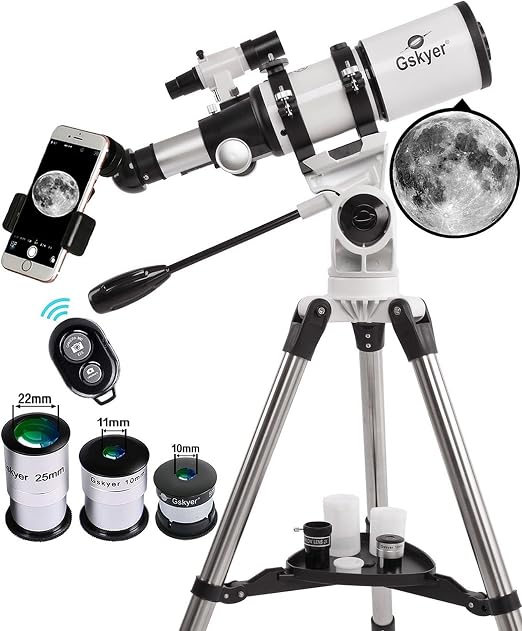
Gskyer 80mm AZ Space Astronomical Refractor Telescope (AZ80400)
A low-cost complete kit: 80mm refractor, three eyepieces, Barlow, phone adapter and stainless tripod.
Strengths
- 80mm aperture with a short 400mm focal length gives bright, wide low-power views of the Moon and clusters
- Three eyepieces, 25mm, 10mm and 5mm, give 16x, 40x and 80x before the included 3x Barlow is added
- A 6x30 finderscope is larger than the small finders on many budget kits, which helps first aiming
- Phone adapter and wireless remote in the box let beginners try Moon photos without extra purchases
Limitations
- The quoted top magnifications with the Barlow exceed what a short achromatic tube shows cleanly
- Documentation is thinner than Celestron manuals, so beginners may need online setup help
- Focuser and eyepiece quality are entry level, and a future eyepiece upgrade improves the scope most
What owners report
Most praised
- Buyers on a tight budget value opening one box and having eyepieces, Barlow and phone holder ready
- The wide low-power view makes finding the Moon and bright clusters less stressful for new users
- Gift buyers report the kit works as a complete present, with no immediate accessory hunt
Common complaints
- Owners who push the Barlow to its advertised extremes get soft, dim images and blame the tube
- Assembly instructions leave first-timers guessing about diagonal and finder orientation
- The mount needs gentle handling at high power, where vibrations linger
| Optical design | Achromatic refractor |
|---|---|
| Aperture | 80mm |
| Focal length | 400mm, f/5 |
| Eyepieces | 25mm (16x), 10mm (40x), 5mm (80x), plus 3x Barlow |
| Mount | Manual alt-azimuth, stainless steel tripod |
| Finder | 6x30 finderscope |
Best for: Budget buyers and families who want the full accessory set in one box, including phone photography.
Skip if: Optical refinement matters more than kit completeness; this is a starter refractor, not a premium optic.
Best smart telescope
ZWO Seestar S50 Smart Telescope
No eyepiece, no star-hopping: a 50mm smart telescope that finds, tracks and photographs the sky from a phone.

Strengths
- All-in-one design combines telescope, camera, focuser, mount and dew heater in one 5.5 lb listing-weight unit
- The app finds and tracks targets automatically, then stacks short exposures into a visible deep-sky image
- 50mm triplet apochromatic optics at 250mm focal length with a Sony IMX462 sensor suit nebulae and clusters
- Included carbon tripod, solar filter and carrying case make the kit genuinely portable and travel ready
Limitations
- 50mm aperture and a small sensor cannot match a visual 8 inch scope for planets or fine lunar detail
- Single frames are 10 seconds, so total image quality depends on stacking time and steady setup
- Everything runs through the app, so a phone problem or app issue stops the whole observing session
What owners report
Most praised
- City observers are struck by nebula images emerging on a phone screen from light-polluted gardens
- The setup routine is short enough that the scope gets used on weeknights, not just planned trips
- Sharing stacked images straight from the phone turns solitary observing into a family activity
Common complaints
- Planetary imagers find small, soft planet disks and wish for far more focal length
- Field rotation and stacking limits show up on longer sessions without the equatorial mode hardware
- Owners miss the immediacy of an eyepiece, since every view arrives through a screen
| Optical design | Triplet apochromatic refractor, smart telescope |
|---|---|
| Aperture | 50mm |
| Focal length | 250mm, f/5 |
| Sensor | Sony IMX462, 1920 x 1080 |
| Control | Seestar app, autofocus, automatic tracking |
| Kit | Carbon tripod, solar filter, carrying case |
Best for: Photography-first beginners, city observers and anyone who wants deep-sky images without learning visual astronomy.
Skip if: Looking through an eyepiece is the point for you; this scope has no eyepiece at all.
How we chose
Aperture first, magnification last
Aperture decides light gathered, and light decides what you actually see. A 70mm scope shows the Moon and planets well and deep-sky targets faintly. A 130mm scope brightens clusters and nebulae visibly. A 203mm scope changes the whole deep-sky list. Magnification is just aperture divided by eyepiece focal length, and pushing it past what the sky and mount support only makes a dimmer, shakier image.
The mount is half the telescope
A steady mount at low power beats a shaky mount at high power every night. Alt-azimuth mounts aim naturally. Equatorial mounts track with one axis once aligned. Dobsonian bases are the simplest stable option for larger reflectors. GoTo mounts add motors and menus. Judge the mount by how long an image stays still, not by how many features the box lists.
Finding help decides whether beginners stay
Most abandoned telescopes were not optically bad; their owners could not find anything. A red dot finder helps on bright targets. StarSense guidance uses a phone to point a manual mount. GoTo finds and tracks from a database. A smart telescope finds, tracks and photographs. Pick the finding level that matches your patience, not the one that sounds most impressive.
Portability decides use
The best telescope is the one that gets carried outside on an ordinary Tuesday. A backpack refractor, a collapsible Dobsonian and a compact Schmidt-Cassegrain all earn use in different ways. A large tripod Newtonian that lives in a garage because setup feels like a project is a worse buy than a smaller scope used weekly, whatever the aperture gap says on paper.
Questions, answered
What size telescope should a beginner buy?
Start with aperture and mount, not magnification. A 70mm to 80mm refractor suits first nights and travel. A 102mm to 130mm scope is a stronger all-round first buy for Moon, planets and bright deep sky. A 203mm scope suits committed observers who know they will use it often. Whatever the size, a steady mount and a finding system you trust matter as much as the optics.
Is a GoTo telescope worth it for a beginner?
Yes, if finding targets is what would stop you observing. GoTo scopes find and track from a database after alignment, which turns a dark night into a tour. They cost more, need power and need careful alignment. If you enjoy learning the sky by star-hopping, a manual or app-guided scope teaches more and costs less.
Can a small telescope show galaxies and nebulae?
Bright ones, yes, but faintly. A 70mm scope shows the Orion Nebula as a glowing patch and bright galaxies as small smudges. A 130mm scope brightens them noticeably. A smart telescope builds a brighter photographed image by stacking exposures, which is a different experience from looking through an eyepiece. Dark skies help every aperture far more than extra magnification does.
Do I need extra eyepieces straight away?
No. Start with the eyepieces in the box and learn which magnifications you actually use. Most observers settle on a low-power finder eyepiece and one medium-power eyepiece for planets. Buy a better eyepiece later, once you know whether you want wider fields, higher power or more eye relief. A Barlow lens is a cheaper way to add magnifications than a full eyepiece set.
Every guide on Telescopes15 pages
- Topic hubTelescopes
- A beginner ranking should measure first-night success, not catalogue aperture. This guide weights finding help, mount simplicity and setup time ahead of raw optics, because a scope that finds the Moon and a planet on night one gets used again, while a scope that leaves a beginner sweeping empty sky gets stored. Manual classics stay in the list for learners who want the traditional route, but they are judged honestly against guided alternatives.The Best Telescopes for Beginners (2027)
- Planetary observing rewards focal length, steady air and a mount that holds a planet still at high power. Wide-field deep-sky scopes can show planets, but they are not optimised for the job. This ranking therefore favours longer focal lengths, slow-motion or GoTo tracking, and mounts that settle quickly, while keeping aperture honest: a steady 102mm scope often beats a shaky 130mm scope on a planet.The Best Telescopes for Planets (2027)
- Astrophotography beginners face a fork: photograph deep sky with a smart scope that does the work, or learn visual astronomy first and add a camera later. This guide is blunt about that fork. Smart scopes produce deep-sky images from night one but teach little about eyepiece observing. GoTo visual scopes can take Moon and planet photos, but long deep-sky exposures need equatorial mounts and guiding that none of the visual scopes here promise. The ranking follows what each scope actually delivers, not what a camera adapter implies.The Best Telescopes for Astrophotography Beginners (2027)
- ReviewCelestron AstroMaster 70AZ Review (2027)
- ReviewCelestron PowerSeeker 127EQ Review (2027)
- ReviewCelestron NexStar 130SLT Review (2027)
- ReviewCelestron NexStar 8SE Review (2027)
- ReviewCelestron Travel Scope 70 Review (2027)
- ReviewGskyer 80mm AZ (AZ80400) Review (2027)
- Head to headCelestron AstroMaster 70AZ vs Travel Scope 70 (2027)
- Head to headCelestron NexStar 130SLT vs NexStar 8SE (2027)
- Buying guideTelescope Buying Guide (2027)
- Fix itTelescope Cannot Find Anything? Fixes (2027)
Related topics in Outdoor & Adventure
Outdoor & Adventure
The Best Fishing Rods (2027)
Spinning and casting rods ranked on blank, action, length and the water they suit.

Outdoor & Adventure
The Best Paddle Boards (2027)
Inflatable paddle boards ranked on stability, glide, carrying weight and how complete the kit in the box really is.
Outdoor & Adventure
The Best Binoculars (2027)
Binoculars ranked on glass, field of view, low-light reach, weight and weather sealing, from a pocket 8x25 to a tripod-mounted 15x70 for the night sky.

Outdoor & Adventure
The Best Hiking Shoes (2027)
Low-cut hiking shoes ranked on waterproofing, grip, fit and trail weight, from leather classics to featherweight trail runners and real kids sizes.