In-depth review
Celestron NexStar 8SE Review (2027)
The NexStar 8SE is the long-running 8 inch GoTo classic. Our research-based verdict on its optics, mount and staying power.
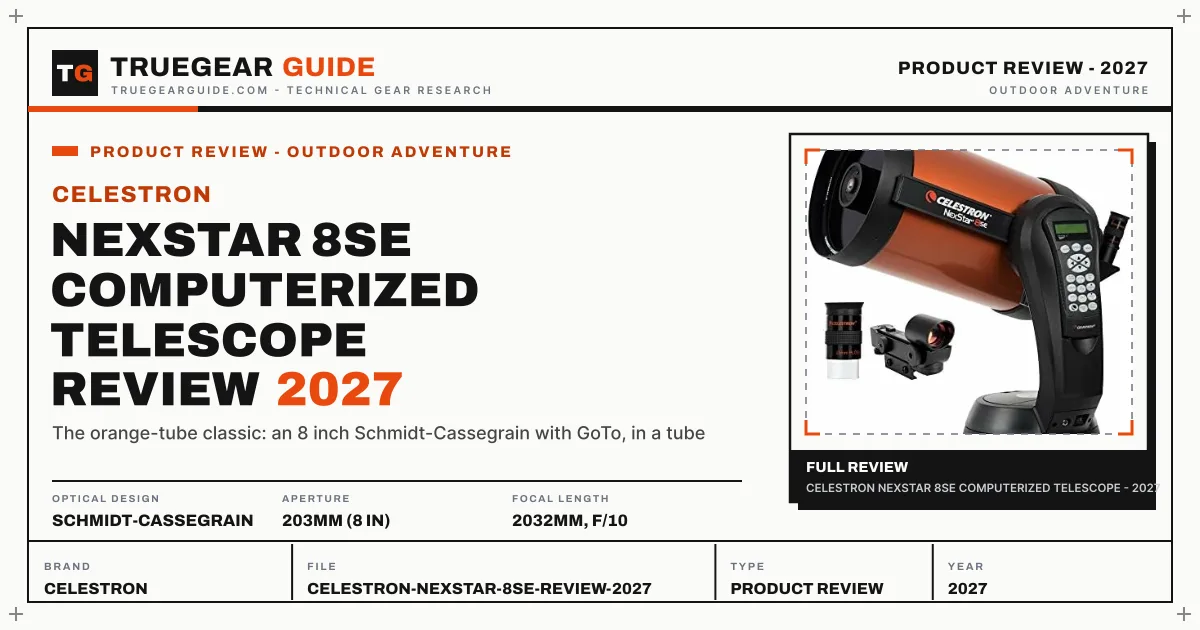

Celestron NexStar 8SE Computerized Telescope
The orange-tube classic: an 8 inch Schmidt-Cassegrain with GoTo, in a tube shorter than most 8 inch reflectors.
Our verdict
The NexStar 8SE remains a benchmark visual telescope because it balances three things few scopes manage together: 8 inches of aperture, GoTo finding from a 40,000-object database, and a tube short enough to travel. It shows planets in detail, resolves globular clusters into stars, and reaches galaxies that smaller scopes only hint at. Its single fork arm mount is a visual mount, not an imaging mount, and dew and power need planning. As a long-term eyepiece scope, it is the strongest pick in this guide.
What we like
- 203mm Schmidt-Cassegrain aperture with StarBright XLT coatings gathers enough light for globular clusters and galaxies
- Long 2032mm focal length at f/10 suits lunar and planetary detail, with a 25mm eyepiece giving 81x
- Fully automated GoTo mount with a database of more than 40,000 objects locates and tracks targets
- The folded optical path keeps the tube to 432mm, so an 8 inch scope travels like a much smaller one
What to watch out for
- The single fork arm mount and alt-azimuth tracking suit visual use, not long deep-sky exposures
- Power comes from 8 AA batteries or an external source, none included, and GoTo eats batteries on long nights
- At this aperture and price, a dew shield and a sturdier power supply become near-essential extras
What owners report: Celestron NexStar 8SE Computerized Telescope
Synthesized from recurring themes in long-term owner feedback.
Most praised
- Long-term owners keep coming back to how much sky an 8 inch tube shows from a suburban garden
- The orange tube and fork mount set up as one familiar unit, with no separate mount assembly puzzle
- Planetary observers single out Saturn and Jupiter detail that smaller starters only hint at
Common complaints
- The fork arm and tripod show their limits when the tube is loaded with heavy eyepieces or cameras
- Dew on the corrector plate ends autumn nights early unless a shield or heater is added
- Buyers who skip the power-supply question end up feeding the mount a stream of AA batteries
Who it is for
Committed visual observers who want a main scope for years, and upgraders moving from a beginner scope to serious aperture.
Why 8 inches changes the list
Aperture is not a linear improvement. At 203mm, globular clusters that looked like fuzzy balls in a 70mm scope resolve into individual stars, galaxies show structure, and planetary detail gains contrast and scale. The Schmidt-Cassegrain design folds a 2032mm focal length into a 432mm tube, so this aperture travels in a way an 8 inch Newtonian cannot. That combination of reach and portability is the 8SE argument in one sentence.
GoTo at this level feels different
With a 40,000-object database, the 8SE is less a beginner tour scope and more a deep-sky catalogue on a mount. Faint galaxies, planetary nebulae and double stars that a manual observer might hunt for an hour land in the eyepiece after alignment. SkyAlign still applies, so alignment care matters, but the payoff grows with aperture: the fainter the target, the more finding help is worth.
The ownership chores
Three chores define 8SE ownership. Power: plan an external supply, because AA batteries are a short-term answer. Dew: the corrector plate dews up on humid nights, so a dew shield is a near-essential accessory. Weight and balance: the fork mount handles the tube well for visual use, but heavy eyepieces and cameras test it, and long-exposure imaging wants a different mount entirely. None of these chores undermines the scope; all of them should be budgeted before purchase.
Key specifications
- Optical design
- Schmidt-Cassegrain
- Aperture
- 203mm (8 in)
- Focal length
- 2032mm, f/10
- Eyepiece
- 25mm Plossl (81x)
- Mount
- Computerized alt-azimuth, single fork arm
- Database
- More than 40,000 objects, SkyAlign
Also consider

Celestron NexStar 130SLT Computerized Telescope
A compact GoTo Newtonian: 130mm of aperture with a hand control that finds and tracks thousands of objects.
Why consider it: The compact GoTo alternative, for observers who want GoTo finding at a lower price and in a smaller package
- Optical design: Newtonian reflector
- Aperture: 130mm

Sky-Watcher Heritage 130 Tabletop Dobsonian Telescope
Maximum aperture for the money: a collapsible 130mm Dobsonian that sits on a sturdy table and just works.
Why consider it: The manual value alternative, for observers who want 130mm of deep-sky reach without GoTo cost or complexity
- Optical design: Newtonian reflector, Dobsonian
- Aperture: 130mm
Research-based assessment. TrueGear has not hands-on tested this product; this evaluation synthesizes manufacturer specifications, retailer documentation, and published expert reviews.
Questions, answered
Is the NexStar 8SE good for astrophotography?
For Moon and planet photos, yes, with a camera adapter. For long deep-sky exposures, it is limited: the alt-azimuth fork mount causes field rotation, and serious deep-sky imaging wants an equatorial mount and guiding. Treat the 8SE as a superb visual scope with planetary imaging potential, not as a deep-sky imaging rig.
How heavy is the 8SE to set up?
Manageable for one adult in two main pieces: tube and fork, plus tripod. It is not a one-hand carry like a backpack scope, but it is far easier to move than a large Dobsonian. A dedicated storage spot near the door makes regular use much more likely.
Does the 8SE need collimation?
Less often than a Newtonian, but it is not collimation-free. Schmidt-Cassegrain collimation is checked on a star and adjusted rarely, and most owners go long periods without touching it. Rough handling or transport knocks are the usual reasons to check.
Every guide on Telescopes15 pages
- Topic hubTelescopes
- Best ofThe Best Telescopes (2027)
- A beginner ranking should measure first-night success, not catalogue aperture. This guide weights finding help, mount simplicity and setup time ahead of raw optics, because a scope that finds the Moon and a planet on night one gets used again, while a scope that leaves a beginner sweeping empty sky gets stored. Manual classics stay in the list for learners who want the traditional route, but they are judged honestly against guided alternatives.The Best Telescopes for Beginners (2027)
- Planetary observing rewards focal length, steady air and a mount that holds a planet still at high power. Wide-field deep-sky scopes can show planets, but they are not optimised for the job. This ranking therefore favours longer focal lengths, slow-motion or GoTo tracking, and mounts that settle quickly, while keeping aperture honest: a steady 102mm scope often beats a shaky 130mm scope on a planet.The Best Telescopes for Planets (2027)
- Astrophotography beginners face a fork: photograph deep sky with a smart scope that does the work, or learn visual astronomy first and add a camera later. This guide is blunt about that fork. Smart scopes produce deep-sky images from night one but teach little about eyepiece observing. GoTo visual scopes can take Moon and planet photos, but long deep-sky exposures need equatorial mounts and guiding that none of the visual scopes here promise. The ranking follows what each scope actually delivers, not what a camera adapter implies.The Best Telescopes for Astrophotography Beginners (2027)
- ReviewCelestron AstroMaster 70AZ Review (2027)
- ReviewCelestron PowerSeeker 127EQ Review (2027)
- ReviewCelestron NexStar 130SLT Review (2027)
- ReviewCelestron Travel Scope 70 Review (2027)
- ReviewGskyer 80mm AZ (AZ80400) Review (2027)
- Head to headCelestron AstroMaster 70AZ vs Travel Scope 70 (2027)
- Head to headCelestron NexStar 130SLT vs NexStar 8SE (2027)
- Buying guideTelescope Buying Guide (2027)
- Fix itTelescope Cannot Find Anything? Fixes (2027)