In-depth review
Celestron AstroMaster 70AZ Review (2027)
The AstroMaster 70AZ is the classic first refractor. Our research-based verdict on its 70mm optics, simple mount and real beginner limits.
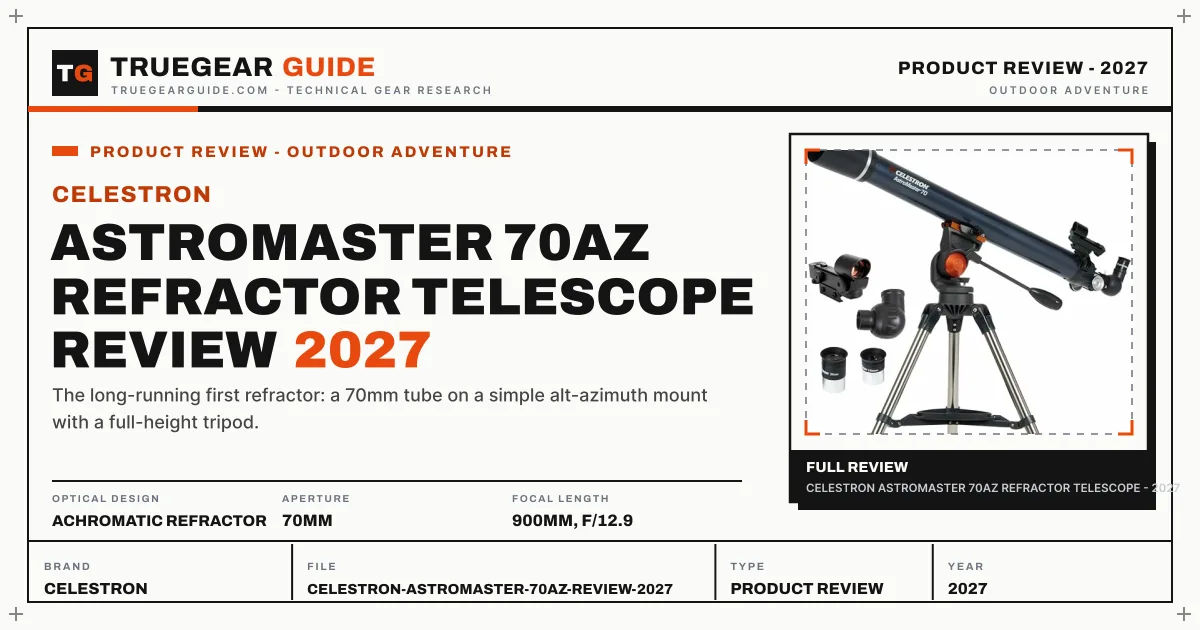

Celestron AstroMaster 70AZ Refractor Telescope
The long-running first refractor: a 70mm tube on a simple alt-azimuth mount with a full-height tripod.
Our verdict
The AstroMaster 70AZ earns its long life by being honest about what a first scope should do. It shows the Moon in crater detail, Jupiter with its moons, and Saturn as a ringed disk, on a mount a beginner can aim without a lesson. It does not pretend to be a deep-sky instrument, and buyers who accept that limit get a scope that teaches the sky instead of frustrating it. For a first scope at a beginner price, that honesty is the whole argument.
What we like
- 70mm fully coated achromatic objective with a long 900mm focal length, a forgiving combination for lunar and planetary detail
- Alt-azimuth mount moves the way a camera tripod does, so first-night aiming needs no polar alignment lesson
- Two eyepieces, 20mm for 45x and 10mm for 90x, plus an erect image diagonal for correct-orientation daytime views
- StarPointer red dot finder and an adjustable-height tripod keep the whole kit usable standing up
What to watch out for
- At f/12.9 the tube is long for its aperture, so storage and transport need more room than a short-tube scope
- An achromatic refractor at this price shows some colour fringing on the brightest Moon and planet edges
- The mount is a starter mount: it steadies low-power views well and shudders more as magnification climbs
What owners report: Celestron AstroMaster 70AZ Refractor Telescope
Synthesized from recurring themes in long-term owner feedback.
Most praised
- First-time buyers get the Moon in the eyepiece on the first clear night without a long setup ritual
- Parents value a scope children can aim by pushing the tube rather than learning mount controls first
- The erect image diagonal turns the same kit into a usable daytime spotting scope for distant scenery
Common complaints
- Owners expecting galaxy detail from a 70mm tube are disappointed by how faint deep-sky targets look
- The tripod legs and mount head feel light for the long tube in a breeze
- High-power views demand patience, because small mount vibrations take a moment to settle
Who it is for
Absolute beginners, families and anyone buying a first telescope without knowing yet whether the hobby will stick.
A long tube that helps beginners
The 900mm focal length looks old-fashioned next to short-tube starters, but it helps. It gives useful planetary magnification from ordinary eyepieces, keeps the mount behaviour predictable, and makes the Moon an easy first target. The trade is storage: this tube needs a corner, not a drawer. For a first scope kept in a house, that is a fair trade.
The mount is the real specification
Alt-azimuth movement matches how people naturally point things. Up, down, left and right, with no polar alignment, counterweight or latitude dial in the way. The mount is light for the long tube, so high-power views need a settled hand and a calm night. At the 45x and 90x the included eyepieces give, that compromise rarely spoils the view.
Where it stops being enough
Deep-sky targets are the limit. Clusters brighten nicely, the Orion Nebula glows, and bright galaxies appear as faint patches, but the 70mm aperture cannot turn them into detailed objects. Colour fringing on the brightest Moon edges is also part of the achromatic price. Neither flaw makes the scope a bad buy; both define the moment a committed observer starts shopping for 102mm or 130mm.
Key specifications
- Optical design
- Achromatic refractor
- Aperture
- 70mm
- Focal length
- 900mm, f/12.9
- Eyepieces
- 20mm (45x) and 10mm (90x)
- Mount
- Manual alt-azimuth, adjustable-height tripod
- Finder
- StarPointer red dot finder
Also consider

Celestron Travel Scope 70 Portable Refractor Telescope
A backpack refractor: 70mm optics, a full-height tripod and a carry bag for camping and travel nights.
Why consider it: The backpack alternative for travel and camping, where packability outranks the longer tube and higher planetary power
- Optical design: Achromatic refractor
- Aperture: 70mm

Celestron StarSense Explorer LT 80AZ Telescope
A phone-guided 80mm refractor: dock a smartphone, follow on-screen arrows, and stop hunting blind.
Why consider it: The guided step up, for beginners who want phone arrows to find targets instead of learning star-hopping first
- Optical design: Achromatic refractor
- Aperture: 80mm
Research-based assessment. TrueGear has not hands-on tested this product; this evaluation synthesizes manufacturer specifications, retailer documentation, and published expert reviews.
Questions, answered
Can the AstroMaster 70AZ show Saturn rings?
Yes, clearly. At 90x with the 10mm eyepiece, Saturn appears as a small ringed disk, and Jupiter shows its main cloud bands and four bright moons. Expect small, bright disks, not the large detailed planets seen in photographs.
Is it suitable for children?
Yes, with adult help for setup and aiming at first. The alt-azimuth mount is intuitive, the tripod adjusts to different heights, and the Moon is an easy early success that keeps children interested.
What should I buy next after the 70AZ?
A better low-power eyepiece for wider views, then a Moon filter for comfortable lunar observing. Do not buy extreme magnification eyepieces: this scope shows its best views at low and medium power. The next scope, not the next eyepiece, is the real upgrade.
Every guide on Telescopes15 pages
- Topic hubTelescopes
- Best ofThe Best Telescopes (2027)
- A beginner ranking should measure first-night success, not catalogue aperture. This guide weights finding help, mount simplicity and setup time ahead of raw optics, because a scope that finds the Moon and a planet on night one gets used again, while a scope that leaves a beginner sweeping empty sky gets stored. Manual classics stay in the list for learners who want the traditional route, but they are judged honestly against guided alternatives.The Best Telescopes for Beginners (2027)
- Planetary observing rewards focal length, steady air and a mount that holds a planet still at high power. Wide-field deep-sky scopes can show planets, but they are not optimised for the job. This ranking therefore favours longer focal lengths, slow-motion or GoTo tracking, and mounts that settle quickly, while keeping aperture honest: a steady 102mm scope often beats a shaky 130mm scope on a planet.The Best Telescopes for Planets (2027)
- Astrophotography beginners face a fork: photograph deep sky with a smart scope that does the work, or learn visual astronomy first and add a camera later. This guide is blunt about that fork. Smart scopes produce deep-sky images from night one but teach little about eyepiece observing. GoTo visual scopes can take Moon and planet photos, but long deep-sky exposures need equatorial mounts and guiding that none of the visual scopes here promise. The ranking follows what each scope actually delivers, not what a camera adapter implies.The Best Telescopes for Astrophotography Beginners (2027)
- ReviewCelestron PowerSeeker 127EQ Review (2027)
- ReviewCelestron NexStar 130SLT Review (2027)
- ReviewCelestron NexStar 8SE Review (2027)
- ReviewCelestron Travel Scope 70 Review (2027)
- ReviewGskyer 80mm AZ (AZ80400) Review (2027)
- Head to headCelestron AstroMaster 70AZ vs Travel Scope 70 (2027)
- Head to headCelestron NexStar 130SLT vs NexStar 8SE (2027)
- Buying guideTelescope Buying Guide (2027)
- Fix itTelescope Cannot Find Anything? Fixes (2027)