In-depth review
Celestron NexStar 130SLT Review (2027)
The NexStar 130SLT is a compact GoTo Newtonian. Our research-based verdict on its finding, tracking and travel value.
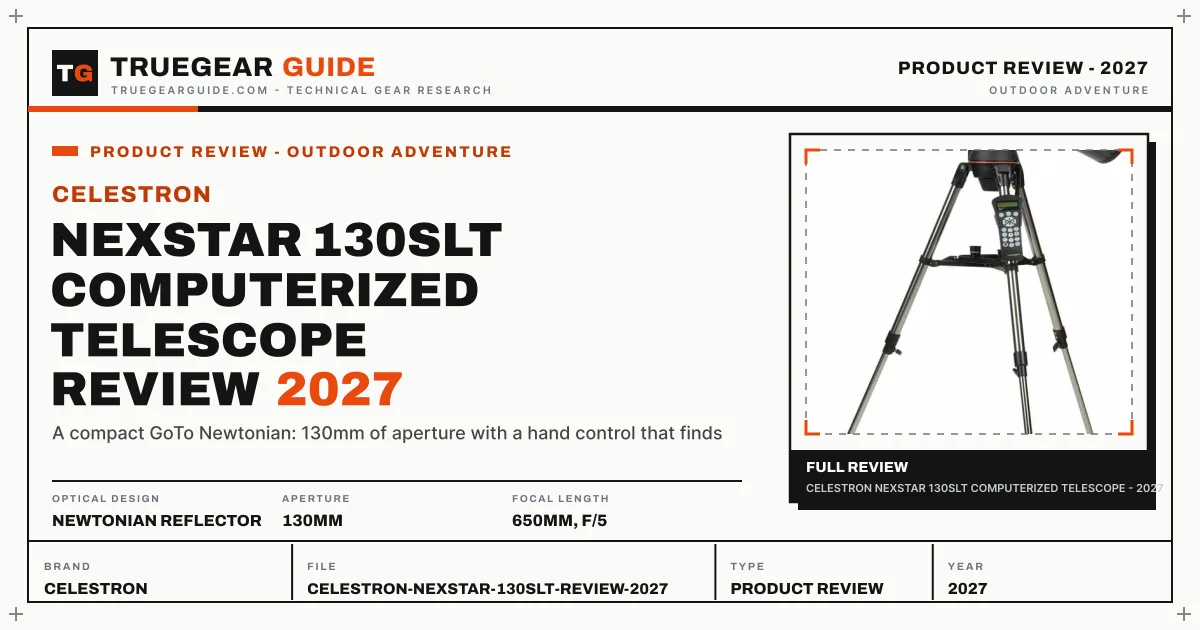

Celestron NexStar 130SLT Computerized Telescope
A compact GoTo Newtonian: 130mm of aperture with a hand control that finds and tracks thousands of objects.
Our verdict
The NexStar 130SLT solves the beginner problem that ends most telescope hobbies: finding things. After a three-object alignment, its hand control slews to thousands of targets and tracks them, which turns a first dark-site night into a guided tour. The compact 130mm tube travels well and sets up fast. The costs are power planning, alignment care and the limits of a single fork arm mount. For observers who value finding over learning star-hopping, those costs are worth paying.
What we like
- Computerized alt-azimuth mount slews to objects from a database of more than 4,000 stars, galaxies and nebulae
- SkyAlign alignment needs any three bright objects centred in the eyepiece, not named stars from a chart
- 130mm Newtonian tube at 650mm focal length stays compact for transport and sets up in minutes
- NexStar+ hand control tracks targets once found, so planets stay in view while observers swap eyepieces
What to watch out for
- It runs on 8 AA batteries or 12V DC, neither included, so a first night needs a power plan
- A single fork arm alt-azimuth mount is convenient, not a long-exposure astrophotography platform
- GoTo accuracy depends on careful alignment and a level tripod, and sloppy setup shows up as missed targets
What owners report: Celestron NexStar 130SLT Computerized Telescope
Synthesized from recurring themes in long-term owner feedback.
Most praised
- The hand control turns a first dark-site night into a tour, with one target after another landing in view
- The short tube packs into a car far more easily than the long refractors beginners often start with
- SkyAlign feels forgiving, because it accepts bright objects the observer can already recognise
Common complaints
- Battery appetite surprises buyers who assumed a mains or rechargeable pack came in the box
- Alignment fails frustrate first users until they learn to level the tripod and centre stars carefully
- The mount can sound and feel busy while slewing, which puts off observers used to silent manual scopes
Who it is for
Beginners and travellers who want GoTo finding and tracking, and observers who visit dark sites with a compact scope.
SkyAlign is the feature that matters
Traditional GoTo alignment asks for named stars, which assumes knowledge a beginner does not yet have. SkyAlign asks for any three bright objects centred in the eyepiece, and the computer works out the sky from there. That difference is why this scope suits beginners: alignment becomes a practical task, not a test. Care still matters, because a level tripod and carefully centred objects decide whether targets land in view.
A travel-friendly GoTo tube
At 650mm focal length, the Newtonian tube is short for its aperture, and the fork mount and tripod pack into a car without the bulk of a long refractor or a large Dobsonian base. Setup is genuinely quick once the routine is learned. That portability is a real observing advantage, because darker skies are usually a drive away, and a scope that travels gets used under better skies.
What GoTo does not fix
GoTo does not fix light pollution, unsteady air or a shaky tripod, and it does not turn this alt-azimuth mount into a long-exposure imaging platform. Field rotation limits deep-sky photography, and the mount is a visual mount first. Power is the practical chore: 8 AA batteries drain on long nights, so an external power supply becomes the sensible first accessory.
Key specifications
- Optical design
- Newtonian reflector
- Aperture
- 130mm
- Focal length
- 650mm, f/5
- Eyepieces
- 20mm and 9mm
- Mount
- Computerized alt-azimuth, single fork arm
- Database
- More than 4,000 objects, SkyAlign
Also consider

Celestron NexStar 8SE Computerized Telescope
The orange-tube classic: an 8 inch Schmidt-Cassegrain with GoTo, in a tube shorter than most 8 inch reflectors.
Why consider it: The larger GoTo step up, for observers who want 8 inch aperture and a much larger object database
- Optical design: Schmidt-Cassegrain
- Aperture: 203mm (8 in)

Celestron StarSense Explorer DX 130AZ Telescope
StarSense guidance on a 130mm Newtonian: reflector aperture and phone pointing on a full-height tripod.
Why consider it: The manual guided alternative, for observers who want app help without motors, menus or batteries
- Optical design: Newtonian reflector
- Aperture: 130mm
Research-based assessment. TrueGear has not hands-on tested this product; this evaluation synthesizes manufacturer specifications, retailer documentation, and published expert reviews.
Questions, answered
How long does alignment take on the 130SLT?
A few minutes once the routine is familiar. Level the tripod, centre three bright objects as prompted, and the mount is ready. First attempts take longer, because centring stars carefully is a new skill. Rushing alignment is the commonest cause of missed targets.
Can the 130SLT track planets for a whole evening?
Yes, for visual observing. Once aligned, the mount tracks targets and keeps them in view while eyepieces are swapped. Tracking accuracy is for eyepiece use, not for long photographic exposures, which need an equatorial mount.
What power supply should I use?
Plan for an external 12V supply or a rechargeable power tank rather than relying on AA batteries. GoTo slewing and tracking draw steady power, and a fading battery pack shows up as sluggish slews and lost alignment on long nights.
Every guide on Telescopes15 pages
- Topic hubTelescopes
- Best ofThe Best Telescopes (2027)
- A beginner ranking should measure first-night success, not catalogue aperture. This guide weights finding help, mount simplicity and setup time ahead of raw optics, because a scope that finds the Moon and a planet on night one gets used again, while a scope that leaves a beginner sweeping empty sky gets stored. Manual classics stay in the list for learners who want the traditional route, but they are judged honestly against guided alternatives.The Best Telescopes for Beginners (2027)
- Planetary observing rewards focal length, steady air and a mount that holds a planet still at high power. Wide-field deep-sky scopes can show planets, but they are not optimised for the job. This ranking therefore favours longer focal lengths, slow-motion or GoTo tracking, and mounts that settle quickly, while keeping aperture honest: a steady 102mm scope often beats a shaky 130mm scope on a planet.The Best Telescopes for Planets (2027)
- Astrophotography beginners face a fork: photograph deep sky with a smart scope that does the work, or learn visual astronomy first and add a camera later. This guide is blunt about that fork. Smart scopes produce deep-sky images from night one but teach little about eyepiece observing. GoTo visual scopes can take Moon and planet photos, but long deep-sky exposures need equatorial mounts and guiding that none of the visual scopes here promise. The ranking follows what each scope actually delivers, not what a camera adapter implies.The Best Telescopes for Astrophotography Beginners (2027)
- ReviewCelestron AstroMaster 70AZ Review (2027)
- ReviewCelestron PowerSeeker 127EQ Review (2027)
- ReviewCelestron NexStar 8SE Review (2027)
- ReviewCelestron Travel Scope 70 Review (2027)
- ReviewGskyer 80mm AZ (AZ80400) Review (2027)
- Head to headCelestron AstroMaster 70AZ vs Travel Scope 70 (2027)
- Head to headCelestron NexStar 130SLT vs NexStar 8SE (2027)
- Buying guideTelescope Buying Guide (2027)
- Fix itTelescope Cannot Find Anything? Fixes (2027)