In-depth review
Celestron Travel Scope 70 Review (2027)
The Travel Scope 70 is a backpack refractor for camping and travel. Our research-based verdict on its portability and limits.
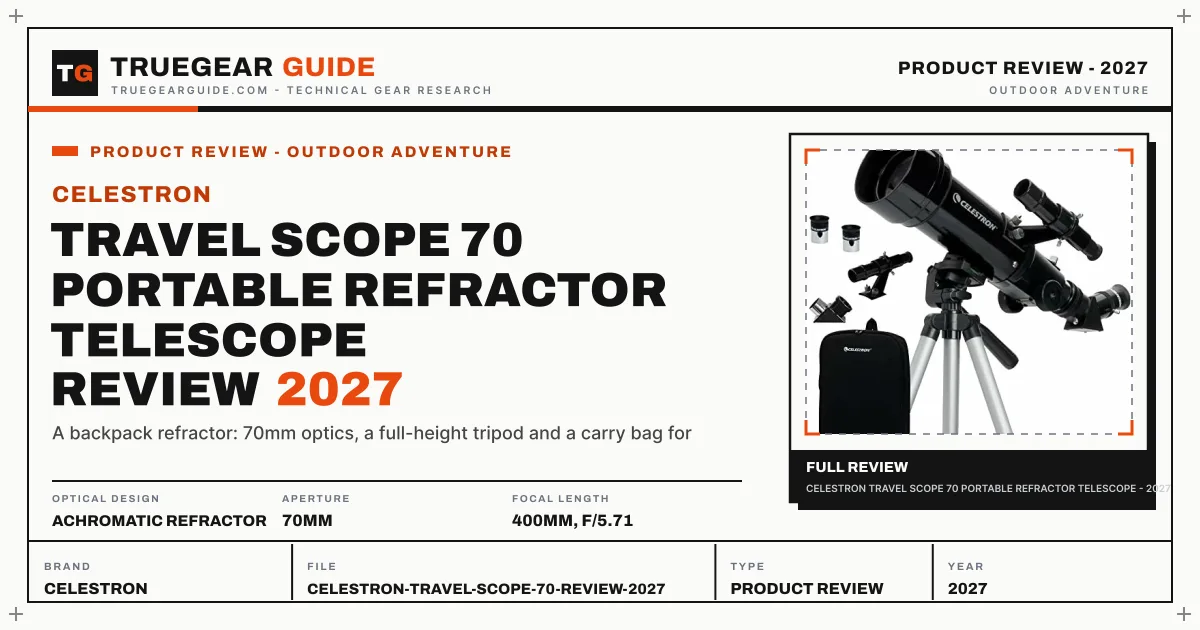

Celestron Travel Scope 70 Portable Refractor Telescope
A backpack refractor: 70mm optics, a full-height tripod and a carry bag for camping and travel nights.
Our verdict
The Travel Scope 70 succeeds by a different measure from other scopes here: use. It packs into a backpack, sets up tool-free in seconds, and therefore gets taken on trips where a larger scope would stay home. Its short 400mm tube gives bright, wide views of the Moon, clusters and daytime scenery, but not detailed planet views. For travellers and families who need a scope that travels, that trade is exactly right. For planet-only observers, it is the wrong scope.
What we like
- The whole kit, tube, tripod and eyepieces, packs into the included custom backpack
- Tool-free assembly gets the scope from bag to observing in seconds, which matters on short trips
- Fully coated 70mm optics with 20mm and 10mm eyepieces give 20x and 40x views for Moon and scenery
- A 45 degree erect image diagonal keeps daytime views the right way up for wildlife and landscapes
What to watch out for
- Short focal length and modest aperture cap planetary detail well below longer 70mm refractors
- The travel tripod prioritises pack size over rigidity, so high-power views shake more
- A 400mm tube needs low-power patience: it is a wide-field scope, not a high-magnification planet scope
What owners report: Celestron Travel Scope 70 Portable Refractor Telescope
Synthesized from recurring themes in long-term owner feedback.
Most praised
- Campers report the backpack is the reason the scope actually leaves the house, unlike heavier kits
- Children manage the pan-handle mount on their own after one guided evening
- Daytime users keep it by a window for birds and distant hills between night sessions
Common complaints
- Owners chasing crisp planet detail find the short tube runs out of useful magnification early
- The included tripod flexes in wind, and buyers often plan a sturdier tripod as the first upgrade
- The finderscope needs careful alignment, or beginners sweep past the Moon more than once
Who it is for
Travellers, campers, families and anyone whose scope must pack into a bag and set up in seconds.
Packability is the optical feature
Most telescope advice ignores the bag, and most unused telescopes prove why it matters. The Travel Scope 70 kit, tube, tripod, eyepieces and diagonal, fits its backpack, and the whole routine from bag to first view takes seconds. On a camping trip or a holiday, that speed decides whether the scope comes out after dinner or stays zipped. Wide-field views suit that use: sweeping the Milky Way and framing the Moon whole feel rewarding at 20x.
Daytime use earns its keep
The erect image diagonal matters more than it sounds. It turns the scope into a daytime spotting scope for birds, wildlife and distant landscapes, so the kit is useful on every day of a trip, not only on clear nights. Families in particular get double value: scenery by day, Moon and clusters by night, from one backpack.
The short-tube limit
At 400mm focal length, planetary magnification is limited. The 10mm eyepiece gives 40x, which shows Jupiter as a small disk with moons and Saturn as a small ringed oval, not the detailed views a longer 70mm refractor gives. The travel tripod also prioritises pack size over rigidity. Accept both limits and the scope delights; fight them with extreme eyepieces and it disappoints.
Key specifications
- Optical design
- Achromatic refractor
- Aperture
- 70mm
- Focal length
- 400mm, f/5.71
- Eyepieces
- 20mm (20x) and 10mm (40x)
- Mount
- Manual alt-azimuth, pan handle, full-height tripod
- Kit
- Backpack, erect image diagonal, 5x24 finderscope
Also consider

Celestron AstroMaster 70AZ Refractor Telescope
The long-running first refractor: a 70mm tube on a simple alt-azimuth mount with a full-height tripod.
Why consider it: The home-based 70mm alternative, for observers who want longer focal length and higher planetary power without travel needs
- Optical design: Achromatic refractor
- Aperture: 70mm
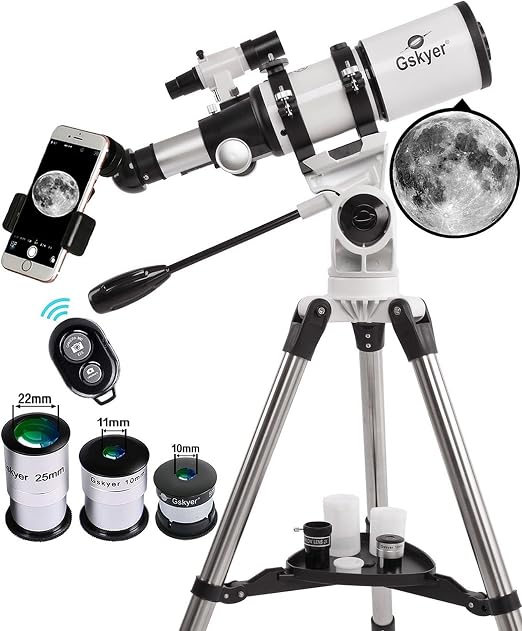
Gskyer 80mm AZ Space Astronomical Refractor Telescope (AZ80400)
A low-cost complete kit: 80mm refractor, three eyepieces, Barlow, phone adapter and stainless tripod.
Why consider it: The budget kit alternative, for buyers who want more eyepieces and a phone adapter in a low-cost package
- Optical design: Achromatic refractor
- Aperture: 80mm
Research-based assessment. TrueGear has not hands-on tested this product; this evaluation synthesizes manufacturer specifications, retailer documentation, and published expert reviews.
Questions, answered
Can I take the Travel Scope 70 on a plane?
As cabin or checked baggage depends on airline rules and the backpack size, but the kit is designed to pack as one bag. Check dimensions against your airline allowance, protect the objective lens, and carry eyepieces separately if the bag will be checked.
Is it good for children?
Yes, it is one of the most child-friendly scopes here. The pan-handle mount is intuitive, setup needs no tools, and the backpack makes children feel the scope is theirs to carry. Adult help with aiming and focusing still helps on the first nights.
Can I photograph the Moon with it?
Yes, with a phone adapter held to the eyepiece. The Moon is bright and large enough at 20x and 40x for pleasing phone photos. A dedicated phone adapter, like the one in the Gskyer kit, is worth adding if Moon photos become a habit.
Every guide on Telescopes15 pages
- Topic hubTelescopes
- Best ofThe Best Telescopes (2027)
- A beginner ranking should measure first-night success, not catalogue aperture. This guide weights finding help, mount simplicity and setup time ahead of raw optics, because a scope that finds the Moon and a planet on night one gets used again, while a scope that leaves a beginner sweeping empty sky gets stored. Manual classics stay in the list for learners who want the traditional route, but they are judged honestly against guided alternatives.The Best Telescopes for Beginners (2027)
- Planetary observing rewards focal length, steady air and a mount that holds a planet still at high power. Wide-field deep-sky scopes can show planets, but they are not optimised for the job. This ranking therefore favours longer focal lengths, slow-motion or GoTo tracking, and mounts that settle quickly, while keeping aperture honest: a steady 102mm scope often beats a shaky 130mm scope on a planet.The Best Telescopes for Planets (2027)
- Astrophotography beginners face a fork: photograph deep sky with a smart scope that does the work, or learn visual astronomy first and add a camera later. This guide is blunt about that fork. Smart scopes produce deep-sky images from night one but teach little about eyepiece observing. GoTo visual scopes can take Moon and planet photos, but long deep-sky exposures need equatorial mounts and guiding that none of the visual scopes here promise. The ranking follows what each scope actually delivers, not what a camera adapter implies.The Best Telescopes for Astrophotography Beginners (2027)
- ReviewCelestron AstroMaster 70AZ Review (2027)
- ReviewCelestron PowerSeeker 127EQ Review (2027)
- ReviewCelestron NexStar 130SLT Review (2027)
- ReviewCelestron NexStar 8SE Review (2027)
- ReviewGskyer 80mm AZ (AZ80400) Review (2027)
- Head to headCelestron AstroMaster 70AZ vs Travel Scope 70 (2027)
- Head to headCelestron NexStar 130SLT vs NexStar 8SE (2027)
- Buying guideTelescope Buying Guide (2027)
- Fix itTelescope Cannot Find Anything? Fixes (2027)