In-depth review
Gskyer 80mm AZ (AZ80400) Review (2027)
The Gskyer AZ80400 is a low-cost complete telescope kit. Our research-based verdict on its value, optics and documentation gaps.
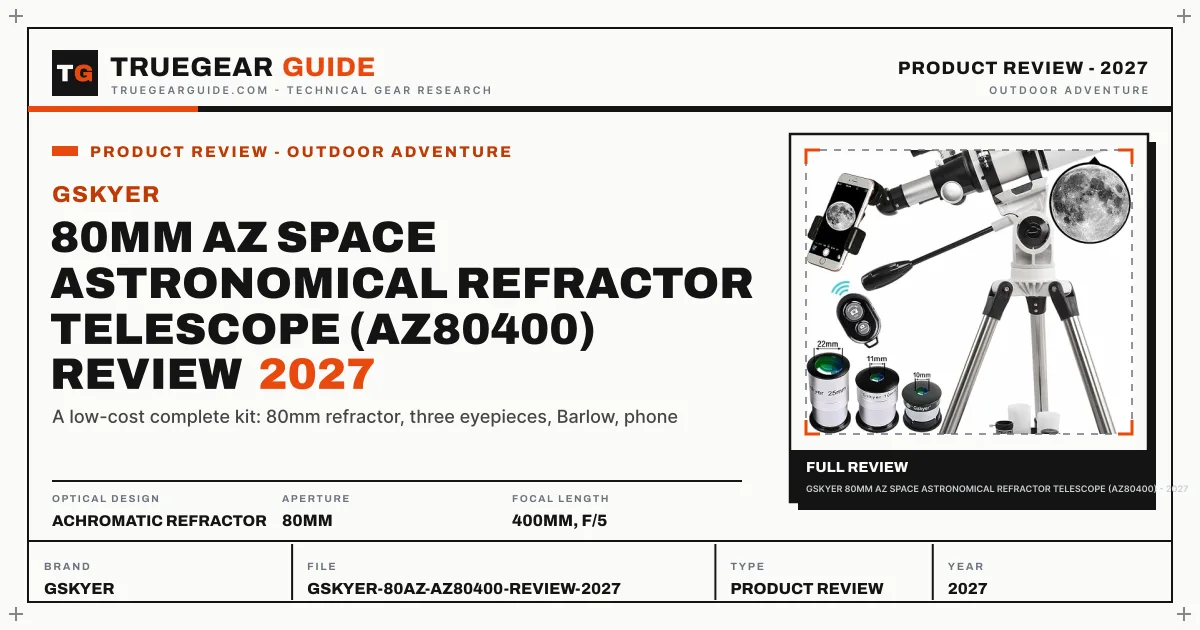
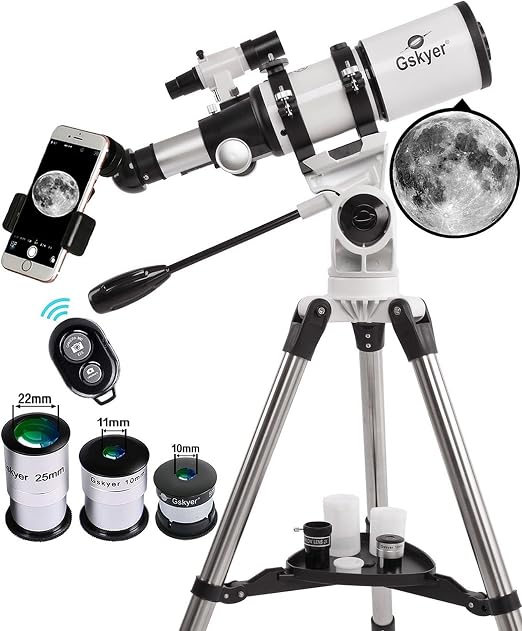
Gskyer 80mm AZ Space Astronomical Refractor Telescope (AZ80400)
A low-cost complete kit: 80mm refractor, three eyepieces, Barlow, phone adapter and stainless tripod.
Our verdict
The Gskyer AZ80400 is best judged as a kit, not as an optic. For a low price it delivers an 80mm refractor, three eyepieces, a Barlow, a phone adapter and a stainless tripod, which is more complete than many beginner kits at twice the price. The optics are entry level, the documentation is thin, and the extreme magnifications should be ignored. Buyers who want a complete, cheap first kit and are willing to learn setup from online help will be pleased. Buyers who want refined optics should spend more on a Celestron refractor.
What we like
- 80mm aperture with a short 400mm focal length gives bright, wide low-power views of the Moon and clusters
- Three eyepieces, 25mm, 10mm and 5mm, give 16x, 40x and 80x before the included 3x Barlow is added
- A 6x30 finderscope is larger than the small finders on many budget kits, which helps first aiming
- Phone adapter and wireless remote in the box let beginners try Moon photos without extra purchases
What to watch out for
- The quoted top magnifications with the Barlow exceed what a short achromatic tube shows cleanly
- Documentation is thinner than Celestron manuals, so beginners may need online setup help
- Focuser and eyepiece quality are entry level, and a future eyepiece upgrade improves the scope most
What owners report: Gskyer 80mm AZ Space Astronomical Refractor Telescope (AZ80400)
Synthesized from recurring themes in long-term owner feedback.
Most praised
- Buyers on a tight budget value opening one box and having eyepieces, Barlow and phone holder ready
- The wide low-power view makes finding the Moon and bright clusters less stressful for new users
- Gift buyers report the kit works as a complete present, with no immediate accessory hunt
Common complaints
- Owners who push the Barlow to its advertised extremes get soft, dim images and blame the tube
- Assembly instructions leave first-timers guessing about diagonal and finder orientation
- The mount needs gentle handling at high power, where vibrations linger
Who it is for
Budget buyers, gift buyers and families who want a complete telescope kit in one box without immediate extra purchases.
Completeness is the selling point
Most budget scopes arrive with two eyepieces and a promise. This kit arrives with three eyepieces, a 3x Barlow, a 6x30 finder, a phone adapter and a wireless remote. That completeness matters for gifts and first purchases, because there is no immediate second order to make the scope usable. The 16x low-power view is genuinely useful for finding the Moon and wide clusters, which is where beginners should start anyway.
Use the sensible magnifications
The kit advertises extreme magnifications when the Barlow is stacked with the shortest eyepiece. Ignore those numbers. A short 80mm achromatic tube shows its best views at 16x and 40x, with 80x usable on steady nights for the Moon. The Barlow is useful for reaching medium power from the longer eyepieces, not for chasing the advertised maximum. Observers who follow that rule enjoy the scope; observers who chase the maximum blame the scope for physics.
Where the savings show
Savings show in three places: documentation, focuser feel and eyepiece quality. Setup instructions leave gaps that Celestron manuals fill, so first-time owners should watch a setup video before night one. The focuser and eyepieces work, but they are the first parts worth upgrading if the hobby sticks. None of this makes the kit a bad buy at its price; it makes it a starter kit with a clear upgrade path, not a finished system.
Key specifications
- Optical design
- Achromatic refractor
- Aperture
- 80mm
- Focal length
- 400mm, f/5
- Eyepieces
- 25mm (16x), 10mm (40x), 5mm (80x), plus 3x Barlow
- Mount
- Manual alt-azimuth, stainless steel tripod
- Finder
- 6x30 finderscope
Also consider

Celestron AstroMaster 70AZ Refractor Telescope
The long-running first refractor: a 70mm tube on a simple alt-azimuth mount with a full-height tripod.
Why consider it: The refined manual alternative, for buyers who prefer better documentation and a longer focal length over kit completeness
- Optical design: Achromatic refractor
- Aperture: 70mm

Celestron Travel Scope 70 Portable Refractor Telescope
A backpack refractor: 70mm optics, a full-height tripod and a carry bag for camping and travel nights.
Why consider it: The travel alternative, for buyers who value a backpack and tool-free setup over extra eyepieces
- Optical design: Achromatic refractor
- Aperture: 70mm
Research-based assessment. TrueGear has not hands-on tested this product; this evaluation synthesizes manufacturer specifications, retailer documentation, and published expert reviews.
Questions, answered
Is the Gskyer 80AZ good for kids?
Yes, as a first kit, with adult setup help. The wide low-power view makes finding targets easier, and the phone adapter lets children photograph the Moon. Keep expectations at low and medium power, and the scope works well for young observers.
Should I use the 3x Barlow with the 5mm eyepiece?
No, not for regular observing. That combination pushes magnification far past what the optics and mount support cleanly, giving dim, soft images. Use the Barlow with the 25mm or 10mm eyepiece for useful medium-power views instead.
What is the first upgrade for this scope?
A better low-power eyepiece, once you know you enjoy observing. A decent Plossl eyepiece improves sharpness and eye relief more than any other single purchase. After that, a sturdier tripod helps high-power views, if the scope is used often enough to justify it.
Every guide on Telescopes15 pages
- Topic hubTelescopes
- Best ofThe Best Telescopes (2027)
- A beginner ranking should measure first-night success, not catalogue aperture. This guide weights finding help, mount simplicity and setup time ahead of raw optics, because a scope that finds the Moon and a planet on night one gets used again, while a scope that leaves a beginner sweeping empty sky gets stored. Manual classics stay in the list for learners who want the traditional route, but they are judged honestly against guided alternatives.The Best Telescopes for Beginners (2027)
- Planetary observing rewards focal length, steady air and a mount that holds a planet still at high power. Wide-field deep-sky scopes can show planets, but they are not optimised for the job. This ranking therefore favours longer focal lengths, slow-motion or GoTo tracking, and mounts that settle quickly, while keeping aperture honest: a steady 102mm scope often beats a shaky 130mm scope on a planet.The Best Telescopes for Planets (2027)
- Astrophotography beginners face a fork: photograph deep sky with a smart scope that does the work, or learn visual astronomy first and add a camera later. This guide is blunt about that fork. Smart scopes produce deep-sky images from night one but teach little about eyepiece observing. GoTo visual scopes can take Moon and planet photos, but long deep-sky exposures need equatorial mounts and guiding that none of the visual scopes here promise. The ranking follows what each scope actually delivers, not what a camera adapter implies.The Best Telescopes for Astrophotography Beginners (2027)
- ReviewCelestron AstroMaster 70AZ Review (2027)
- ReviewCelestron PowerSeeker 127EQ Review (2027)
- ReviewCelestron NexStar 130SLT Review (2027)
- ReviewCelestron NexStar 8SE Review (2027)
- ReviewCelestron Travel Scope 70 Review (2027)
- Head to headCelestron AstroMaster 70AZ vs Travel Scope 70 (2027)
- Head to headCelestron NexStar 130SLT vs NexStar 8SE (2027)
- Buying guideTelescope Buying Guide (2027)
- Fix itTelescope Cannot Find Anything? Fixes (2027)